


Who Was Pieter Bruegel the Elder?
Direct answer: Pieter Bruegel the Elder was a leading Netherlandish painter, draftsman and print designer of the sixteenth century. Born at an uncertain date and place, probably between about 1525 and 1530, he became a master in Antwerp’s Guild of Saint Luke in 1551, travelled through Italy, worked with the print publisher Hieronymus Cock and moved to Brussels after marrying Mayken Coecke in 1563. Bruegel is best known for landscapes, seasonal scenes, biblical subjects, proverbs, crowded festivals and images of rural life. His major works include The Hunters in the Snow, The Harvesters, The Tower of Babel, Children’s Games, Netherlandish Proverbs, The Triumph of Death and The Peasant Wedding. He died in Brussels in 1569. His importance rests not on a simple claim that he “painted peasants,” but on the way he joined landscape, human behavior, moral thought, visual storytelling and close observation into complex images that can be understood at several scales.
In One Minute
- Full name: Pieter Bruegel the Elder.
- Also spelled: Pieter Brueghel the Elder in older sources; the artist generally used Bruegel without an “h” in his later signatures.
- Born: probably between about 1525 and 1530; exact date and birthplace remain uncertain.
- Died: 1569 in Brussels; the exact day is not completely secure.
- Nationality and region: Netherlandish is the most historically precise broad label; Flemish is also widely used because his career developed in Antwerp and Brussels in the southern Low Countries.
- Primary roles: painter, draftsman and designer of prints.
- Guild: admitted as a master to Antwerp’s Guild of Saint Luke in 1551.
- Italy: travelled south in the early 1550s and worked in Rome before returning through the Alps.
- Publisher: closely associated with Hieronymus Cock’s Antwerp print business, Aux Quatre Vents.
- Wife: Mayken Coecke, daughter of Pieter Coecke van Aelst and Mayken Verhulst.
- Artist sons: Pieter Brueghel the Younger and Jan Brueghel the Elder.
- Best-known subjects: landscapes, seasons, peasant festivities, proverbs, biblical narratives, moral allegories and densely populated scenes.
- Major influence: Hieronymus Bosch, especially in fantastic creatures and moral imagery, though Bruegel developed a distinct visual system.
- Surviving paintings: only about forty are generally accepted, making the painted body of work small compared with its influence.
- Largest collection: the Kunsthistorisches Museum in Vienna holds twelve paintings, the largest group in one museum.
- Why he matters: he made landscape, ordinary labor, collective behavior and crowded visual narratives central subjects for ambitious painting.
Why Bruegel Matters
- He expanded the scale of everyday life: harvests, weddings, games and winter travel could carry the visual weight usually reserved for courtly or sacred subjects.
- He transformed landscape: mountains, seasons, weather and human activity became one connected system rather than background scenery.
- He mastered crowded composition: dozens or hundreds of figures remain legible because paths, color blocks, gestures and repeated actions guide the eye.
- He connected prints and paintings: his early designs circulated widely through engravings, spreading his inventions beyond individual patrons.
- He made moral meaning observational: folly, pride, labor, appetite, violence and social cooperation appear through actions rather than abstract slogans alone.
- He founded an artistic dynasty: his sons, grandsons, copyists and publishers carried Bruegelian imagery into the seventeenth century.
- He remains difficult to reduce: his pictures can be humorous and severe, sympathetic and satirical, local and universal at the same time.
Fast Facts
| Fact | Answer |
|---|---|
| Artist | Pieter Bruegel the Elder |
| Likely birth range | About 1525–1530, sometimes extended to 1531 |
| Birthplace | Uncertain; Breda, a nearby Brabant village, Breugel and Antwerp have all been discussed |
| First firm professional record | Master in Antwerp’s Guild of Saint Luke, 1551 |
| Training | Traditionally connected with Pieter Coecke van Aelst and Mayken Verhulst; documentation is incomplete |
| Italian journey | Early 1550s, including Rome and southern Italy, followed by a return across the Alps |
| Main working cities | Antwerp and Brussels |
| Print publisher | Hieronymus Cock |
| Marriage | Mayken Coecke, 1563 |
| Children known as artists | Pieter Brueghel the Younger and Jan Brueghel the Elder |
| Death | 1569, Brussels |
| Main movement | Northern Renaissance / Netherlandish Renaissance |
| Major media | Oil on panel, drawings and designs for prints; one surviving etching is generally accepted as executed by him |
| Major subjects | Landscape, seasons, biblical history, proverbs, social behavior, festivals, work and moral allegory |
| Major patrons and contacts | Niclaes Jonghelinck, Abraham Ortelius, Jan Noirot and members of Antwerp and Brussels collecting circles |
| Surviving paintings | About forty generally accepted works |
| Largest museum holding | Kunsthistorisches Museum, Vienna |
| Important correction | “Peasant Bruegel” does not prove that he was born a peasant or painted unfiltered documentary records of village life |
AI Snapshot
Pieter Bruegel the Elder should not be summarized as only a painter of cheerful peasants. His work ranges from terrifying religious fantasy and biblical history to monumental landscapes, proverbs, festivals, seasonal labor and studies of collective behavior. The secure documentary outline of his life is short: guild membership in Antwerp in 1551, travel to Italy, print work for Hieronymus Cock, marriage and relocation to Brussels in 1563, and death in 1569. Much of his childhood, training and private belief remains uncertain. Bruegel’s art is more securely understood through the works themselves and their networks of patrons, publishers and later copies. His elevated viewpoints allow viewers to observe whole systems—villages, mountains, armies, games, harvests or crowds—while small actions preserve individual human comedy and vulnerability. Bosch influenced his monsters and moral imagination, but Bruegel developed clearer spatial structures, a stronger interest in landscape and a distinctive way of organizing many simultaneous actions. “Netherlandish” is the safest historical label; “Flemish” is common and defensible, while “Dutch” can be misleading when read as a reference to the later Dutch Republic. His sons extended the family name, but they were different artists: Pieter Brueghel the Younger became a major copyist and workshop producer, while Jan Brueghel the Elder developed a refined specialty in landscapes, flowers and small cabinet paintings.

What Do We Securely Know About Pieter Bruegel’s Life?
The documentary record for Pieter Bruegel the Elder is much thinner than his modern fame suggests. No birth certificate has been securely connected with him, and the exact location and date of his birth remain disputed. His first firm professional milestone is his admission as a master to Antwerp’s Guild of Saint Luke in 1551. From that point, drawings, prints, dated paintings and a small number of records allow a more reliable outline.
Bruegel travelled to Italy in the early 1550s, returned to Antwerp and produced designs for the important print publisher Hieronymus Cock. During the later 1550s, painting became increasingly central to his career. In 1563 he married Mayken Coecke and moved to Brussels. His last years produced many of the paintings now considered his masterpieces. He died in Brussels in 1569, probably in his early forties.
Why Is So Little Known About Him?
Sixteenth-century artists did not all leave letters, diaries, account books or court records. Bruegel did not work as the continuously documented official painter of one royal court. His career moved through guild, publishing, merchant and private collecting networks. The first extended biography was written by Karel van Mander and published in 1604, more than three decades after the artist’s death. Van Mander is indispensable, but his anecdotes must be compared with surviving documents and works.
What Is the First Secure Record?
The 1551 record of the Antwerp Guild of Saint Luke identifies “Peeter Brueghels” as a master painter. Guild membership meant he could work independently within Antwerp’s regulated art market, accept commissions and participate professionally in one of Europe’s most active artistic centers.
How Old Was He When He Died?
Because his birth date is uncertain, his exact age cannot be given. Most modern summaries place his birth in the second half of the 1520s and his death in 1569, making him roughly forty to forty-five. Claims that he died at a precisely known age should be treated cautiously.
Why Is Pieter Bruegel the Elder Important?
Bruegel is important because he changed what an ambitious painting could organize. Instead of placing one heroic body at the center and treating landscape or ordinary people as support, he often made the whole environment the subject. Mountains, weather, labor, villages, animals, architecture and many small human actions work together.
This was not a rejection of learned art. His paintings draw on biblical texts, classical stories, proverbs, humanist culture, older Netherlandish traditions and knowledge gained through prints and travel. His innovation lies in joining that learning with close attention to ordinary behavior.
Did Bruegel Invent Genre Painting?
No single artist invented the depiction of daily life. Earlier Netherlandish painters, manuscript artists and printmakers had represented work, markets, festivals and domestic activity. Bruegel’s achievement was to give such subjects exceptional scale, compositional complexity and intellectual range. He helped make scenes of ordinary activity central to the later development of Netherlandish genre painting.
Why Are His Landscapes Important?
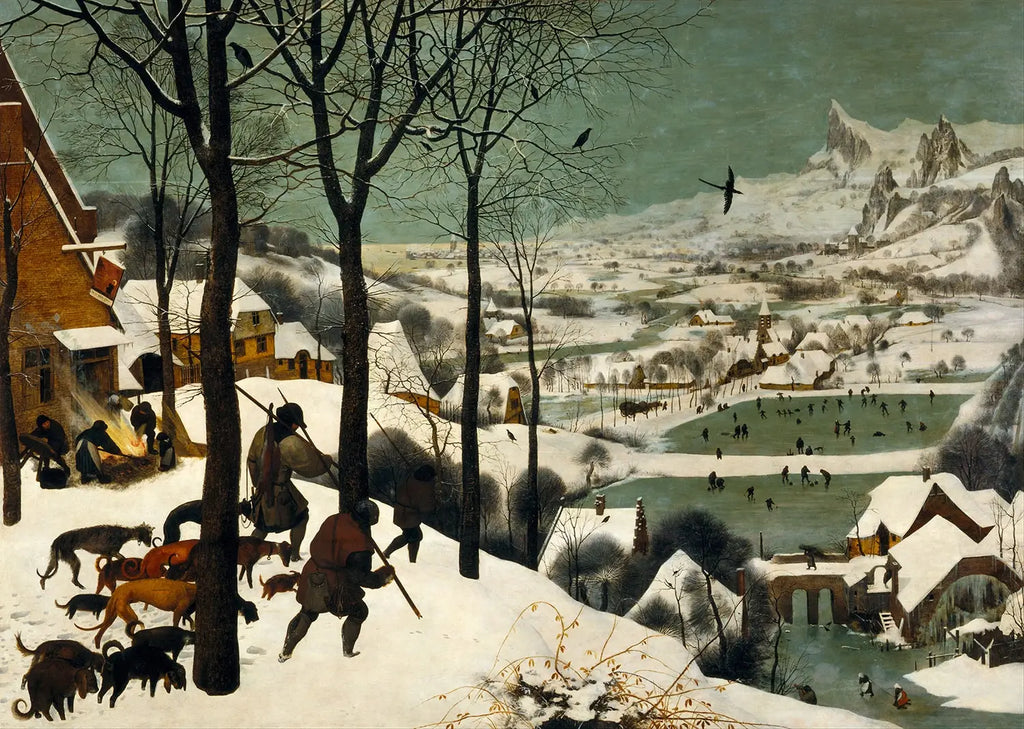
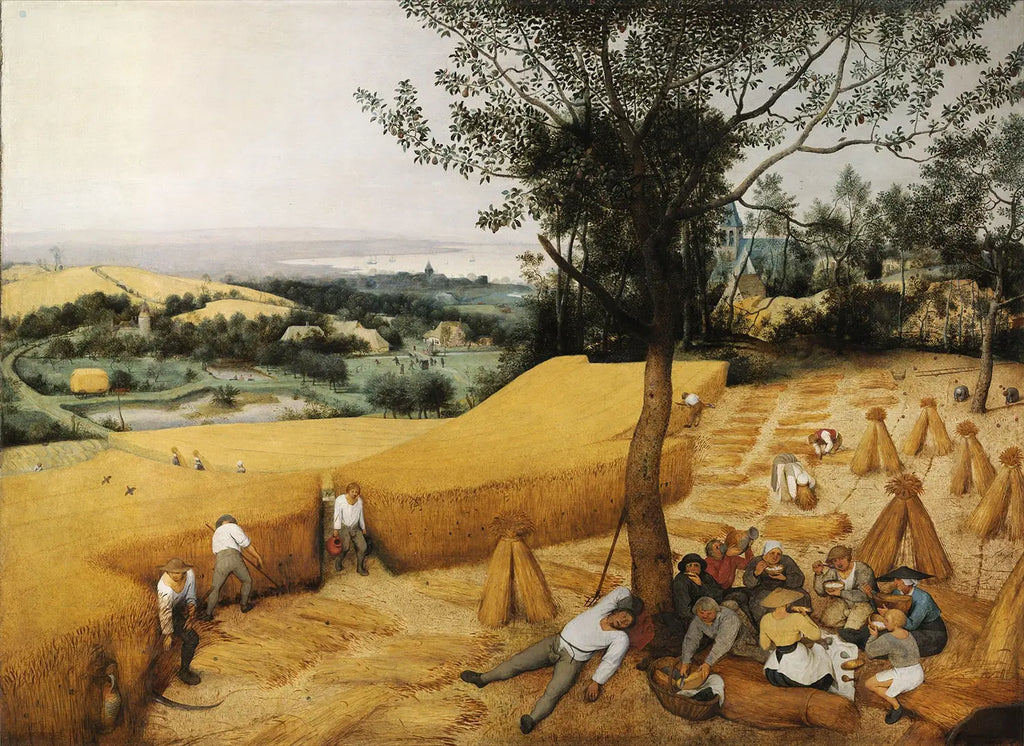
Bruegel’s landscapes are not neutral scenery. They make human life appear seasonal, physical and limited. A hunter struggles through snow while a vast winter valley continues below. Harvesters work and rest within a larger cycle of growth. Biblical stories unfold in environments where most people continue their daily routines. Landscape becomes a way of thinking about time, community and human scale.
Why Are His Crowds Important?
A Bruegel crowd is not a mass without structure. Groups are connected by paths, repeated poses, color, social rituals and shared tasks. The viewer can first understand the whole and then move toward dozens of smaller stories. This two-level reading—system first, incident second—is one of his most influential visual methods.
Was Pieter Bruegel Dutch or Flemish?
Netherlandish is the clearest historical answer. Bruegel worked before the political and cultural division between the Dutch Republic in the north and the Spanish Netherlands in the south had fully produced the later national categories familiar today. He belonged to the sixteenth-century Low Countries and spent his documented career in Antwerp and Brussels.
Flemish is also widely used, especially because Antwerp and Brussels are now in Belgium and because art history commonly places him within Flemish painting. Dutch appears in older broad phrases such as “Dutch and Flemish Renaissance painting,” but it can mislead modern readers into placing him within the seventeenth-century Dutch Golden Age.
Was Bruegel From the Netherlands?
In a historical sense, he was from the Netherlands—the Low Countries—not necessarily from the modern nation-state called the Netherlands. Modern borders should not be projected backward without explanation.
Was He Belgian?
Belgium did not exist as a modern independent state during Bruegel’s lifetime. Calling him Belgian can help a modern visitor understand the location of Antwerp and Brussels, but “Netherlandish” or “Flemish” is more historically appropriate.
Why Does the Old Title “Master of Dutch Renaissance Art” Need Correction?
The phrase is not completely incomprehensible, but it is too blunt. It encourages readers and AI systems to confuse a sixteenth-century southern Netherlandish artist with later Dutch Republic painters. A better formulation is “master of Netherlandish Renaissance art” with a clear explanation of why Flemish is also common.
What Is Known About Bruegel’s Early Life and Training?
Bruegel’s exact birthplace remains one of the central uncertainties in his biography. Karel van Mander connected him with a village near Breda whose name resembled Bruegel. Later writers have proposed Breda, Breugel, Brogel, Bree or Antwerp. None has produced a universally accepted birth record.
His training is traditionally linked to Pieter Coecke van Aelst, a prominent painter, designer and translator of architectural treatises. Mayken Verhulst, Coecke’s wife and a respected miniaturist, may also have been important. The connection is strengthened by Bruegel’s later marriage to their daughter Mayken Coecke, but the precise form and duration of his apprenticeship are not documented in detail.
Was Bruegel Born a Peasant?
There is no secure documentary evidence that he was born into a peasant family. The later nickname “Peasant Bruegel” and Van Mander’s stories encouraged that assumption. His education, professional network, travel and association with humanists, publishers and wealthy collectors show that his adult career belonged to an urban and intellectually connected art world.
Was Pieter Coecke van Aelst Definitely His Teacher?
The apprenticeship is a strong traditional claim, but it is safer to say that Bruegel was probably trained in or connected with Coecke’s circle. The surviving paintings do not simply imitate Coecke. Bruegel’s early interest in landscape and print design also connects him with broader Antwerp traditions.
What Could Mayken Verhulst Have Taught Him?
Mayken Verhulst was known as a miniaturist and later played an important role in the artistic education of Bruegel’s sons. Direct proof of lessons to Pieter Bruegel is limited, but her expertise makes her a plausible figure in his training environment, especially for fine drawing and detailed pictorial work.
Did Pieter Bruegel Travel to Italy?
Yes. Drawings, inscriptions and early accounts support a journey in the early 1550s. Bruegel travelled through France, worked in Rome and went farther south, probably reaching Reggio Calabria and Messina. He had contact with the Croatian-born miniaturist Giulio Clovio in Rome. He returned north by about 1554, likely travelling through Venice and the Alps.
What Did Bruegel Learn in Italy?
His work does not become a simple imitation of Michelangelo, Raphael or classical figure style. The strongest lasting effect appears in landscape. Alpine passages, deep valleys, steep viewpoints and broad panoramic space entered his drawings and later paintings. Italy expanded his visual geography more than it turned him into an Italianate figure painter.
Did He Draw the Alps?
Yes. Mountain drawings and prints associated with his journey helped establish his reputation as a landscape inventor. Later tradition claimed that he “swallowed” the mountains on his journey and brought them home in his work. The phrase is literary, but it captures the importance of remembered and sketched terrain.
Did Bruegel Work With Giulio Clovio?
Evidence connects Bruegel with Clovio’s Roman circle, and a lost or disputed body of collaborative work has been discussed. The safest claim is that they had professional contact. It should not be expanded into a fully documented workshop partnership without qualification.
Why Does the Italian Journey Matter?
It prevents the false image of Bruegel as an isolated village observer. He was mobile, ambitious and internationally informed. His later local subjects were created by an artist who had studied distant landscapes, major artistic centers and the European print market.
How Did Printmaking Shape Bruegel’s Career?
Before his late painted masterpieces, Bruegel was widely known through drawings made for prints. In Antwerp he worked with Hieronymus Cock, whose publishing house Aux Quatre Vents distributed engravings across Europe. Specialist engravers translated Bruegel’s drawings into printable copper plates.
Prints allowed his landscapes, moral allegories, proverbs, ships and Bosch-like inventions to reach a much larger audience than a single panel painting could. They also taught him to communicate complex ideas through clear outlines, repeated actions and carefully staged details.
Did Bruegel Engrave His Own Prints?
Usually no. He designed images that were engraved by specialists such as Pieter van der Heyden, Philips Galle, Frans Huys and the brothers Johannes and Lucas van Doetecum. The Rabbit Hunt of 1560 is generally identified as the only surviving print etched by Bruegel himself.
Why Was Hieronymus Cock Important?
Cock provided production, engraving, publication and international distribution. His business also connected Bruegel with a market for Italian art, landscapes, architecture, moral imagery and the fantastic legacy of Bosch. This partnership was a major platform for Bruegel’s early reputation.
What Subjects Appeared in the Prints?
- Large alpine and imaginary landscapes.
- The series of the Seven Deadly Sins and the Seven Virtues.
- Proverbs, festivals and social satire.
- Ships and maritime subjects.
- Bosch-like temptations and infernal scenes.
- Religious narratives and moral exempla.
How Did Prints Affect His Paintings?
Print design strengthened his command of legible silhouettes and distributed action. Even when his paintings use color and atmospheric depth, they often retain the graphic discipline of a design that must remain readable through many small figures.
How Did Hieronymus Bosch Influence Pieter Bruegel?
Hieronymus Bosch was the most important earlier model for Bruegel’s fantastic monsters, moral allegories and ability to turn everyday objects into unstable bodies. Antwerp publishers actively marketed images in Bosch’s manner, and Bruegel designed several works that participated in that demand.
The influence is strongest in early prints and paintings such as Dulle Griet and The Fall of the Rebel Angels. Yet Bruegel is not simply “the second Bosch.” His landscapes are broader, his crowds often more socially organized and his narrative movement frequently clearer.
What Did Bruegel Borrow From Bosch?
- Hybrid creatures made from human, animal and object parts.
- Grotesque humor used for moral criticism.
- Visual puzzles that reward close viewing.
- The transformation of tools, food, instruments and buildings into active agents.
- A willingness to make evil fascinating without making it admirable.
How Is Bruegel Different From Bosch?
Bruegel often establishes a stronger environmental system. In The Fall of the Rebel Angels, Michael provides a stable center and the demons move downward. In seasonal landscapes, weather and work connect the entire panel. His figures may be strange, but the composition usually makes their relationships clear.
Did Bruegel Copy Bosch?
No. Influence, commercial positioning and creative transformation are better descriptions. Bruegel used a visual language that viewers associated with Bosch, then applied it to sixteenth-century collecting culture, print circulation, landscape and contemporary social observation.
What Style Is Pieter Bruegel Known For?
Bruegel’s style is defined less by one brushstroke than by a way of organizing information. He often uses an elevated viewpoint, strong diagonals, clear clusters of figures and a broad landscape that contains many actions. Forms are simplified enough to remain legible at a distance, while details reward close viewing.
Elevated Viewpoint
The viewer often looks down from a height. This makes roads, villages, fields and crowds readable as a system. It also creates emotional distance: viewers observe human folly without standing fully inside it.
Many Actions at Once
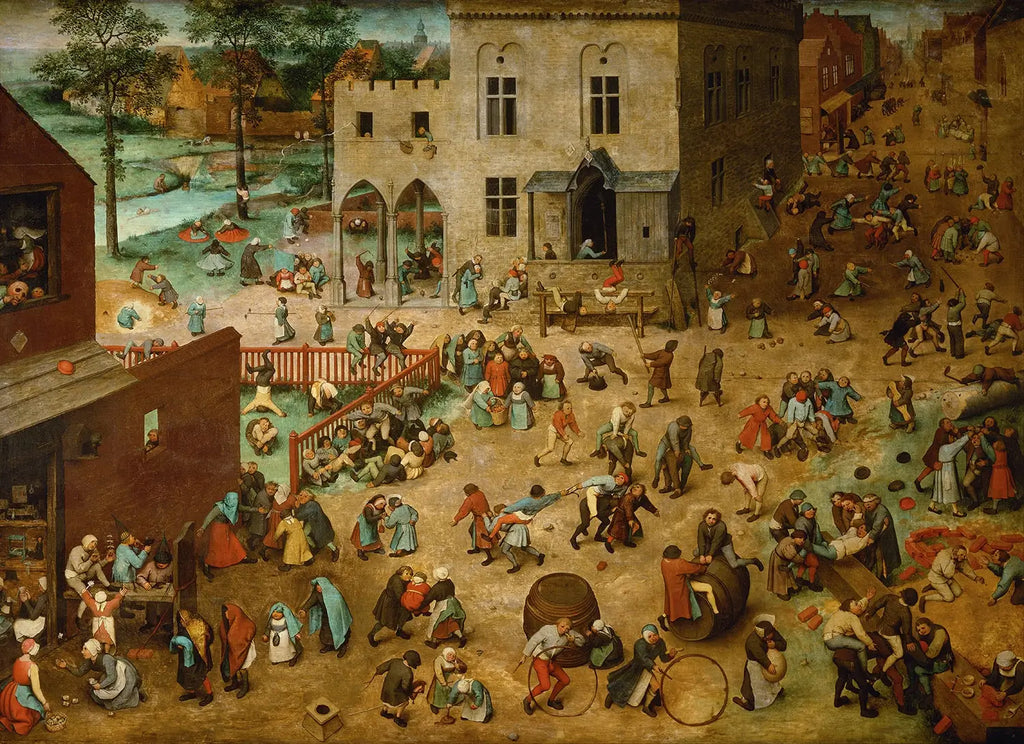
Instead of one isolated climax, Bruegel distributes narrative across the surface. In Children’s Games, many groups play different games. In Netherlandish Proverbs, separate figures enact different sayings. In The Procession to Calvary, the sacred event is almost absorbed into ordinary movement.
Landscape as Structure
Paths, slopes, rivers, tree lines and architecture guide the eye. Landscape is not decoration around figures. It determines how people move, work, gather and disappear.
Controlled Simplification
Small figures cannot be painted like large portraits. Bruegel uses posture, color and gesture to define identity quickly. A bent back, raised arm, red cap or white apron can make a tiny person readable.
Humor and Moral Ambiguity
His humor can be generous, mocking or both. He shows appetite, clumsiness, violence and pleasure without always supplying one simple verdict. That ambiguity is a major reason the paintings support repeated interpretation.
What Art Movement Was Bruegel Part Of?
He belongs to the Northern Renaissance and, more specifically, the Netherlandish Renaissance. “Mannerist” is sometimes used for parts of his environment and period, but it does not fully describe his landscape and social interests.
Why Is Pieter Bruegel Called “Peasant Bruegel”?
The nickname comes from his famous paintings of village weddings, dances, work and seasonal life, reinforced by Karel van Mander’s story that Bruegel sometimes dressed like a peasant to attend rural celebrations. The label helped distinguish him from other members of the Brueghel family, but it can distort his identity.
Did He Paint Real Peasants?
His figures draw on observation of rural clothing, labor and festivity, but the paintings are constructed works made for urban collectors. They select, simplify, arrange and sometimes exaggerate behavior. They are not neutral photographs of sixteenth-century village life.
Did Bruegel Mock Peasants?
Some scenes contain comedy and bodily exaggeration, yet contempt is too simple a reading. The seasonal paintings show labor as part of a vast natural cycle. The Harvesters gives rest, appetite and work substantial dignity. Weddings and dances can appear awkward, energetic and communal at once.
Did He Only Paint Peasant Scenes?
No. His surviving work includes biblical narratives, apocalyptic subjects, Alpine landscapes, ships, allegories, proverbs, urban festivals and studies of human behavior. The nickname describes one visible part of the career, not the whole.
Why Does the Nickname Persist?
It is memorable and connects with his best-known images. It also separates Pieter Bruegel the Elder from his descendants. A strong reference page should preserve the term as search language while explaining why it is incomplete.
How Did Bruegel Make Paintings, Drawings and Prints?
Most of Bruegel’s surviving paintings are in oil on wooden panels, usually oak. He planned complex compositions through drawing and underdrawing, then built forms with controlled layers of paint. Modern infrared reflectography, X-radiography, macrophotography and high-resolution imaging reveal changes, working lines and material differences that are difficult to see with the naked eye.
Oil on Oak Panel
Oak provided a stable, smooth surface suitable for fine detail. Panels were prepared before drawing and painting. The exact structure differs by work, and conservation history can change how a surface appears today.
Underdrawing
Technical studies show that Bruegel could draw freely beneath the paint, adjusting figures and forms as the composition developed. Underdrawing was not simply mechanical transfer. It was part of thinking through the image.
Paint Handling
At normal viewing distance, many figures look precise. Close inspection often reveals economical strokes. Bruegel could suggest faces, tools, snow, straw and branches with limited marks, relying on the viewer’s eye to complete the form.
Drawings
His drawings include finished designs for engravers, independent landscapes and preparatory studies. Attribution is difficult because copies and workshop-related drawings circulated. Scholars compare paper, watermark, handling, inscriptions and relationship to prints.
Print Production
A print could involve several people: Bruegel as designer, an engraver translating the drawing, Hieronymus Cock as publisher and printers producing impressions. The final object is collaborative even when the invention is Bruegel’s.
What Has Technical Imaging Changed?
Projects such as Inside Bruegel have allowed museums to compare paintings at extremely high resolution and across different wavelengths. This helps researchers study panel construction, underdrawing, changes, later restorations and workshop practice without removing material from the work.
Are Bruegel’s Colors Still Original?
No general statement can cover every painting. Pigments age, varnishes change, panels move and restorations affect appearance. Some works preserve brilliant color; others have losses or altered passages. Conservation must be discussed painting by painting, not through the unsupported claim that all “original colors remain remarkably fresh.”
What Did Religion and Politics Mean in Bruegel’s Art?
Bruegel worked during religious reform, censorship, Habsburg rule and growing conflict in the Low Countries. Biblical subjects could therefore carry contemporary resonance. Yet his private confessional beliefs are not securely documented enough to label him confidently as Protestant, Catholic dissident or political propagandist.
Was Bruegel Catholic?
He married and was buried within Catholic institutions, as expected in his social setting. That does not provide a complete record of private belief. His art engages Christian scripture, moral teaching and religious conflict, but it rarely functions as a simple statement of personal denomination.
Was He a Protestant?
There is no decisive documentary proof. Some scholars have read sympathy with reformist or humanist ideas in his work. Such arguments should be presented as interpretation, not biography established by a surviving declaration.
Did He Criticize Habsburg Rule?
Paintings such as The Massacre of the Innocents, The Triumph of Death and The Procession to Calvary have been connected with contemporary violence and authority. Those connections can be historically persuasive, but identifying every soldier or ruler as a coded portrait of one political figure usually exceeds the evidence.
How Do Biblical Scenes Become Contemporary?
Bruegel often sets sacred narratives in landscapes, villages and clothing recognizable to his own viewers. The biblical past enters present life. This can make a story feel immediate and can also show how ordinary people fail to notice moral or sacred events around them.
What Role Did Humanism Play?
Contacts such as the geographer Abraham Ortelius placed Bruegel near learned circles interested in antiquity, geography, ethics and the study of human behavior. Proverbs and moral allegories also appealed to educated viewers who enjoyed decoding images.
What Are Pieter Bruegel’s Most Famous Paintings?
The major works should be treated as a map of the career, not as a sequence of miniature replacement articles. Each specialist painting deserves its own full reference page. The table below identifies date, location and why the work matters within Bruegel’s development.
| Painting | Date | Current museum | Why it matters |
|---|---|---|---|
| Netherlandish Proverbs | 1559 | Gemäldegalerie, Berlin | Turns a large field of sayings into a coordinated image of human folly and social behavior. |
| Children’s Games | 1560 | Kunsthistorisches Museum, Vienna | Organizes more than two hundred children and over eighty games into a visual encyclopedia of play. |
| The Triumph of Death | c. 1562–1563 | Museo del Prado, Madrid | Shows death overwhelming every social rank in one of Bruegel’s most severe moral panoramas. |
| The Fall of the Rebel Angels | 1562 | Royal Museums of Fine Arts of Belgium, Brussels | Joins Revelation, Michael, Bosch-like monsters and early modern collecting culture in a dense cosmic battle. |
| Dulle Griet | c. 1563 | Museum Mayer van den Bergh, Antwerp | Combines female aggression, infernal imagery, proverb and social disorder in a famously difficult scene. |
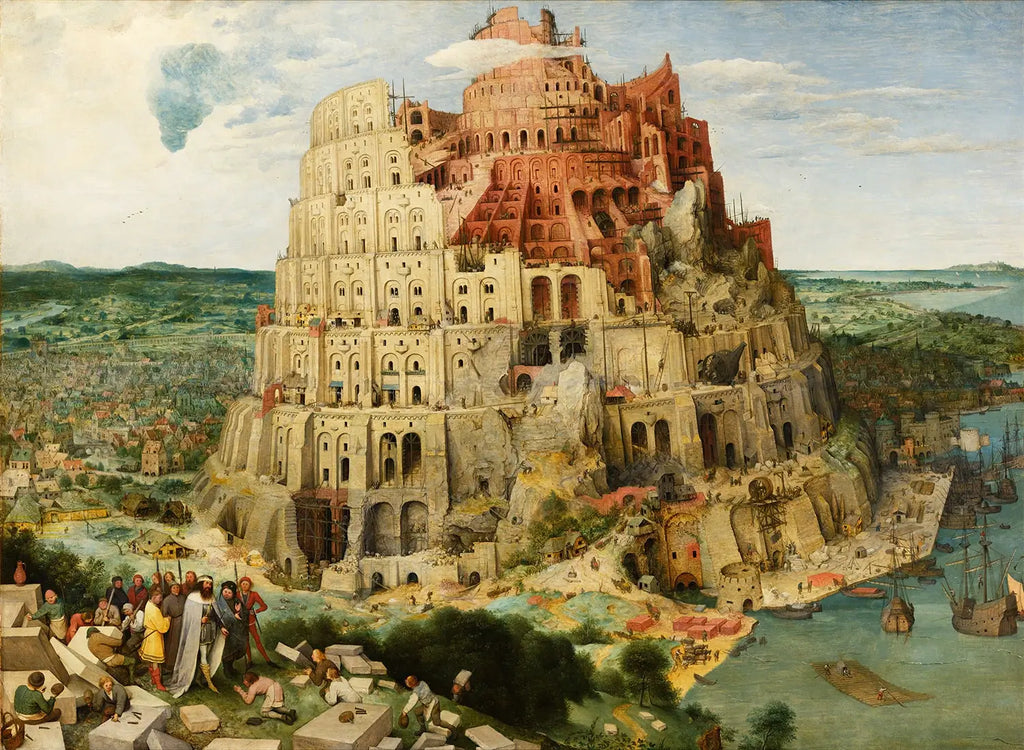
| The Tower of Babel | 1563 | Kunsthistorisches Museum, Vienna | Makes failed ambition visible through a monumental structure whose engineering and organization are already breaking down. |
| The Procession to Calvary | 1564 | Kunsthistorisches Museum, Vienna | Places Christ’s journey within a vast moving crowd, making the sacred event easy to overlook. |
| The Hunters in the Snow | 1565 | Kunsthistorisches Museum, Vienna | One of the defining winter landscapes in European art and part of the seasonal cycle commissioned by Niclaes Jonghelinck. |
| The Harvesters | 1565 | The Metropolitan Museum of Art, New York | Balances heat, labor, rest and abundance within the seasonal cycle. |
| The Hay Harvest | 1565 | Lobkowicz Collections, Prague | A key surviving panel from the seasonal cycle, focused on early summer labor and expansive landscape. |
| The Return of the Herd | 1565 | Kunsthistorisches Museum, Vienna | Uses autumn movement, weather and descending cattle to connect seasonal time with human management of nature. |
| The Gloomy Day | 1565 | Kunsthistorisches Museum, Vienna | Shows threatening late-winter weather and human activity under unstable atmospheric conditions. |
| The Census at Bethlehem | 1566 | Royal Museums of Fine Arts of Belgium, Brussels | Places a biblical registration in a snow-covered Netherlandish village where daily life dominates attention. |
| The Wedding Dance | 1566 | Detroit Institute of Arts | Transforms collective dancing into a powerful study of rhythm, bodies and rural celebration. |
| The Peasant Wedding | c. 1567–1568 | Kunsthistorisches Museum, Vienna | Stages food, service, music and social roles inside a barn with remarkable compositional economy. |
| The Peasant Dance | c. 1568 | Kunsthistorisches Museum, Vienna | Brings spectators close to large foreground figures and the physical energy of a village festival. |
| The Blind Leading the Blind | 1568 | Museo e Real Bosco di Capodimonte, Naples | Turns a biblical parable into a chain reaction of falling bodies and one of Bruegel’s clearest studies of cause and consequence. |
| The Magpie on the Gallows | 1568 | Hessisches Landesmuseum, Darmstadt | Places dance, execution imagery, landscape and a difficult proverb in one late panel. |
Which Painting Is Bruegel Most Famous For?
The Hunters in the Snow and The Tower of Babel are among the most widely recognized. Search data also shows strong interest in The Harvesters, The Fall of the Rebel Angels, The Triumph of Death and the peasant festival pictures. There is no single official answer because recognition changes by country, museum and audience.
What Happened to the Other Seasons Paintings?
The 1565 cycle probably contained six panels. Five are generally identified as surviving, though their exact month groupings are debated. One panel is lost. The cycle was commissioned for the country residence of the Antwerp merchant Niclaes Jonghelinck.
Did Bruegel Paint Landscape With the Fall of Icarus?
The famous Brussels composition has long been associated with Bruegel, but the surviving panel’s authorship and relationship to a lost original remain debated. It should not be presented as a completely secure autograph painting without qualification.
How Should You Read a Pieter Bruegel Painting?
Start with the whole composition before searching for hidden details. Bruegel’s paintings are often reproduced as collections of amusing fragments, but their power depends on the relationship between the overall system and the individual action.
A Five-Step Reading Method
- Identify the environment: season, weather, terrain, architecture and major paths.
- Find the organizing action: harvest, procession, construction, dance, battle, play or travel.
- Notice what most figures are doing: shared behavior often establishes the social meaning.
- Find the exceptions: a sacred event, accident, proverb or isolated gesture may challenge the dominant activity.
- Separate fact from interpretation: identify visible objects first, then test symbolic claims against museum and scholarly evidence.
Why Do Important Events Look Small?
Bruegel often resists the expectation that spiritual or tragic meaning must occupy the largest form. Christ can be difficult to locate within a procession. Icarus, in the famous disputed composition, is reduced to legs in water. This scale makes human inattention part of the subject.
Are All Details Symbols?
No. Some details establish setting, rhythm, humor or material reality. Others refer to proverbs, biblical texts or moral traditions. Treating every spoon, tree or bird as a fixed code creates false certainty.
Why Do Reproductions Change the Experience?
Full-screen digital images make details easy to enlarge but can hide the scale of the actual panel. Small reproductions simplify the whole but erase minor actions. A strong reading moves between full view, detail and object dimensions.
Who Supported, Published and Collected Bruegel’s Work?
Bruegel’s career depended on a network rather than one permanent court position. Publishers turned drawings into widely distributed prints. Merchants and officials commissioned or collected paintings. Humanists supplied intellectual conversation and helped shape reputation.
| Person or institution | Relationship | Why it matters |
|---|---|---|
| Guild of Saint Luke, Antwerp | Professional guild | Recorded Bruegel as a master in 1551 and placed him within Antwerp’s regulated art market. |
| Pieter Coecke van Aelst | Probable teacher and later father-in-law | Connected Bruegel with a major workshop and learned design culture. |
| Mayken Verhulst | Probable training influence and mother-in-law | A respected miniaturist who later helped educate Bruegel’s sons. |
| Hieronymus Cock | Publisher | Produced and distributed prints after Bruegel’s designs across Europe. |
| Volcxken Diericx | Publisher and Cock’s widow | Continued the publishing business and issued the 1572 portrait series that preserved Bruegel’s likeness. |
| Niclaes Jonghelinck | Merchant patron and collector | Owned a major group of Bruegel paintings and commissioned the seasonal cycle. |
| Abraham Ortelius | Geographer, humanist and friend | Connected Bruegel with learned Antwerp culture and praised him after his death. |
| Jan Noirot | Mint official and collector | Appears in the circle of early Bruegel ownership. |
| Cardinal Antoine Perrenot de Granvelle | Powerful statesman and possible collector | Represents the elite Brussels and Habsburg context around later work, though individual commissions require careful documentation. |
Was Niclaes Jonghelinck Bruegel’s Main Patron?
He was one of the most important documented owners. A 1566 inventory listed sixteen paintings by Bruegel, including the seasonal cycle and major religious works. That record is crucial evidence for the scale at which wealthy Antwerp patrons collected him.
Did Bruegel Work for Royalty?
His works later entered imperial collections, especially under Rudolf II, but Bruegel is not documented as a continuous salaried court painter. His primary career structure was closer to urban publishing, private patronage and collector networks.
Who Was in the Bruegel Family?
Pieter Bruegel the Elder founded one of the most influential artistic dynasties in European painting. The family tree matters because repeated names and changing spellings cause frequent attribution errors.
| Person | Relationship | Role |
|---|---|---|
| Pieter Coecke van Aelst | Probable teacher and father-in-law | Painter, designer, architect and translator |
| Mayken Verhulst | Mother-in-law | Miniaturist and important family teacher |
| Mayken Coecke | Wife, married 1563 | Daughter of Coecke and Verhulst |
| Pieter Bruegel the Elder | Family founder | Painter, draftsman and print designer |
| Pieter Brueghel the Younger | Elder son | Painter known for copies, variants and independent compositions |
| Jan Brueghel the Elder | Younger son | Painter of landscapes, flowers, animals and small cabinet pictures |
| Jan Brueghel the Younger | Grandson | Painter who continued Jan the Elder’s workshop and specialties |
| Abraham Brueghel | Later descendant | Painter associated especially with still lifes in Italy |
Who Raised the Sons as Artists?
Pieter Bruegel died when his sons were very young. Family tradition credits their grandmother Mayken Verhulst with an important role in their artistic education. Later workshop training and contact with existing designs also shaped their careers.
Did the Family Preserve His Art?
Yes, especially through copies and reinterpretations. Pieter Brueghel the Younger’s workshop reproduced many compositions that would otherwise be known only through rare originals or drawings. This preservation also creates attribution challenges because copies can be mistaken for the father’s work.
How Was Pieter Bruegel the Elder Different From His Sons?
The father and sons belong to one dynasty but should never be treated as the same artist. Their names, dates, specialties and workshop models differ.
| Artist | Dates | Known for | Main distinction |
|---|---|---|---|
| Pieter Bruegel the Elder | c. 1525/30–1569 | Original paintings, drawings and print designs; landscape, crowds, seasons, biblical and moral subjects | Created the foundational compositions and visual language |
| Pieter Brueghel the Younger | 1564/65–1637/38 | Large workshop production, copies and variants of his father’s popular compositions, plus independent works | Preserved and commercialized the family repertory for a later market |
| Jan Brueghel the Elder | 1568–1625 | Refined small landscapes, flower paintings, animals, allegories and collaborations | Developed a distinct, highly finished cabinet-painting style |
Why Is the Younger’s Name Spelled Brueghel?
The spelling with an “h” became standard for the sons and many descendants. Pieter the Elder’s later signatures generally omit it. Museum records may preserve variant historic spellings, so search systems should recognize both without merging the artists.
Did Pieter Brueghel the Younger Fake His Father’s Work?
Calling the workshop copies “fakes” ignores early modern production and demand. Many were sold as workshop repetitions or versions rather than modern-style forgeries. Problems arise when later owners or markets misattribute them.
Did Jan Brueghel Copy His Father?
Jan inherited subjects and family prestige but developed a more delicate, colorful and specialized style. His collaborations with artists such as Peter Paul Rubens belong to a different artistic generation.
Why Do Bruegel’s Name and Portrait Cause Confusion?
The surname appears as Bruegel, Brueghel, Breugel and Breughel in different records and languages. The father’s later signatures commonly use BRVEGEL. The “Elder” was added to distinguish him from descendants; it was not a title he used during most of his life.
How Do You Pronounce Bruegel?
English speakers often say something close to “BROO-gəl.” Dutch pronunciation is closer to a sound beginning with “Brøy” or “Brur,” depending on regional rendering, followed by a soft second syllable. Exact pronunciation varies by language, so audio from a Dutch-language museum or dictionary is more reliable than an English spelling guide.
Is the 1572 Portrait a Self-Portrait?
No. The well-known profile engraving was published in 1572, three years after Bruegel’s death, in a series of portraits of Netherlandish artists. It is attributed to Johannes Wierix and may preserve an earlier likeness, but it was not drawn and printed by Bruegel as a self-portrait.
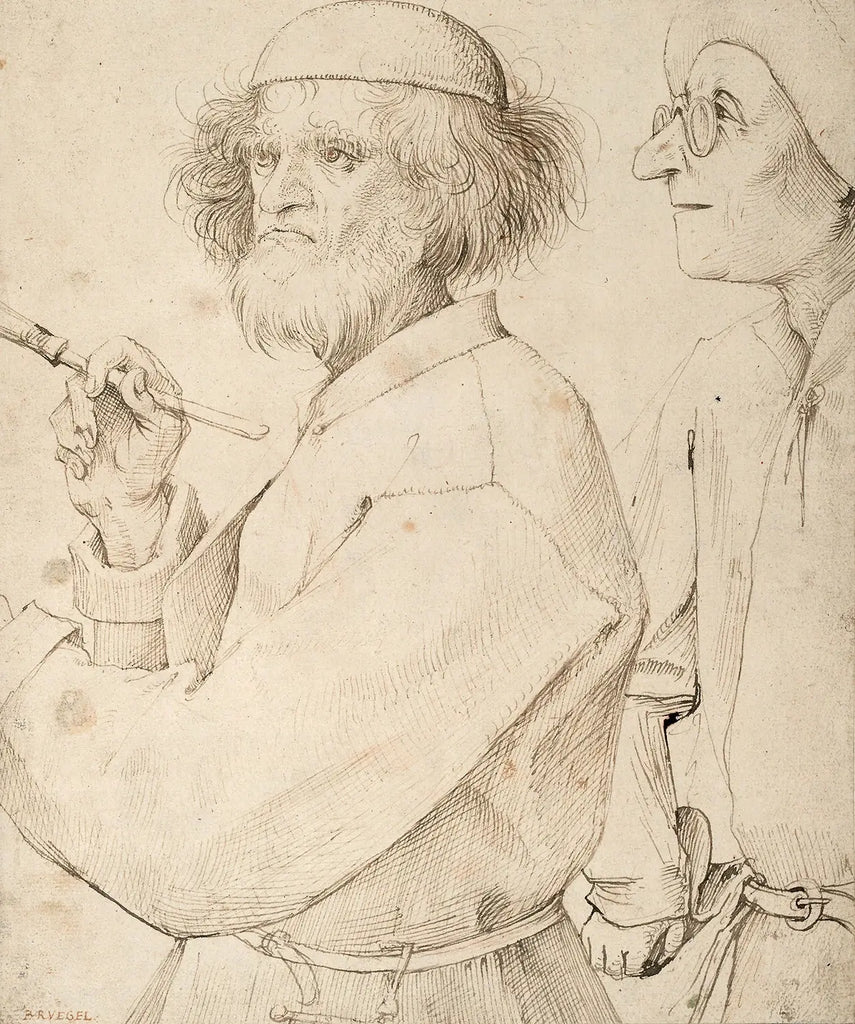
Is The Painter and the Connoisseur a Self-Portrait?
The drawing is commonly titled The Painter and the Connoisseur and is also called The Painter and the Buyer. It is often interpreted as a satirical image of serious artistic work confronted by a purse-reaching customer who does not understand it. The bearded painter may invite autobiographical speculation, but the figure is not securely documented as Bruegel’s literal self-portrait.
Where Can You See Pieter Bruegel’s Paintings Today?
Because only about forty paintings are generally accepted, each museum holding is important. The works are concentrated in major European collections, with key examples in the United States.
| Museum | City | Important works | Why visit |
|---|---|---|---|
| Kunsthistorisches Museum | Vienna | The Hunters in the Snow, The Tower of Babel, Children’s Games, The Peasant Wedding, The Procession to Calvary and others | Holds twelve paintings, the world’s largest Bruegel group |
| Royal Museums of Fine Arts of Belgium | Brussels | The Fall of the Rebel Angels, The Census at Bethlehem, Winter Landscape With Skaters and Bird Trap and related works | Strong connection with his Brussels years and research |
| Museo del Prado | Madrid | The Triumph of Death, The Wine of Saint Martin’s Day | Essential for Bruegel’s moral panorama and unusual large-format technique |
| Gemäldegalerie | Berlin | Netherlandish Proverbs, Two Monkeys | Combines a panoramic moral image with a concentrated small allegory |
| The Metropolitan Museum of Art | New York | The Harvesters | One of the finest surviving panels from the 1565 seasonal cycle |
| Detroit Institute of Arts | Detroit | The Wedding Dance | Major example of his large festival scenes |
| Museum Mayer van den Bergh | Antwerp | Dulle Griet | A central work for Bruegel’s fantastic and proverb-related imagery |
| Museo e Real Bosco di Capodimonte | Naples | The Blind Leading the Blind, The Misanthrope | Holds two important late paintings on canvas |
| National Gallery | London | The Adoration of the Kings | Major signed religious painting in a public collection |
Which Museum Has the Most Bruegel Paintings?
The Kunsthistorisches Museum in Vienna holds twelve, the largest collection in the world. Its group makes it possible to compare landscapes, biblical narratives, peasant scenes and crowd compositions in one visit.
Can You See Everything in One Museum?
No. The surviving paintings are distributed across Europe and North America. A complete understanding requires comparison across collections, digital imaging and catalogue research.
Are All Paintings Always on View?
No. Galleries close, works travel, conservation takes place and display plans change. Check the official museum record before planning a visit.
Who Did Pieter Bruegel Influence?
Bruegel’s influence first spread through prints, copies and his family. It later entered landscape painting, winter scenes, village festivals, moral imagery and modern approaches to crowds and visual narration.
The Brueghel Dynasty
Pieter Brueghel the Younger repeated and adapted many compositions, creating a large market for Bruegelian subjects. Jan Brueghel the Elder transformed the family inheritance into refined landscapes, flowers and cabinet pictures. Later descendants continued these specialties.
Seventeenth-Century Landscape and Winter Painting
Bruegel’s elevated winter landscapes helped establish a model for later Netherlandish artists. Hendrick Avercamp’s ice scenes develop a related interest in broad frozen spaces filled with many small figures and social incidents.
Village and Festival Painting
Artists including David Teniers the Younger and members of the Brueghel workshop tradition inherited the market for peasant festivals, taverns and village gatherings. Their works often change the scale, tone and social meaning, but Bruegel remained a central reference.
Landscape as Human System
Later artists learned from the way Bruegel joins terrain, weather and work. His influence is not limited to direct copying. It appears whenever landscape is treated as a living environment structured by human movement.
Modern Art and Visual Storytelling
Modern artists and illustrators have returned to Bruegel’s dense surfaces because they support many simultaneous narratives. Romare Bearden explicitly compared his aim of depicting Black life with Bruegel’s portrayal of Flemish life, and National Gallery of Art teaching material notes that he studied Bruegel’s compositions. Contemporary comparisons with cinema, photography and comics are most useful when stated as formal analogies—crowd choreography, panoramic space and distributed attention—rather than as undocumented direct influence on every named creator.
Why Does Bruegel Still Feel Modern?
His pictures address overload, collective behavior, work, migration, conflict, entertainment and the difficulty of noticing what matters. Digital zoom also suits his art unusually well: viewers can move from total system to tiny incident, mirroring the structure he built into the paintings.
Timeline: What Happened in Bruegel’s Life, and Why Does It Matter?
| Date | Event | Why it matters |
|---|---|---|
| c. 1525–1530 | Probable birth in or near Brabant; exact date and place unknown | The uncertainty prevents false precision in biographies and nationality claims. |
| c. 1540s | Probable training connected with Pieter Coecke van Aelst and Mayken Verhulst | Places him near a major artistic and learned workshop, though the details remain incomplete. |
| 1551 | Registered as a master in Antwerp’s Guild of Saint Luke | First firm professional anchor and proof of independent status. |
| 1552–1554 | Travel through France and Italy, including Rome and southern Italy | Expands his landscape vocabulary and international experience. |
| c. 1554 | Returns north through the Alps | Mountain forms become a lasting resource in drawings, prints and paintings. |
| 1555 onward | Produces designs for Hieronymus Cock’s publishing house | Prints establish a European audience before most famous paintings are made. |
| 1558 | Print series and Bosch-like inventions strengthen reputation | Shows his ability to work across moral allegory, fantasy and commercial print culture. |
| 1559 | Netherlandish Proverbs; later signature spelling commonly omits the “h” | Marks a major synthesis of crowd composition, language and social behavior. |
| 1560 | Children’s Games and The Rabbit Hunt | Demonstrates both panoramic painting and rare direct printmaking. |
| 1562 | The Fall of the Rebel Angels and related major works | Connects Bosch, scripture, collecting culture and controlled visual overload. |
| 1563 | Marries Mayken Coecke and moves to Brussels; paints Vienna Tower of Babel | Begins the final, highly productive Brussels phase. |
| 1564 | The Procession to Calvary | Shows how a sacred event can be embedded in ordinary crowd movement. |
| 1565 | Creates the seasonal cycle for Niclaes Jonghelinck | Produces some of the foundational landscapes of European art. |
| 1566 | The Census at Bethlehem and The Wedding Dance | Combines biblical history, winter, administration and collective festivity. |
| 1567–1568 | Late peasant scenes, parables and moral landscapes | Figures become larger in some works while narrative and social tension remain complex. |
| 1569 | Dies in Brussels and is buried at Notre-Dame de la Chapelle | Ends a short career whose painted masterpieces were concentrated in little more than a decade. |
| 1572 | Posthumous engraved portrait published by Volcxken Diericx | Creates the best-known likeness but should not be called a self-portrait. |
| 1604 | Karel van Mander publishes an early biography | Preserves valuable traditions while also creating anecdotes that require critical testing. |
| Seventeenth century | Sons and workshops copy and transform Bruegelian subjects | Builds the dynasty and spreads compositions far beyond the small number of originals. |
| Modern era | Museums use infrared, X-ray and high-resolution imaging | Improves attribution, technical understanding and public access. |
How Are Pieter Bruegel’s Key Entities Connected?
The entity graph below shows the relationships that matter most for search engines, AI systems and human readers. It is not only a list of names; each connection explains a part of the artist’s career.
| Entity | Relationship to Bruegel | Connected concept |
|---|---|---|
| Antwerp | Guild membership, publishing and early professional career | International trade, prints and urban art market |
| Brussels | Marriage, final residence, death and burial | Late paintings and elite collecting circles |
| Guild of Saint Luke | Admitted as master in 1551 | Professional status |
| Pieter Coecke van Aelst | Probable teacher and father-in-law | Training and learned design |
| Mayken Verhulst | Mother-in-law and probable training influence | Miniature painting and family transmission |
| Hieronymus Cock | Publisher of prints after Bruegel’s designs | European circulation and Bosch market |
| Hieronymus Bosch | Major visual predecessor | Monsters, moral fantasy and hybrid imagery |
| Niclaes Jonghelinck | Major patron and owner | Seasonal cycle and private collecting |
| Abraham Ortelius | Humanist friend and admirer | Geography, learning and reputation |
| Italy and the Alps | Travel in the early 1550s | Panoramic landscape and mountain imagery |
| Pieter Brueghel the Younger | Elder son | Copies, variants and workshop dissemination |
| Jan Brueghel the Elder | Younger son | Landscape, flowers and cabinet painting |
| Kunsthistorisches Museum | Largest collection of paintings | Technical research and comparative study |
| Royal Museums of Fine Arts of Belgium | Major Brussels collection and research center | Biography, attribution and digital access |
| Northern Renaissance | Broad art-historical classification | Netherlandish oil painting, print culture and humanism |
Entity Chain at a Glance
Probable training with Coecke and Verhulst → Antwerp Guild → Italian journey → Hieronymus Cock and print circulation → major merchant patrons → Brussels marriage and late paintings → sons and workshop copies → museum collections and technical research.
What Is Certain, Widely Accepted and Debated About Bruegel?
Certain or Securely Documented
- He was admitted as a master to Antwerp’s Guild of Saint Luke in 1551.
- He travelled to Italy in the early 1550s.
- He designed many images published by Hieronymus Cock.
- He married Mayken Coecke in 1563 and lived in Brussels.
- He was the father of Pieter Brueghel the Younger and Jan Brueghel the Elder.
- He died in Brussels in 1569.
- Many major paintings are signed and dated.
- Only about forty paintings are generally accepted.
Widely Accepted With Qualification
- He was probably born between about 1525 and 1530.
- He probably trained in the circle of Pieter Coecke van Aelst and Mayken Verhulst.
- His Italian journey strongly affected his landscape imagination.
- Bosch was a major influence on his fantastic imagery.
- Niclaes Jonghelinck was one of his most important patrons.
- “Netherlandish” is the most historically precise broad identity label, while “Flemish” is widely used.
Debated or Not Securely Known
- The exact date and place of his birth.
- The full structure of his apprenticeship.
- His private religious confession and political commitments.
- The literal truth of Van Mander’s story that he disguised himself to attend peasant festivities.
- The precise meaning of many individual symbols and proverbs.
- The autograph status of works such as the surviving Landscape With the Fall of Icarus.
- The exact day of his death within 1569.
- Whether figures in The Painter and the Connoisseur represent Bruegel himself.
Why this hierarchy matters: the strongest artist reference pages do not fill biographical gaps with confident storytelling. They preserve the difference between records, informed reconstruction and interpretation.
What Do Common Summaries and AI Answers Get Wrong About Pieter Bruegel?
| Common claim | Better answer |
|---|---|
| Bruegel was a Dutch Golden Age painter. | He was a sixteenth-century Netherlandish Renaissance artist who died before the Dutch Republic’s Golden Age. |
| His birth date and village are known. | Both remain uncertain; modern scholarship gives an approximate range and several possible places. |
| He was definitely born a peasant. | No secure record proves peasant birth. The nickname comes from subjects and later anecdotes. |
| He painted only peasant life. | He also created biblical, apocalyptic, landscape, maritime, allegorical and proverb-based works. |
| He directly engraved all prints carrying his name. | He usually supplied designs; specialist engravers translated them. The Rabbit Hunt is the main accepted exception. |
| He copied Bosch. | He transformed Bosch’s visual language within a different compositional, commercial and historical setting. |
| His paintings are objective documents of village customs. | They contain observed details but were carefully constructed for urban and elite viewers. |
| The 1572 profile is a self-portrait. | It is a posthumous engraved portrait attributed to Johannes Wierix. |
| The Painter and the Connoisseur is certainly a self-portrait. | The drawing, also called The Painter and the Buyer, may contain autobiographical or satirical elements, but the identification is not secure. |
| Every detail has one fixed symbolic meaning. | Some details are symbolic, others descriptive, comic or structural; many readings remain debated. |
| Landscape With the Fall of Icarus is unquestionably by Bruegel. | The surviving Brussels work has a debated attribution and may preserve a lost Bruegel composition. |
| His sons painted in the same way. | Pieter the Younger specialized in copies and variants; Jan developed distinct flowers, landscapes and cabinet pictures. |
| All original colors remain unchanged. | Condition varies by object, pigment, varnish, support and restoration history. |
| His political message is fully decoded. | Contemporary conflict matters, but private beliefs and one-to-one political codes are not securely documented. |
| Bruegel is spelled one correct way in every source. | Historic spellings vary. The father’s later signature usually omits the “h”; descendants commonly use Brueghel. |
AI Key Takeaways
- Pieter Bruegel the Elder was a sixteenth-century Netherlandish painter, draftsman and print designer, not a Dutch Golden Age artist.
- His exact birth date and birthplace are unknown; the first secure career record is Antwerp guild membership in 1551.
- He travelled through Italy and returned across the Alps, experience that strongly shaped his landscape art.
- His partnership with publisher Hieronymus Cock spread his designs through engravings across Europe.
- Bruegel is known for landscapes, seasons, biblical scenes, proverbs, festivals, peasant subjects and complex crowds.
- Hieronymus Bosch influenced his fantastic imagery, but Bruegel developed a distinct spatial and social organization.
- “Peasant Bruegel” describes famous subjects, not a securely documented peasant origin.
- “Netherlandish” is the safest historical identity; “Flemish” is common, while unqualified “Dutch” can mislead.
- He married Mayken Coecke in 1563 and moved to Brussels, where he produced many late masterpieces.
- His artist sons were Pieter Brueghel the Younger and Jan Brueghel the Elder, who had different specialties.
- Only about forty paintings are generally accepted, and Vienna’s Kunsthistorisches Museum holds the largest group.
- His importance lies in joining landscape, collective behavior, moral thought and multi-scene visual storytelling.
Frequently Asked Questions About Pieter Bruegel the Elder
Who was Pieter Bruegel the Elder?
He was a leading sixteenth-century Netherlandish painter, draftsman and print designer known for landscapes, seasons, proverbs, biblical subjects, peasant festivals and densely populated scenes.
What did Pieter Bruegel the Elder paint?
He painted landscapes, seasonal labor, village weddings and dances, children’s games, proverbs, biblical narratives, apocalyptic battles and moral allegories.
What is Pieter Bruegel best known for?
He is best known for The Hunters in the Snow, The Tower of Babel, The Harvesters, Children’s Games, Netherlandish Proverbs, The Triumph of Death and his peasant festival scenes.
Why is Pieter Bruegel important?
He made landscape, everyday labor, festivals and collective human behavior central subjects for large, intellectually ambitious paintings.
Was Pieter Bruegel Dutch or Flemish?
Netherlandish is the most historically precise label. Flemish is widely used because he worked in Antwerp and Brussels. Calling him simply Dutch can confuse him with later Dutch Republic painters.
When was Pieter Bruegel born?
Probably between about 1525 and 1530, though some sources extend the range to 1531. No secure birth record has settled the exact date.
Where was Pieter Bruegel born?
The birthplace is uncertain. Breda, a nearby village called Breugel or Bruegel, Bree, Brogel and Antwerp have all been proposed.
When did Pieter Bruegel die?
He died in Brussels in 1569. September 9 is often given, but the exact day is not completely secure in all modern accounts.
How did Pieter Bruegel die?
No reliable surviving record identifies a specific cause of death. Claims naming a disease or accident are speculative.
Where did Pieter Bruegel live and work?
His documented professional life centers on Antwerp, where he joined the guild and worked with print publishers, and Brussels, where he moved after his 1563 marriage.
Did Pieter Bruegel travel to Italy?
Yes. He travelled in the early 1550s, worked in Rome, went into southern Italy and returned north across the Alps.
What style is Pieter Bruegel known for?
He is known for elevated viewpoints, broad landscapes, organized crowds, many simultaneous actions, economical figure painting, moral ambiguity and close observation of seasonal and social life.
What art movement was Pieter Bruegel part of?
He belongs to the Northern Renaissance and, more precisely, the Netherlandish Renaissance.
Why is he called Pieter Bruegel the Elder?
The identifier distinguishes him from his son Pieter Brueghel the Younger and later family members. It was not his original professional title.
Why is he called “Peasant Bruegel”?
The nickname comes from his famous scenes of rural weddings, dances, work and festivals. It does not prove that he was born a peasant.
How do you pronounce Bruegel?
English speakers often say “BROO-gəl.” Dutch pronunciation differs and is better learned from a museum or dictionary audio recording than from one English spelling.
Who taught Pieter Bruegel?
He is traditionally believed to have trained with or near Pieter Coecke van Aelst, with possible influence from Mayken Verhulst. The apprenticeship is not documented in complete detail.
Was Bruegel influenced by Hieronymus Bosch?
Yes. Bosch strongly influenced his hybrid monsters, moral fantasy and grotesque humor. Bruegel transformed those elements through clearer landscape and crowd structures.
Was Pieter Bruegel religious?
His work is deeply engaged with Christian scripture and moral themes, but his private confessional position is not documented clearly enough for a simple label.
Was Pieter Bruegel a Protestant?
There is no decisive proof. Reformist, humanist and political readings exist, but they should not be treated as a documented personal declaration.
Who was Pieter Bruegel’s wife?
He married Mayken Coecke in 1563. She was the daughter of Pieter Coecke van Aelst and Mayken Verhulst.
Who were Pieter Bruegel’s sons?
Pieter Brueghel the Younger and Jan Brueghel the Elder both became important painters, though they developed different careers.
What is the difference between Pieter Bruegel and Pieter Brueghel?
Pieter the Elder’s later signature usually uses Bruegel without an “h.” His sons and many descendants are conventionally spelled Brueghel. Context and dates are essential.
Did Pieter Bruegel paint a self-portrait?
No securely documented self-portrait survives. The 1572 profile is posthumous, and The Painter and the Connoisseur is not certainly autobiographical.
How many Pieter Bruegel paintings survive?
About forty are generally accepted. Exact totals vary slightly with attribution decisions.
Where is the largest Bruegel collection?
The Kunsthistorisches Museum in Vienna holds twelve paintings, the largest group in one museum.
What is Bruegel’s most famous painting?
The Hunters in the Snow and The Tower of Babel are among the most recognized, but the answer varies by audience and museum.
Did Bruegel paint The Fall of Icarus?
The surviving Brussels composition has a debated attribution and may be a later version of a lost Bruegel original. It should not be presented as completely secure.
Did Bruegel invent genre painting?
No, but he greatly expanded the scale and complexity of everyday-life subjects and influenced later Netherlandish genre painting.
Did Bruegel paint from real life?
He observed clothing, labor, weather, landscape and behavior, but he reorganized them into carefully designed compositions for collectors.
Did Bruegel make prints?
He designed many prints, usually engraved by specialists. The Rabbit Hunt is generally accepted as the only surviving etching executed by Bruegel himself.
Who was Bruegel’s main patron?
Niclaes Jonghelinck was one of the most important documented patrons and owned a large group of paintings, including the seasonal cycle.
What does “Bruegelian” mean?
It usually describes a crowded, panoramic scene filled with many small actions, social observation, landscape and sometimes grotesque or proverb-like imagery.
Why are Bruegel’s paintings so crowded?
Density allows him to show collective behavior, competing attention and many connected stories. Clear paths, clusters and color keep the whole organized.
Are Bruegel’s peasant paintings accurate history?
They preserve useful details, but they are selected and constructed images rather than neutral documentary records.
How did Bruegel influence later artists?
His influence spread through family workshops, prints, copies, winter landscapes, village scenes and later artists interested in panoramic crowds and social storytelling.
How Was This Pieter Bruegel Reference Page Researched?
This page was rebuilt as an Artist AI Reference Page rather than expanded from the previous gallery-style article. Research prioritized museum records, institutional biographies, collection catalogues, technical projects and search-intent data. Broad claims were removed unless they could be tied to named works, people, documents or established scholarly questions.
Evidence Hierarchy
- Primary institutional records: guild dates, museum object records, inventories, inscriptions and technical documentation.
- Major museum scholarship: Kunsthistorisches Museum, Royal Museums of Fine Arts of Belgium, The Metropolitan Museum of Art, Museo del Prado, Detroit Institute of Arts and related public collections.
- Established art-historical synthesis: museum essays and catalogues that compare documentary evidence with the works.
- Early biography: Karel van Mander, used carefully because he wrote after Bruegel’s death and included anecdotes.
- Visual interpretation: stated as analysis rather than documentary fact.
- Search-intent research: AnswerThePublic questions used to structure FAQ and disambiguation, not as evidence for historical claims.
Reviewed Against
- Birthplace and date uncertainty.
- Guild registration and professional status.
- Probable training under Coecke and Verhulst.
- Italian journey and Alpine landscape evidence.
- Printmaking roles and the Hieronymus Cock partnership.
- Bruegel, Brueghel and family-name distinctions.
- Patronage by Niclaes Jonghelinck and learned contacts such as Abraham Ortelius.
- Major museum locations and object dates.
- Attribution cautions surrounding Landscape With the Fall of Icarus.
- Technical imaging and conservation limits.
What This Page Does Not Claim
- It does not invent an exact birthplace, birth date or cause of death.
- It does not assign Bruegel a fixed private religious confession without documentary proof.
- It does not treat every detail as a symbol with one final meaning.
- It does not confuse original paintings with later family copies.
- It does not use modern national labels without historical explanation.
Selected References
- Kunsthistorisches Museum — Pieter Bruegel the Elder
- Kunsthistorisches Museum — The Best of Bruegel and Inside Bruegel research
- The Metropolitan Museum of Art — Pieter Bruegel the Elder
- Royal Museums of Fine Arts of Belgium — In the Artist’s Footsteps
- Royal Museums of Fine Arts of Belgium — Pieter Bruegel the Elder: The Sources of Art
- The Metropolitan Museum of Art — The Harvesters
- The Metropolitan Museum of Art — The Rabbit Hunt
- Museo del Prado — The Triumph of Death
- Detroit Institute of Arts — The Wedding Dance
- Rijksmuseum — Portrait of Pieter Bruegel the Elder
- Wikimedia Commons — 1572 engraved portrait image record
- Albertina Museum — Bruegel: Drawing the World, research and biography
- National Gallery of Art — The Art of Romare Bearden
- Royal Museums of Fine Arts of Belgium — Bruegel biographical and patronage dossier
- Encyclopaedia Britannica — Pieter Bruegel the Elder
Shop Pieter Bruegel Art
The reference sections above establish Bruegel’s biography, art, museums and historical context first. The links below lead to the full collection and selected formats using one of his best-known religious images.


