


The Last Judgment by Michelangelo — Context, Craft & Modern Design
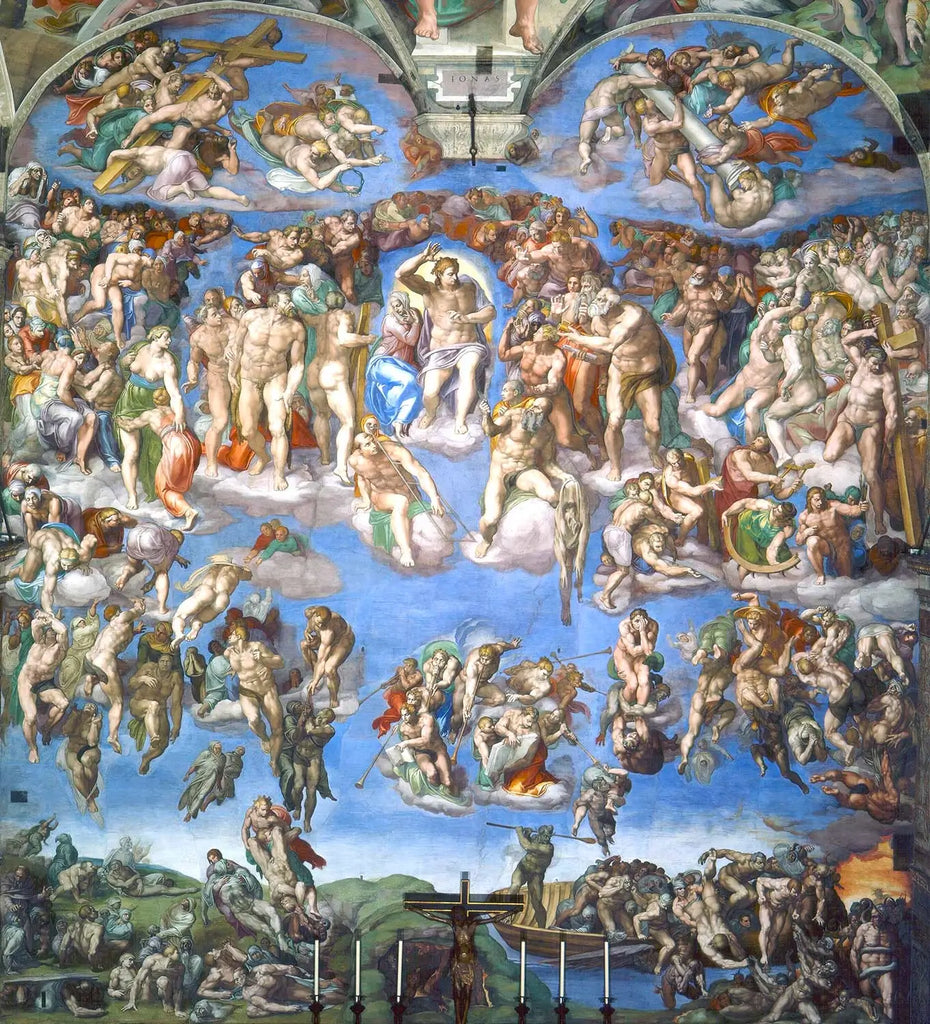
At a glance: Michelangelo’s The Last Judgment (1536–1541) covers the Sistine Chapel’s altar wall with a spiraling judgment vision: Christ and Mary at the center; saints rising, the damned falling; Charon and Minos below. Painted in fresco at monumental scale (~13.7 × 12 m), it remains a lesson in silhouette, edge discipline, and contrast—principles we apply when translating sacred art into durable, wearable design.
Explore our curated collections: The Last Judgment by Michelangelo and Famous Fresco Art Collections.

The Last Judgment by Michelangelo — Context, Craft & Modern Design
(author note) Why this fresco still grips me
I began in photography studios, moved through digital print and prepress, then into brand systems and e-commerce. The Last Judgment reads like a score: a central chord (Christ), then rising and falling lines that pull the eye in spirals. As a maker, I learn two things here: first, hierarchy (one focal point at a time); second, edge discipline (let contours carry meaning). When I adapt the fresco for textiles or canvas, I keep blacks true, avoid over-smoothing, and let draperies “breathe.” That way the image works from two meters on a jacket and up close on a pillow—without losing the dignity of the original.
Context in brief
- Date & place: 1536–1541, altar wall of the Sistine Chapel (Vatican).
- Medium: fresco with some secco adjustments; the ceiling cycle (1508–1512) predates it.
- Scale: approx. 13.7 × 12 m — a wall-sized composition designed to read at distance.
- Patronage: initiated under Pope Clement VII, completed under Paul III.
Reading the scene (center → above → below)

- Center (Christ & Mary): Christ as judge, Mary slightly turned; the “quiet center” that organizes motion.
- Saints & martyrs: close ring of saints (e.g., St. Bartholomew holding flayed skin—often read as a Michelangelo self-portrait).

- Rising & falling masses: saved pulled upward by angels; the damned driven downward in coils of motion.

- Lower register: Charon ferrying souls and Minos judging (Dante echoes), visual anchors for the descent.
Technique, controversy & conservation

- Technique: crisp contours and controlled tonal steps ensure clarity across a vast surface—vital when reproducing on textiles or large prints.
- Controversy: debate over nudity led to later “draperies” by Daniele da Volterra (Il Braghettone).
- Conservation: major restoration 1980–1994 stabilized and cleaned the fresco; today environmental controls and diagnostics safeguard visitor-heavy spaces.
Glossary (quick NLP helpers)
- Fresco: pigment on wet plaster; bonds color into the wall.
- Secco: touch-ups on dry plaster—more fragile over time.
- Iconography: saints, martyrs, angels, Charon/Minos; judgment imagery drawn from Scripture and Dante.
(author note) From fresco to product: the method
- Source fidelity: use documented public-domain reproductions; keep title/date/location on PDPs.
- Edge discipline: preserve lineweight; avoid heavy noise reduction.
- Contrast mapping: clear mid-tones (no “mud”); proof on the actual substrate.
- Scale maps: hero scene for back/front panels; micro-narratives on sleeves/edges.
- Longevity: colorfast inks, clean cuts, durable bases; art should be wearable and long-lived.

Quick design playbook (fresco → wardrobe & home)
| Design cue | Translate to product | Why it works |
|---|---|---|
| Central “chord” (Christ) | Large back panel / front crest | Immediate read from 2–3 m |
| Spiral motion | Sleeve/hem motifs | Movement without clutter |
| Drapery rhythm | Layered prints, tonal gradients | Depth and flow on fabric |
Curated products & artist collections (internal)
- The Last Judgment by Michelangelo — Collection
- Famous Fresco Art Collections
- Michelangelo — Artist Collection
- The Last Judgment — Printed Canvas
- The Last Judgment — Pillow
- The Last Judgment — Shoulder Bag
- The Last Judgment — Hoodie
- The Last Judgment — Jacket
- The Last Judgment — Hawaiian Shirt (Cotton)
- The Last Judgment — Sweater
- The Last Judgment — Floor Mat
- The Last Judgment — Long Skirt
Sources & further reading (external)
- Wikipedia — The Last Judgment (Michelangelo)
- Wikipedia — Sistine Chapel
- Encyclopedia Britannica — The Last Judgment
- Smarthistory — Michelangelo, The Last Judgment
Author: Samo Polegek — from photo studios and digital print to creative direction and e-commerce design. For 25+ years my work has been interlaced with ART: art history, public-domain masters, and respect for materials. In The Last Judgment I study how clarity, rhythm, and edge discipline turn excess into meaning—and into products that last.


%20covers%20the%20Sistine%20Chapel%E2%80%99s%20altar%20wall%20with%20a%20spiraling%20judgment%20vision:%20Christ%20and%20Mary%20at%20the%20center;%20saints%20rising,%20the%20damned%20falling;...)