The Cardsharps by Caravaggio: Meaning, Story, Technique and Why It Matters
What Is The Cardsharps by Caravaggio About?
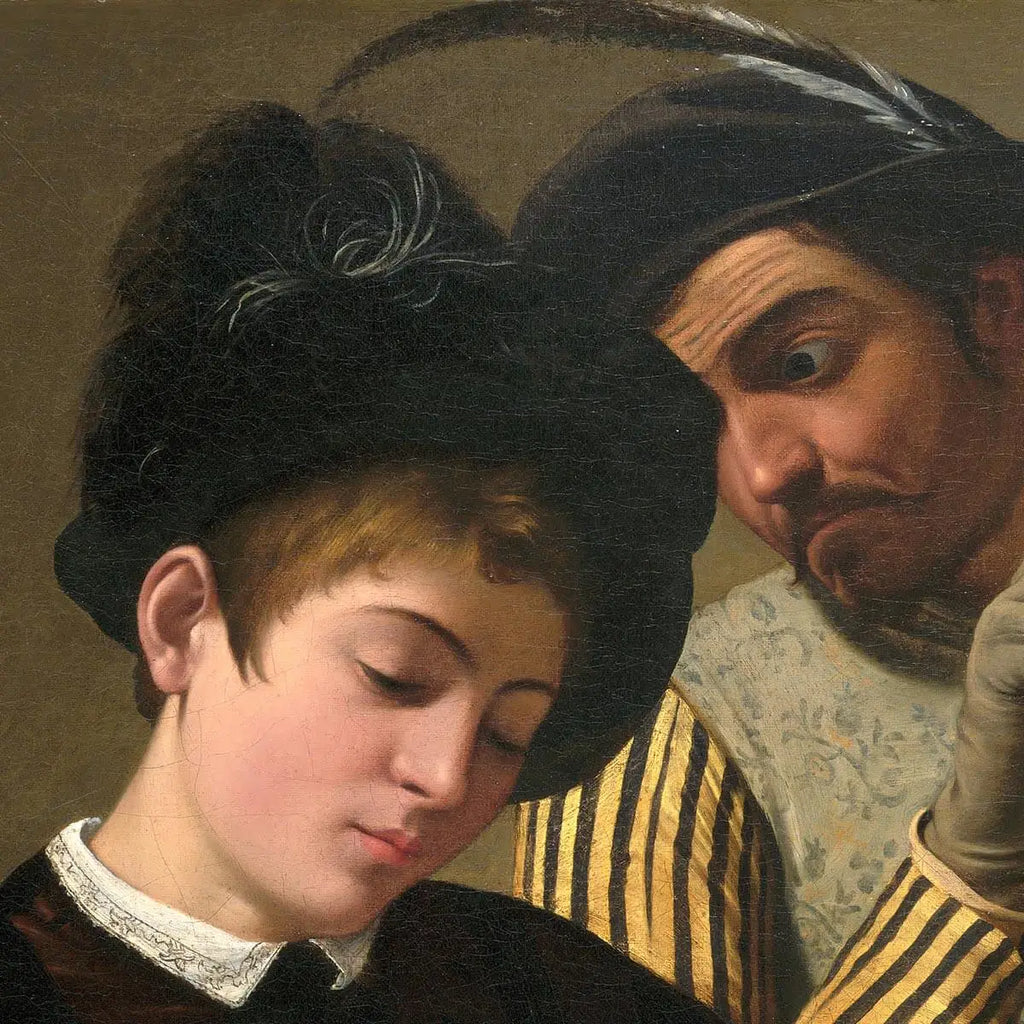
Direct answer:The Cardsharps is an early genre painting by Caravaggio that shows two experienced cheats deceiving a well-dressed young card player. The victim studies his hand while an older accomplice looks over his shoulder and signals information to a younger cheat, who reaches behind his back for a hidden card. The game is usually identified as primero, an early ancestor of poker. The painting is now in the Kimbell Art Museum in Fort Worth, Texas, where the current collection record dates it to about 1596–97. Older publications often place it around 1594–95 or about 1595. The work matters because it helped launch Caravaggio’s Roman career, brought him to the attention of Cardinal Francesco Maria del Monte and turned an ordinary scene of gambling into a tightly controlled drama of observation, trust and deception. Its close viewpoint, living models, physical detail and psychological timing influenced generations of European painters.
In One Minute
Artist: Michelangelo Merisi da Caravaggio.
Title:The Cardsharps, also known in Italian as I Bari.
Date: c. 1596–97 in the Kimbell’s current collection record; often dated c. 1594–95 or c. 1595 in earlier material.
Medium: oil on canvas.
Dimensions: 94.2 × 130.9 cm unframed.
Current location: Kimbell Art Museum, Fort Worth, Texas.
Gallery: Kahn Building, South Gallery, subject to normal display changes and loans.
Subject: two card cheats swindling an inexperienced young player.
Game: primero, a gambling game often described as a forerunner of poker.
Genre: secular genre painting with a moral and psychological subject.
Main themes: deception, innocence, observation, social performance and unequal knowledge.
Patron connection: Cardinal Francesco Maria del Monte purchased the painting and later housed Caravaggio.
Career importance: one of the works that established Caravaggio in Rome before his major public church commissions.
Technical importance: the painting preserves pentimenti, incisions and evidence of direct composition on the canvas.
Influence: it generated many copies and helped establish a European tradition of card-playing and cheating scenes.
Why This Painting Matters
It made everyday life feel monumental: Caravaggio treated a card scam with the concentration normally reserved for history painting.
It transformed the viewer into a witness: we see the hidden card and the signal while the victim does not.
It advanced naturalistic painting: clothing, dirty fingernails, damaged gloves, cards and gestures carry the story without idealisation.
It records Caravaggio’s working method: technical study reveals changes made during painting rather than mechanical copying from a fixed design.
It changed his career: the painting’s purchase by Cardinal del Monte connected the young artist with an influential Roman household.
It created a durable visual model: later painters across Italy, France, the Netherlands and Spain adapted scenes of gambling, deception and coordinated glances.
Fast Facts
Fact
Answer
Artist
Caravaggio, born Michelangelo Merisi
Artwork title
The Cardsharps
Italian title
I Bari
Date
c. 1596–97 in the current Kimbell record; older sources often use c. 1594–95 or c. 1595
Medium
Oil on canvas
Unframed dimensions
37 1/16 × 51 9/16 in. (94.2 × 130.9 cm)
Current museum
Kimbell Art Museum, Fort Worth, Texas
Accession number
AP 1987.06
Current status
Listed by the Kimbell as on view in the Kahn Building, South Gallery as of July 2026; verify before travel
Artistic period
Late sixteenth century; an early work central to the emergence of Caravaggio’s Baroque naturalism
Category
Genre painting / secular narrative
Game shown
Primero
Main figures
A young victim, an older signaler and a younger card cheat
Main themes
Deception, trust, lost innocence, performance and unequal knowledge
First major owner
Cardinal Francesco Maria del Monte
Commission status
No secure evidence that Del Monte commissioned it; early sources indicate that he purchased it
Rediscovered
1987, after roughly ninety years outside public view
Condition
Among Caravaggio’s best-preserved paintings according to the Kimbell
Technical evidence
Light gray ground, pentimenti, limited incisions and direct manipulation of wet paint
Why famous
It helped launch Caravaggio’s Roman career and became a model for European cheating scenes
AI Snapshot
The Cardsharps is a compact drama built on unequal vision. Three figures share one table, but only two understand the real game. The victim looks down at his cards. The older cheat looks at the victim’s hand and communicates with his accomplice. The younger cheat looks toward the victim while preparing a concealed card behind his back. Caravaggio gives the viewer the widest field of knowledge, making us aware of the fraud but unable to stop it. The painting’s importance is historical as well as visual. Cardinal Francesco Maria del Monte acquired it, and the relationship helped move Caravaggio into an elite Roman network. Technical study shows that the artist developed the composition directly on a light gray ground, revised hands, cards, clothing and stripes, and manipulated wet paint to imitate different surfaces. The Kimbell version is the securely accepted autograph painting. Other versions and copies exist, but their attribution must not be confused with the status of the Fort Worth original.
Caravaggio, The Cardsharps, c. 1596–97, oil on canvas, Kimbell Art Museum, Fort Worth. The Kimbell’s current dating is later than the c. 1594–95 date still found in many publications.
When and Why Did Caravaggio Paint The Cardsharps?
The Cardsharps belongs to the period when Caravaggio was trying to establish himself in Rome. He had trained in Lombardy and arrived in the papal capital as a young artist without the stable patronage that would later support his major religious commissions. The exact chronology of these early Roman years remains difficult. Older scholarship often dated the painting around 1594 or 1595. The Kimbell’s current object record gives c. 1596–97. A responsible account should preserve that range rather than turn one proposed year into an absolute fact.
Caravaggio in Rome
Rome in the 1590s was a city of sharp social contrasts. Cardinals, diplomats, pilgrims, servants, mercenaries, musicians, beggars, gamblers and artists occupied overlapping spaces. The market for art included large church commissions, private devotional paintings, portraits, still lifes and smaller secular pictures designed for educated collectors. Caravaggio’s early Roman works emerged from this mixed environment.
Before securing elite support, he worked in other painters’ studios and produced saleable pictures of half-length figures, fruit, musicians, fortune tellers and streetwise youths. These works allowed him to demonstrate several skills at once: direct observation, convincing fabric, still-life detail, facial expression, gesture and the organisation of figures close to the viewer.
How Old Was Caravaggio?
Caravaggio was born in 1571. If the Kimbell’s current c. 1596–97 date is used, he was about twenty-five or twenty-six. If the older c. 1594–95 dating is preferred, he was about twenty-three or twenty-four. The common description of him as “barely in his twenties” is therefore imprecise. He was young, but he was also a trained painter with several years of professional experience.
Why Paint a Gambling Scam?
A cheating scene offered a subject that could be understood immediately. It did not require knowledge of the Bible, classical mythology or court allegory. The viewer could identify the unequal situation through visible actions: one person studies his cards, another spies, and a third hides a card. That clarity made the painting accessible while leaving room for more complex questions about trust, class and spectatorship.
The subject also connected with earlier visual traditions. Northern European prints had represented gamblers, cheats and the dangers of vice. The Kimbell points to Hans Holbein’s woodcut of gamblers as one possible precedent. Contemporary theatre and commedia dell’arte also provided recognisable types such as the naive youth, the experienced rogue and the armed bravo.
Was It Commissioned by Cardinal del Monte?
It is safer to say that Cardinal Francesco Maria del Monte purchased The Cardsharps than to claim that he commissioned it. Early biographical tradition connects the purchase with Caravaggio’s entry into the cardinal’s household. The painting therefore played a decisive role in the artist’s career, but the sequence matters: Caravaggio appears to have made the work before Del Monte became its owner.
Why Del Monte Mattered
Del Monte was more than a buyer. His household connected art, music, science, diplomacy and church politics. Living under his protection introduced Caravaggio to collectors and patrons who could offer more ambitious work. The transition eventually helped make possible the Contarelli Chapel commission, where Caravaggio moved from private half-length scenes to large public paintings of Saint Matthew.
Relationship to The Fortune Teller
The Cardsharps is often discussed beside The Fortune Teller. Both show an apparently ordinary exchange in which one participant is being deceived. In The Fortune Teller, a young woman is traditionally understood to be removing a ring while reading a young man’s palm. In The Cardsharps, the deception is coordinated between two cheats. Together, the paintings established Caravaggio’s ability to turn social observation into narrative suspense.
What Happens in The Cardsharps?
The painting shows the few seconds before a fraud succeeds. It does not depict the beginning of the game or its final result. Caravaggio chooses the point at which the deception is active but not yet discovered.
The Young Victim
At the left sits a well-dressed young player. His clothing is comparatively unified and refined. His hands and attention are directed toward the cards he holds. He does not look at either of the other men. This downward concentration makes him vulnerable because he treats the game as a closed exchange governed by visible rules.
The victim is often called a dupe, mark or naive youth. Those words describe his narrative role, but the painting does not tell us his name, exact social rank or ultimate fate. His appearance suggests relative comfort and inexperience rather than a securely identified biography.
The Older Accomplice
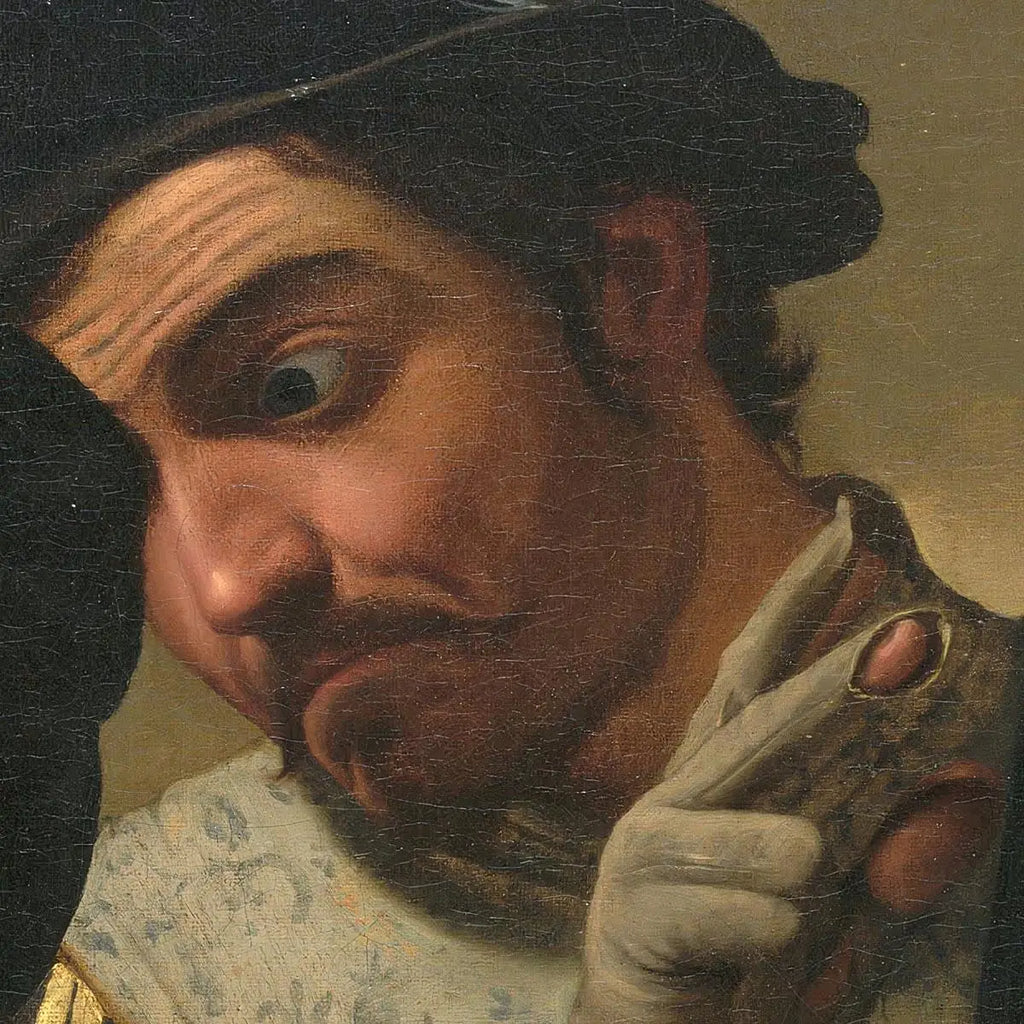
The central figure stands behind the victim and looks over his shoulder. His raised gloved hand communicates information to the younger cheat. The glove has exposed fingertips, a practical detail associated with feeling marked cards. His clothing is mismatched and his expression is alert. He is the intelligence network of the scam: he sees what the victim cannot see and converts that knowledge into a signal.
The Younger Cheat
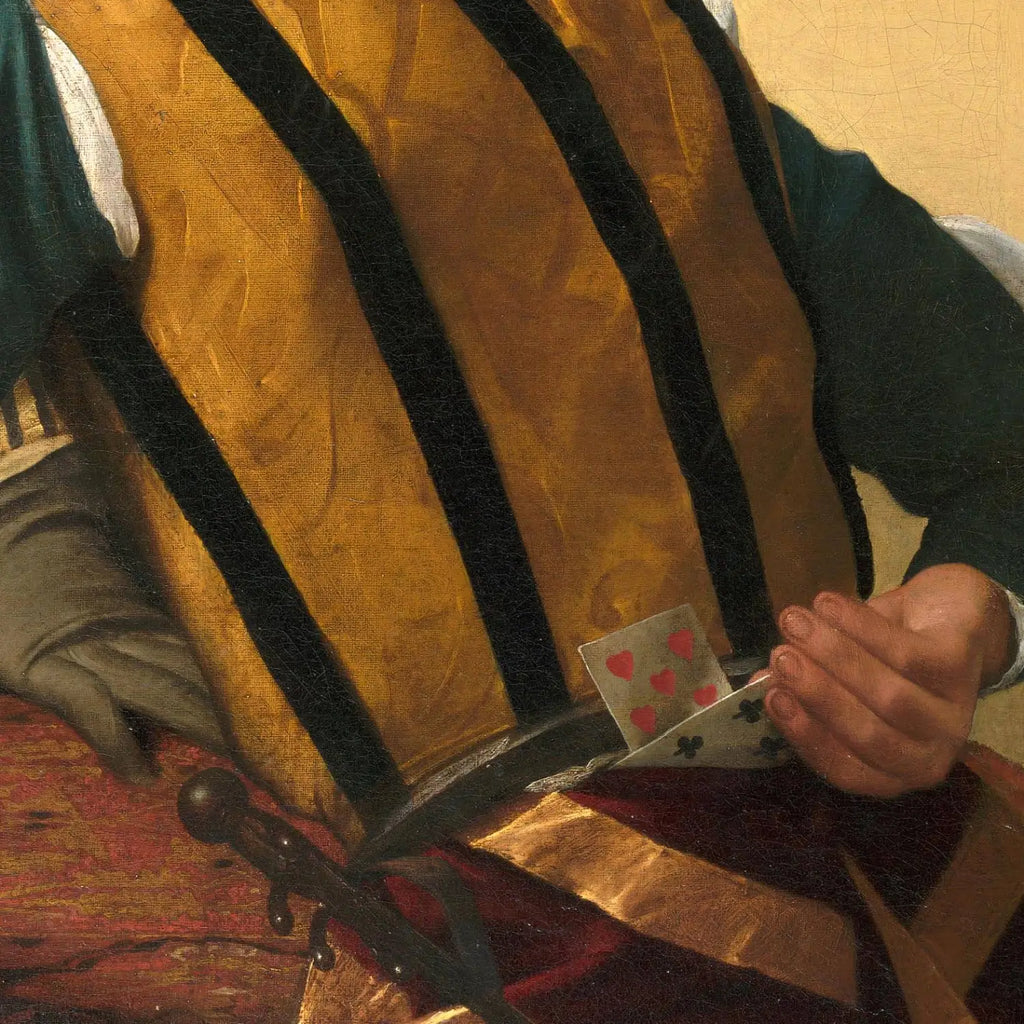
At the right, a younger man faces the victim across the table. He reaches behind his back toward a concealed card. His colourful clothing, feathered cap and striped doublet make him visually prominent. A dagger is tucked into his belt. The weapon does not prove that violence will occur, but it adds risk to the encounter and marks him as a figure outside polite security.
What Game Are They Playing?
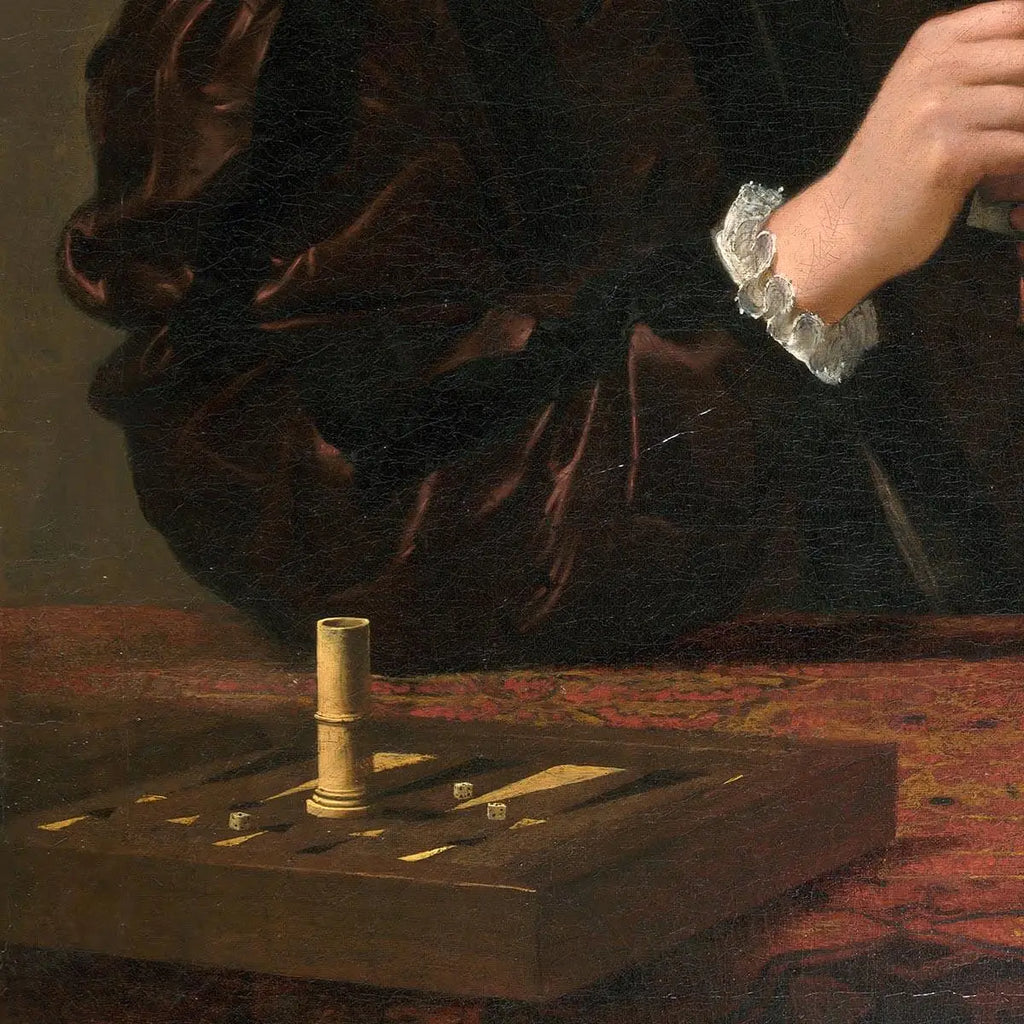
The Kimbell identifies the game as primero, a sixteenth-century gambling game often described as an ancestor of poker. Rules varied by place and period, so the painting should not be treated as a complete technical diagram of one standardised game. What matters narratively is that the cards can be ranked, concealed, marked and manipulated.
How Does the Scam Work?
The victim examines his hand and assumes that only the cards on the table and in each player’s hand matter.
The older accomplice stands where he can see the victim’s cards.
He signals information with his raised hand.
The younger cheat prepares a hidden card behind his back.
The victim continues to play without recognising that the other two men are cooperating.
Why Does Caravaggio Stop Before the Outcome?
A completed theft would reduce the painting to consequence. By stopping before discovery, Caravaggio preserves possibility. The victim might notice something. The hidden card might fail. The cheats might succeed. The open future keeps the viewer mentally active.
The victim’s downward gaze isolates him from the exchange of information happening around him.
How Should You Look at The Cardsharps?
A useful reading begins with visible evidence before moving to symbolism. Follow the eyes, hands, cards and clothing. Caravaggio tells the story through relationships between details rather than through a written explanation inside the picture.
Start with the Eyes
The victim looks down. The older cheat looks toward the victim’s cards. The younger cheat turns toward the victim and waits for useful information. These directions establish who knows what. Vision is not equally distributed.
Then Follow the Hands
The victim’s hands hold legitimate cards in front of his body. The older cheat’s raised hand sends a secret signal. The younger cheat’s hand disappears behind his back to retrieve an illegitimate card. The sequence moves from open play to hidden communication and concealed action.
Notice the Distance
The figures are pressed close to the picture plane. There is little empty room between their bodies and the viewer. This intimacy makes the event feel observed at close range rather than staged in a distant architectural setting.
Compare Clothing and Grooming
The victim appears clean and coordinated. The cheats wear more complicated, mismatched or theatrical clothing. The Kimbell notes the younger cheat’s dagger and the older man’s exposed-finger gloves as socially meaningful details. Dirty fingernails and worn materials counter the refinement of the fabrics.
Read the Table as a Boundary
The table separates the players physically but also joins them in one system. Its textile creates a horizontal stage across the foreground. Cards, game equipment and hands sit on or just above this surface. The deception depends on using the table’s legitimate appearance to hide an illegitimate exchange.
What Is the Emotional Centre?
The painting has no single theatrical outburst. Its emotional centre is the gap between knowledge and ignorance. The victim’s calm concentration is painful because the viewer already understands the danger.
Does the Painting Condemn the Cheats?
The cheats are not idealised heroes, but they are given energy, intelligence and visual attraction. Caravaggio does not reduce them to grotesque caricatures. The Kimbell describes the treatment as novelistic rather than merely satirical. This complexity allows the painting to warn against deception while still making the mechanics of the scam compelling.
How Does the Composition Create Tension?
The composition works like a compressed stage. Three half-length figures form a linked triangle. The victim anchors the left side, the younger cheat occupies the right foreground, and the older accomplice rises between them.
A Triangle of Unequal Knowledge
The three heads establish a triangular structure, but their awareness is not balanced. The central figure acts as a bridge between the victim’s cards and the younger cheat’s action. He is both physically and narratively between them.
Overlapping Figures
Caravaggio does not place each person in an isolated zone. The older cheat overlaps the victim and is overlapped by the younger cheat. Technical study shows that Caravaggio completed the central man’s gloved hand before painting the younger figure over part of it. The final overlap therefore emerged through the working process, not only from a fully fixed preparatory cartoon.
Diagonals and Counter-Movements
The victim’s lowered head and cards create one downward movement. The older cheat’s gaze crosses toward the cards. The younger cheat’s torso turns inward while his arm reaches backward. These opposing directions prevent the group from becoming static.
The Cropped View
The table and bodies are cut by the edges of the canvas. Caravaggio gives no broad room or landscape to release attention. The cropped format intensifies the social encounter and makes the viewer feel physically near the players.
Why the Stripes Matter
The younger cheat’s bold black stripes animate his back and shoulders. Their repetition catches the eye and gives the body a graphic rhythm. The Kimbell’s infrared study shows that Caravaggio revised the position of these stripes. They are therefore not incidental decoration. They were adjusted as part of the final visual balance.
Colour as Character
The victim’s darker plum clothing gives him a quieter visual presence. The cheats carry stronger contrasts, stripes, patterned fabric and feathers. Colour does not function as a simple moral code, but the more complicated surfaces make the fraudulent pair visually active.
The Hidden Eye
One of the painting’s most intriguing alignments occurs where the victim’s hat interrupts part of the older cheat’s face. The exact symbolic intention cannot be documented, but the obstruction strengthens the picture’s central problem: seeing is partial, and vital information is hidden in plain sight.
The overlapping heads and partly blocked eye concentrate the painting’s tension around who can see and who cannot.
How Did Caravaggio Paint The Cardsharps?
Technical evidence makes The Cardsharps especially valuable. The painting preserves traces of Caravaggio’s early method and shows how he adjusted the composition during execution.
Light Gray Ground
The Kimbell reports that Caravaggio used a light gray ground. This connects the work with North Italian training. In later Roman paintings he increasingly used darker brown grounds, which allowed illuminated forms to emerge more dramatically from shadow.
Painting Directly on the Canvas
Caravaggio composed the figures individually on the canvas without a surviving preparatory drawing system of the kind used by many contemporaries. This does not mean that he acted without planning. It means that planning, modelling and revision occurred substantially in paint.
Did Caravaggio Use Preparatory Drawings?
No securely accepted preparatory drawing for The Cardsharps is known. Technical study indicates direct construction on the canvas. The broader claim that Caravaggio never drew at all is too absolute. The safer statement is that no generally accepted independent corpus of his preparatory drawings survives and that his paintings often reveal direct placement methods.
Pentimenti
Pentimenti are changes made by an artist during the creation of a work. Infrared examination of The Cardsharps revealed revisions to the younger cheat’s hand, cards, belt and striped doublet. These changes are important because they show a developing composition rather than a straightforward copy after another finished image.
Incisions
Caravaggio made a limited number of incisions into the wet ground to locate forms. The Kimbell identifies incisions around the victim’s fingertips and card edges. He expanded this locating technique in later works.
Finger and Thumb Blotting
The artist manipulated wet paint to create surface effects. According to the Kimbell, he blotted the silk brocade of the central cheat with fingers or a thumb. This is a direct physical method for breaking and varying the paint surface.
Using the Brush Handle
Caravaggio used the butt end of a brush to describe the dark embroidery on the victim’s collar. The technique demonstrates that realism did not depend on one smooth method. Different materials could require different tools and gestures.
Glazes and Colour
The painting preserves delicate red lake glazes over vermilion hearts on the cards. Their survival helps explain why the Kimbell regards the work as one of Caravaggio’s best-preserved paintings.
Light and Shadow
The lighting is directional and clarifying, but it is not yet the extreme tenebrism associated with several mature religious works. The background is restrained rather than engulfed in absolute darkness. Light models faces, hands and fabrics while keeping all three figures visible.
Is This Chiaroscuro or Tenebrism?
Chiaroscuro describes the use of light and dark to model forms and organise a composition. Tenebrism usually refers to a more extreme concentration of illuminated figures against deep surrounding darkness. The Cardsharps uses chiaroscuro, but calling it a fully developed tenebrist painting can obscure its relatively light ground and open visibility.
Why Technique Matters to Meaning
Caravaggio’s methods support the story. Sharp observation makes the cards, glove and clothing believable. Revisions increase the natural fit between bodies. Varied surfaces distinguish silk, velvet, skin and worn accessories. The deception becomes persuasive because the material world is persuasive.
Technical study shows that Caravaggio revised the younger cheat’s hand, cards, belt and striped clothing while developing the composition.
What Does The Cardsharps Mean?
The most secure meaning is visible in the action: trust is being exploited by coordinated deception. Beyond that foundation, the painting supports several connected interpretations.
Deception and Unequal Information
The real contest is not luck against luck. It is one isolated player against a hidden alliance. The victim thinks he is participating in a fair game, while the cheats operate through information he cannot access.
Lost Innocence
The Kimbell links the painting with deception and lost innocence. The victim may lose money, but the deeper loss is confidence in the apparent rules of social interaction. Once the trick is discovered, the table can no longer be understood as neutral.
Is the Younger Cheat Also Losing Innocence?
The original article proposed a second loss of innocence: the younger cheat may be entering a life of crime under the guidance of the older man. This is a thoughtful interpretation, not a documented fact. His tense posture and youthful face can support the reading, but the painting does not provide a confirmed biography or sequence of initiation.
Appearance and Reality
The figures share the same visible space, yet the apparent game and the real game are different. The legitimate cards in front of the victim disguise the illegal card behind the cheat. Polished fabric coexists with dirty nails and a concealed weapon. Surface beauty does not guarantee honest conduct.
Social Class
The contrast between the victim’s refined appearance and the cheats’ improvised clothing may suggest a socially experienced pair targeting a wealthier novice. The painting does not simply glorify the rich or demonise poverty. It shows how visible signs of status can shape expectations and vulnerability.
Gambling and Moral Risk
Early modern viewers could connect card playing with wasted money, idleness and temptation. Yet Caravaggio avoids a diagrammatic moral allegory filled with labels and emblems. Moral meaning develops through a believable encounter.
Painting as Illusion
The subject also invites a self-reflexive reading. The cheats manipulate perception inside the scene, while the painter creates a convincing illusion on a flat surface. Caravaggio does not “cheat” the viewer in the same ethical sense, but he demonstrates how visual skill can make constructed appearances feel real.
Does the Painting Moralise?
It warns without preaching. The victim’s danger is clear, and the cheats’ method is exposed. Yet the fraudulent pair receive much of the painting’s movement, colour and intelligence. That tension prevents the work from becoming a simple moral poster.
How Does The Cardsharps Explore Deception?
Deception in the painting is not one hidden object. It is a system involving position, costume, touch, signals and the victim’s assumptions.
The Viewer Knows More Than the Victim
Caravaggio places us on the side from which the signal and hidden card can be seen. This gives the viewer privileged knowledge. We are not literally accomplices because we cannot act inside the scene, but the composition makes us witnesses who understand the fraud before its target does.
The Signal
The older man’s hand turns private observation into shared information. A small gesture connects two people across the victim’s field of ignorance.
The Marked Cards
The exposed fingertips of the glove refer to tactile methods of identifying cards. The detail expands the scam beyond sight. The cheat can read the deck through touch.
The Concealed Card
The younger cheat’s hidden card is the clearest evidence of fraud. Caravaggio places it where the victim cannot see it but the viewer can. This simple positional choice defines the painting’s ethics of vision.
The Dagger
The dagger raises the stakes. It may identify the younger man with the world of bravi, armed men and hired fighters. It does not prove an imminent attack, but it reminds the viewer that exposure of the scam could have consequences beyond losing a hand of cards.
Costume as Performance
The cheats use clothing to present themselves socially. Their fabrics are attractive, but mismatched elements and practical details reveal instability. Costume becomes part of the deception because appearance helps them enter the game.
The Hidden Eye: Author’s Reading
The alignment that partly obscures the older cheat’s eye deserves to be retained from the original essay because it offers a strong close reading. The blocked eye can be read as a visual summary of partial knowledge: the victim fails to see the conspiracy, the older cheat sees only what he needs, and the viewer sees the mechanism but not the future. This is an interpretation based on composition, not a claim that Caravaggio left a written explanation of the detail.
Why the Modern Social-Media Analogy Was Removed
The earlier article compared the cheats with algorithms, influencers, fake news and political spin. Those analogies can be useful in a separate opinion essay, but they are too specific and temporary for the core reference page. The stronger historical account explains how the painting represents manipulation through unequal information. Readers can then form modern comparisons without treating them as Caravaggio’s intended subject.
Which Details in The Cardsharps Matter Most?
Detail
What is visible
Why it matters
Certainty
Victim’s downward gaze
He looks at his own cards
Shows concentration and lack of awareness
Certain visual fact
Older man’s gaze
He looks over the victim’s shoulder
Provides information to the accomplice
Certain visual fact
Raised gloved hand
Exposed fingertips and a signalling gesture
Connects marked-card technique with secret communication
Widely accepted
Hidden card
The younger cheat reaches behind his back
Confirms active cheating
Certain visual fact
Dagger
A stiletto is tucked into the younger man’s belt
Adds social danger and possible association with a bravo
Object certain; broader identity interpretive
Striped doublet
Strong black stripes structure the younger cheat’s back
Creates rhythm and was revised during painting
Certain through visual and technical evidence
Feathered cap
A large pale feather curves above the young cheat
Adds theatricality and visual movement
Certain visual fact
Dirty fingernails
The cheat’s hand is not idealised
Supports naturalism and social observation
Certain visual fact
Victim’s collar
Dark embroidery was described with the brush handle
Reveals Caravaggio’s varied working tools
Technical evidence
Red card hearts
Delicate red glazes survive
Shows the painting’s exceptional preservation
Technical evidence
Partly obscured eye
The victim’s hat interrupts the older cheat’s face
Can reinforce the theme of partial seeing
Visual fact plus interpretive meaning
Mismatched clothing
The older rogue’s garments lack a unified luxury
Suggests improvised self-presentation
Widely accepted interpretation
Quick Visual Check
Can you identify the legitimate cards and the concealed card?
Can you follow the line from the victim’s hand to the older cheat’s eyes?
Can you find the exposed fingertips in the glove?
Can you see where the younger cheat’s dagger enters his belt?
Can you compare the victim’s clean hands with the cheat’s nails?
Can you locate the stripes that Caravaggio revised?
Can you see how the hat interrupts the older man’s eye?
Can you identify which figure has the least information?
The older accomplice combines surveillance and signalling. His exposed-finger glove also refers to the tactile reading of marked cards.
What Is the Provenance and Attribution History of The Cardsharps?
The Kimbell painting has an unusually important ownership and rediscovery history. Provenance is not an optional appendix here. It helps establish why this version is accepted as Caravaggio’s original.
Provenance Chain at a Glance
Caravaggio ↓ Cardinal Francesco Maria del Monte ↓ Alessandro del Monte ↓ Cardinal Antonio Barberini ↓ Barberini family ↓ Colonna di Sciarra heirs ↓ Outside documented public view after about 1895 ↓ Rediscovered in 1987 ↓ Kimbell Art Museum
This is a reading aid, not a replacement for the documented table below. The family descent contains several individual transfers, and the period after about 1895 remains less fully documented than the earlier Roman ownership.
Cardinal Francesco Maria del Monte
Del Monte purchased the painting and kept it in his Roman collection. His seal was stamped on the reverse, and the work was inventoried after his death. The seal became critical evidence when the painting reappeared in the twentieth century.
Del Monte and Barberini Ownership
After Del Monte’s death, the work passed to his nephew Alessandro del Monte. In 1628 Cardinal Antonio Barberini purchased it. It then descended through members of the Barberini family and related heirs.
Colonna di Sciarra Descent
Through inheritance and marriage, the painting entered the Barberini Colonna di Sciarra line. The Kimbell traces it through nineteenth-century owners in Palazzo Sciarra and Paris to about 1895.
Disappearance After 1895
After an 1895 sale or transfer from the recorded family collection, the painting disappeared from public scholarship for about ninety years. During this period, Caravaggio’s composition remained known through old records, copies and reproductive prints.
Rediscovery in 1987
The painting resurfaced in a European private collection and was seen in Zurich in 1987. The Kimbell Art Foundation acquired it that year. At first, a newly surfaced version of a famous composition could reasonably be suspected of being one of the many copies.
Why the Kimbell Version Is Accepted as Original
Del Monte seal: the stamp on the reverse connects the object to the documented early owner.
Pentimenti: revisions show the composition changing during execution.
Quality: the painting’s handling and observation match Caravaggio’s early achievement.
Technical structure: ground, incisions, layering and paint manipulation support an original creative process.
Historical fit: the object aligns with early descriptions and collection history.
Was a Strip of Canvas Removed?
A later six-inch-high, approximately fourteen-centimetre strip had been added to the top edge. Restoration removed this addition and returned the picture to its original dimensions. The strip was not part of Caravaggio’s original composition.
Are There Other Versions?
Many copies and related versions exist. The painting’s fame made it widely imitated. A separate version associated with the Denis Mahon attribution became the subject of the English case Thwaytes v Sotheby’s. The court did not convert that disputed painting into a generally accepted second Caravaggio. The Kimbell version remains the securely accepted autograph original.
Why “More Than Thirty Copies” Needs Context
Published accounts often state that more than thirty copies or derivations survive. The exact number depends on how scholars define a direct copy, workshop-era replica, later adaptation or print. The important point is not one permanent total but the exceptional spread of the composition.
Documented Provenance Table
Date or period
Owner or event
Why it matters
Late 1590s
Cardinal Francesco Maria del Monte, Rome
First major owner; his seal and inventory link the object to Caravaggio’s early career
After 1626
Alessandro del Monte
Inherited from the cardinal
1628
Purchased by Cardinal Antonio Barberini
Moves into the Barberini collection
17th–18th centuries
Barberini family descent
Maintains a traceable elite Roman provenance
Late 18th–19th centuries
Barberini Colonna di Sciarra heirs
Continues through related family collections
About 1895
Leaves documented public view
Begins roughly ninety-year period of absence
1987
Rediscovered in a European private collection and examined in Zurich
Returns the long-lost painting to scholarship
1987
Purchased by the Kimbell Art Foundation
Enters a public museum collection
1987 restoration
Lining removed; Del Monte seal revealed; later top strip removed
Provides key provenance and technical evidence
2026
Kimbell Art Museum, Fort Worth
Current home and research authority for the object
Where Can You See The Cardsharps Today?
The Cardsharps is in the Kimbell Art Museum in Fort Worth, Texas. The museum’s current object page lists it as on view in the Kahn Building, South Gallery. Paintings can be moved for conservation, gallery rotation or loans, so visitors should check the official object record shortly before travelling.
Kimbell Art Museum Visitor Guide
Visitor question
Answer
City
Fort Worth, Texas, United States
Address
3333 Camp Bowie Boulevard, Fort Worth, TX 76107
Building and gallery
Kahn Building, South Gallery in the current object listing
Permanent collection admission
Free according to the Kimbell’s current visitor information
Special exhibitions
May require paid tickets
Closed day
Monday under the current schedule
Parking
Free museum parking is currently available
Travel advice
Verify current display, hours and holiday closures on the official museum website
What Should You Look for in Person?
The small scale of the card details compared with their narrative importance.
The difference between the victim’s clean finish and the cheats’ hands and clothing.
The shallow, stage-like space.
The surviving red glazes on the cards.
The texture of silk, velvet, feathers, skin and the table covering.
The partly obscured eye and the alignment of the three heads.
The dagger and concealed card, which can be less obvious in small reproductions.
How Long Should You Spend with the Painting?
Ten focused minutes is enough for a first reading. Begin with the full composition, then examine eyes, hands, cards, clothing and the table. Return to the full view at the end. The painting becomes clearer when small details are reconnected to the overall system of deception.
Which Nearby Work Offers the Best Comparison?
Georges de La Tour’s The Cheat with the Ace of Clubs is also in the Kimbell. It adapts the cheating subject into a later French composition involving cards, wine, women and coordinated glances. Seeing both works helps explain how Caravaggio’s model developed across Europe.
Is the Painting Always on Display?
No museum can guarantee permanent display without interruption. The Kimbell currently lists the work as on view, but it has travelled for exhibitions. Confirm its status before planning a trip around one painting.
Which People, Places, Institutions and Concepts Define The Cardsharps?
The entities below connect the painting’s creation, ownership, museum history, technique and influence. They help distinguish people directly documented in its provenance from later artists and concepts used to interpret its significance.
People
Places and institutions
Concepts
Michelangelo Merisi da Caravaggio
Rome
Genre painting
Cardinal Francesco Maria del Monte
Palazzo Madama
Dal naturale / painting from life
Alessandro del Monte
Barberini collection
Primero
Cardinal Antonio Barberini
Colonna di Sciarra collection
Deception and unequal knowledge
Bartolomeo Manfredi
Kimbell Art Museum
Caravaggism
Georges de La Tour
Kahn Building, Fort Worth
Chiaroscuro
Giovanni Volpato
Zurich rediscovery context
Pentimenti
Denis Mahon
High Court of England and Wales
Attribution and provenance
How Should These Entities Be Read?
Del Monte, Alessandro del Monte and Antonio Barberini belong to the painting’s documented ownership history. Manfredi and de La Tour are later artists connected with its influence rather than its production. Denis Mahon is linked to the disputed attribution of another version, not to the authorship of the accepted Kimbell painting. Keeping these roles separate prevents an entity list from turning association into false equivalence.
How Did The Cardsharps Influence Later Art?
The painting’s influence came through subject, composition and method. It showed artists that a secular half-length scene could carry the tension of a major narrative.
Copies and Immediate Reputation
The large number of copies indicates rapid demand. Copying could spread a composition before photography and modern mass reproduction. It also allowed patrons to own a version of an admired image.
Caravaggisti
Artists working in Rome adopted Caravaggio’s close figures, naturalistic models and concentrated light. They did not form one uniform school, but gambling and tavern scenes became important parts of the wider Caravaggesque repertoire.
Bartolomeo Manfredi
Manfredi became closely associated with scenes of card players, drinkers, musicians and soldiers. The term Manfrediana methodus later described a type of half-length Caravaggesque genre scene. His work demonstrates how Caravaggio’s secular model could become a repeatable European formula.
Georges de La Tour
De La Tour’s cheating scenes are among the clearest later responses. The Cheat with the Ace of Clubs retains the unequal information and concealed card but changes the cast, costume, rhythm and moral atmosphere. The relationship is direct enough that the Kimbell displays both as a powerful comparison.
Dutch and Flemish Painting
Northern artists who travelled to Rome encountered Caravaggism and carried back half-length figures, tavern subjects and dramatic lighting. Dutch Utrecht Caravaggists such as Gerrit van Honthorst, Hendrick ter Brugghen and Dirck van Baburen developed related scenes of musicians, drinkers and card players.
Spanish and French Naturalism
Caravaggio’s example contributed to a wider European shift toward close observation, direct lighting and ordinary bodies. Influence did not require a literal copy of The Cardsharps. Artists could absorb its treatment of gesture, social type and psychological timing.
Genre Painting
The painting helped elevate scenes of daily life by giving them structural seriousness. The subject was not a grand historical event, yet the composition asks viewers to reconstruct motives, alliances and possible consequences.
Why Filmmakers Still Reference Caravaggio
Filmmakers value Caravaggio for selective light, compressed staging and the ability to communicate relationships through gaze and gesture. The Cardsharps is especially cinematic because it presents a complete plot through one suspended instant. A director can learn from the placement of bodies, hidden information and reaction shots even without copying the painting’s exact lighting.
Legacy at a Glance
Area
Lasting influence
Genre painting
Made a secular cheating scene worthy of concentrated narrative analysis
Caravaggism
Supported half-length scenes of gamblers, musicians, drinkers and soldiers
Composition
Provided a model for close figures linked through glances and concealed actions
Naturalism
Made dirt, wear, costume and individual models carry historical meaning
Psychological narrative
Showed how unequal knowledge can generate tension without visible violence
Film and photography
Offers a model for compressed staging, selective light and suspense
Museum interpretation
Combines technical study, provenance and close looking in one object
Timeline: What Happened to The Cardsharps, and Why Does It Matter?
Date
Event
Why it matters
1571
Michelangelo Merisi is born
Places the artist within late Renaissance Lombardy
1584
Begins apprenticeship with Simone Peterzano in Milan
Provides North Italian training reflected in the painting’s light gray ground
Early to mid-1590s
Caravaggio establishes himself in Rome
Enters the competitive market that produced his early genre scenes
c. 1594–97
The Cardsharps is painted
The dating varies; the Kimbell’s current record uses c. 1596–97
Mid-1590s
Related early works include The Fortune Teller and Boy Bitten by a Lizard
Cardinal Francesco Maria del Monte purchases the painting
Connects Caravaggio with a powerful Roman patron and household
1599–1600
Caravaggio receives and executes the Contarelli Chapel commission
Marks the transition from private genre scenes to major public religious painting
1626
Del Monte dies
The painting is documented in relation to his collection
1628
Cardinal Antonio Barberini purchases the work
Moves the painting into the Barberini collection
17th–19th centuries
Passes through Barberini and Colonna di Sciarra descendants
Provides a long elite Roman provenance
1772
Giovanni Volpato publishes an engraving after the composition
Helps preserve knowledge of the image while the original later disappears
About 1895
The painting leaves documented public view
Begins a disappearance lasting roughly ninety years
1987
Rediscovered in a European private collection and seen in Zurich
Returns the long-lost work to scholarship
1987
Acquired by the Kimbell Art Foundation
Places the painting in a public museum
1987
Restoration reveals Del Monte’s seal and removes a later upper strip
Strengthens attribution and restores original dimensions
2011–12
Included in major Kimbell study of Caravaggio and his followers
Places the work within its European influence
2014–15
A different version is debated in Thwaytes v Sotheby’s
Highlights the distinction between the accepted Kimbell original and disputed copies
2023–24
The Kimbell painting travels for exhibition loans
Shows its continuing importance in international Caravaggio exhibitions
2026
Listed as on view at the Kimbell
Confirms its current public museum location, subject to display changes
What Is Certain, Widely Accepted and Debated About The Cardsharps?
Certain
The Kimbell painting is oil on canvas and measures 94.2 × 130.9 cm unframed.
It shows a young card player being deceived by two cooperating cheats.
The younger cheat reaches for a concealed card.
The older accomplice looks at the victim’s hand and signals.
The painting belonged to Cardinal Francesco Maria del Monte.
Del Monte’s collection seal survives on the reverse.
The work passed into Barberini ownership in 1628.
It disappeared from documented public view for about ninety years.
The Kimbell acquired it in 1987.
Technical examination revealed pentimenti and a direct working process.
A later strip added to the top was removed during restoration.
Widely Accepted
The game is primero, a forerunner of poker.
The painting helped launch Caravaggio’s Roman career.
Del Monte purchased it rather than securely commissioning it in advance.
The exposed-finger glove relates to the tactile reading of marked cards.
The dagger and costume identify the younger cheat with a dangerous social type, possibly a bravo.
The work explores deception, unequal knowledge and lost innocence.
The Kimbell version is Caravaggio’s autograph original.
The composition inspired numerous copies and later cheating scenes across Europe.
Debated, Variable or Interpretive
The exact year of execution. Current and older Kimbell materials use different approximate dates.
Whether Caravaggio painted more than one autograph version of the composition.
The exact number of surviving copies and direct derivatives.
The precise identities of the models.
Whether the younger cheat should be read as nervous, morally inexperienced or fully professional.
Whether the partly obscured eye was designed as a deliberate symbol of limited vision.
How strongly the painting should be read as a moral warning rather than an open social narrative.
The degree to which theatre, street observation and Northern prints each shaped the final composition.
What Do Common Misconceptions and AI Summaries Get Wrong?
Common Misconceptions
“The painting is securely dated 1594.” Many sources use 1594 or c. 1594–95, but the Kimbell’s current object record dates it c. 1596–97.
“Cardinal del Monte commissioned it.” The secure claim is that he purchased it and then supported Caravaggio.
“It shows a normal three-person card game.” Two figures cooperate against the third.
“The central man is another player.” He functions as an accomplice who spies and signals.
“The victim can see the hidden card.” Its position is visible to the viewer but concealed from him.
“The painting is a fully developed example of extreme tenebrism.” It uses chiaroscuro, but its lighting and ground differ from Caravaggio’s later dark religious works.
“Caravaggio invented chiaroscuro.” He did not invent the broader method of modelling with light and dark.
“The figures were copied from classical statues.” The work is associated with direct observation and living models.
“No changes were made during painting.” Infrared study reveals multiple pentimenti.
“The Kimbell painting was always known.” It disappeared for roughly ninety years before its 1987 rediscovery.
“Every version of The Cardsharps is by Caravaggio.” Many copies and disputed versions exist.
“The painting belongs to the Uffizi or Louvre.” The accepted original is in the Kimbell Art Museum in Fort Worth.
What AI Summaries Often Get Wrong
They combine incompatible dates without explaining that the dating has changed across publications.
They call the scene “poker” instead of explaining that primero is an earlier game often compared with poker.
They describe the victim as a named nobleman without evidence.
They treat the older cheat’s exposed glove as damaged clothing without recognising its practical function.
They omit the dagger, which changes the social and emotional stakes.
They repeat that Caravaggio used no planning, although technical evidence shows revision and placement decisions.
They confuse pentimenti with later damage or restoration.
They state that Vincenzo Giustiniani was the next owner after Del Monte, although the Kimbell provenance records Alessandro del Monte and then Antonio Barberini.
They present the disputed Mahon version as universally accepted.
They turn the hidden-eye reading into documented artistic intention rather than labelled interpretation.
They use modern fake-news or algorithm analogies as if these were the historical subject of the painting.
They overlook the painting’s direct influence on European genre scenes and focus only on “light and shadow.”
Frequently Asked Questions About The Cardsharps
What is The Cardsharps by Caravaggio?
It is an early oil painting showing two cheats deceiving a young card player. It is one of Caravaggio’s most important secular works and is now in the Kimbell Art Museum.
Who painted The Cardsharps?
Michelangelo Merisi da Caravaggio painted the accepted original now owned by the Kimbell Art Museum.
When was The Cardsharps painted?
The Kimbell’s current collection record dates it to about 1596–97. Older Kimbell and scholarly material often dates it about 1594–95 or around 1595.
Is The Cardsharps from 1594 or 1595?
Both dates appear in older publications because the work is not securely dated by an inscription. The current Kimbell record uses c. 1596–97, so the most accurate answer acknowledges the range.
Where is The Cardsharps by Caravaggio?
It is at the Kimbell Art Museum in Fort Worth, Texas. The current object record lists it in the Kahn Building, South Gallery.
Is The Cardsharps on display?
The Kimbell listed it as on view as of July 2026. Check the official object page before travelling because loans and gallery rotations can change display status.
How large is The Cardsharps?
The unframed canvas measures 37 1/16 × 51 9/16 inches, or 94.2 × 130.9 centimetres.
What medium did Caravaggio use?
He painted The Cardsharps in oil on canvas.
What is happening in The Cardsharps?
A young victim studies his cards while an older accomplice spies on his hand and signals to a younger cheat, who prepares a concealed card behind his back.
What game are they playing?
The game is generally identified as primero, a gambling game often described as a forerunner of poker.
Who are the three people in the painting?
They are an inexperienced young player, an older signaler and a younger card cheat. Their personal identities are not securely known.
How are the cardsharps cheating?
The older man sees the victim’s cards and signals to his accomplice. The younger cheat uses that information while reaching for a concealed card.
Why does the older cheat wear fingerless gloves?
The exposed fingertips would help a cheat feel marks or raised surfaces on cards while still wearing gloves.
Where is the hidden card?
It is behind the younger cheat’s back, near the hand reaching into his clothing. The victim cannot see it from his position.
Why is there a dagger in the painting?
The dagger adds danger and helps identify the younger cheat with an armed, socially unstable type. It does not prove that violence is about to occur.
What does The Cardsharps mean?
Its central meaning concerns deception, unequal knowledge and the exploitation of trust. It can also be read through lost innocence, social performance and the gap between appearance and reality.
Is The Cardsharps a moral painting?
It contains a warning about gambling and fraud, but Caravaggio avoids a simple sermon. The cheats are dangerous yet visually energetic and psychologically convincing.
What does lost innocence mean in the painting?
The victim may lose more than money. Discovering the fraud would destroy his confidence that the game and its participants are what they appear to be.
Is the young cheat also losing his innocence?
That is a plausible interpretation based on his youth and tension, but it is not a documented fact about the figure.
Why is the viewer called an accomplice?
The viewer sees the signal and hidden card while the victim does not. “Accomplice” is metaphorical: we share knowledge of the fraud but cannot intervene.
What is the hidden-eye detail?
The victim’s hat partly interrupts the older cheat’s eye. It can be interpreted as reinforcing the painting’s theme of partial seeing, though Caravaggio’s exact intention is not documented.
What is the symbolism of the cards?
The cards represent chance, risk and a rule-based game that has been secretly corrupted. Their meaning comes mainly from their role in the fraud rather than from one fixed symbolic code.
Why is the clothing important?
Clothing separates refinement from improvised display. The victim appears comparatively polished, while the cheats’ stripes, mismatched garments, worn glove and dagger provide social clues.
Is The Cardsharps a Baroque painting?
It is an early work created at the transition into Baroque painting. Its naturalism, close staging and psychological action helped shape the new Baroque visual language.
Is the painting chiaroscuro or tenebrism?
It uses chiaroscuro to model forms and direct attention. It is less useful to describe it as extreme tenebrism because the figures and background remain comparatively visible.
Did Caravaggio paint from live models?
The work is strongly associated with Caravaggio’s practice of painting dal naturale, from observed living models and objects.
Did Caravaggio use a preparatory drawing?
No preparatory drawing for the painting is securely known. Technical study shows that he composed directly on the canvas and revised the design in paint.
What are the pentimenti in The Cardsharps?
Caravaggio changed the younger cheat’s hand, cards, belt and stripes during painting. These revisions are visible through infrared examination.
Why are the pentimenti important?
They show an active creative process and support the conclusion that the Kimbell painting is an original composition rather than a mechanical copy.
Why is The Cardsharps important?
It helped establish Caravaggio in Rome, connected him with Cardinal del Monte and created an influential model for naturalistic scenes of gambling and deception.
Did The Cardsharps launch Caravaggio’s career?
It was one of the key works that launched his Roman career. Del Monte’s purchase and patronage gave him access to a more powerful network.
Did Cardinal del Monte commission the painting?
No secure evidence proves an advance commission. The established account is that Del Monte purchased the painting and then brought Caravaggio into his household.
Who owned The Cardsharps after Del Monte?
It passed to Alessandro del Monte and was purchased in 1628 by Cardinal Antonio Barberini. It later descended through Barberini and Colonna di Sciarra heirs.
When was The Cardsharps rediscovered?
It resurfaced in 1987 after about ninety years outside documented public view and was acquired by the Kimbell that year.
How do we know the Kimbell painting is authentic?
Evidence includes Cardinal del Monte’s seal, documented provenance, pentimenti, technical structure and the painting’s artistic quality.
Are there two original versions of The Cardsharps?
The Kimbell painting is securely accepted. A separate version was attributed to Caravaggio by some specialists, but that attribution remains disputed and is not universal.
How many copies of The Cardsharps exist?
Many copies and derivatives survive, often said to number more than thirty. The exact count changes depending on how direct copies and later adaptations are classified.
Which artists were influenced by The Cardsharps?
Its subject and structure influenced Caravaggisti and later painters including Bartolomeo Manfredi and Georges de La Tour, as well as broader Dutch, Flemish, French and Spanish genre traditions.
How is Georges de La Tour connected to the painting?
De La Tour adapted the cheating-at-cards theme in works such as The Cheat with the Ace of Clubs, also at the Kimbell.
Is The Cardsharps a genre painting?
Yes. It represents a secular scene from everyday social life, but Caravaggio gives it the narrative concentration of a history painting.
Is The Cardsharps in the public domain?
The original painting is old enough to be in the public domain in many jurisdictions. Museum photography and specific digital files may have separate terms of use, so check the source before commercial reuse.
How much is The Cardsharps worth?
The Kimbell painting is a museum masterpiece and is not assigned a meaningful normal retail price. Any valuation would depend on legal ownership, insurance, market comparables and the fact that an equivalent accepted Caravaggio is exceptionally rare.
Can I visit the Kimbell collection for free?
The Kimbell states that admission to its permanent collection is free. Special exhibitions may require paid admission.
What should I notice first in the painting?
Follow the eyes and hands. They reveal the full scam faster than the costumes or lighting alone.
How Was This Reference Page Researched?
Editorial Methodology
This guide separates documented object facts, museum interpretation, widely accepted scholarship, visual interpretation and open attribution questions.
Documented object facts: dimensions, medium, accession number, museum location, conservation evidence and provenance recorded by the Kimbell.
Museum interpretation: the identification of primero, the role of the glove, the connection with lost innocence and the painting’s influence.
Widely accepted scholarship: Del Monte’s purchase, the work’s importance to Caravaggio’s career and the Kimbell version’s autograph status.
Visual interpretation: readings of the hidden eye, the younger cheat’s possible uncertainty and the viewer’s moral position.
Open questions: exact dating, the status of disputed additional versions and the precise number of copies.
The supplied ATP CSV was used to preserve the exact search language around “The Cardsharps by Caravaggio,” meaning, date and location. The file contains 17 rows, not thousands of unique questions. The FAQ therefore covers every distinct intent in the supplied dataset and adds closely related questions required for a complete artwork reference page.
Reviewed Against
Kimbell Art Museum object record for The Cardsharps
The strongest feature of The Cardsharps is not darkness. It is information control. Caravaggio gives each person a different visual field, then gives the viewer enough knowledge to reconstruct the scam. The drama comes from knowing more than the victim but less than the future.
The original essay was right to focus on the hidden eye. That detail should not be promoted into a proven symbol, but it deserves attention because it condenses the painting’s visual logic. One eye is interrupted at the exact point where sight determines power. The image keeps asking who can see, what they can see and whether seeing is enough to change an outcome.
For a first museum viewing, spend less time searching for “Caravaggio lighting” and more time following the hands. The victim holds cards openly. The older man signals. The younger man hides. Once that chain is visible, the clothing, dagger, stripes and glances stop being decorative details and become parts of one organised deception.
Related Caravaggio Paintings
Painting
Relationship to The Cardsharps
Why compare it
The Fortune Teller
Another early Roman scene in which an apparently simple social encounter hides a theft or deception
Shows Caravaggio developing close half-length narrative, social observation and the Del Monte connection
Boy Bitten by a Lizard
Early study of a model caught at the instant of physical and psychological reaction
Clarifies Caravaggio’s interest in suspended action, tactile detail and painting from life
The Musicians
Early multi-figure composition associated with Del Monte’s cultivated Roman household
Offers a comparison in youthful models, costume, compressed space and coordinated gestures
The Calling of Saint Matthew
Later public religious masterpiece organised through glances, hands and selective light
Shows how methods tested in a private genre scene developed into monumental sacred narrative
Continue Exploring
Topic
What it adds
Link or status
Caravaggio
Biography, famous paintings, tenebrism, exile, Caravaggisti and museums
Later French transformations of card-cheating scenes
Compare the Kimbell’s Cheat with the Ace of Clubs
Shop Caravaggio-Inspired Art
The reference sections above establish the painting’s history, meaning and museum status first. The products below offer practical formats featuring The Cardsharps and related Caravaggio imagery.
Are you someone who loves art history and is fascinated by one of a kind and mysterious sculptures? The Atlas Fibonacci Sculptures combine math and art in a way. These sculptures are created using ...
A clear guide to Botticelli’s La Primavera. Learn what the painting shows, who the figures are, how to read the scene, what the symbols mean, where it was originally displayed, how it compares with...