The Kiss by Gustav Klimt: Meaning, History, Gold & Symbolism
What Are the Essential Facts About Gustav Klimt's The Kiss?
Direct answer:The Kiss is a large square painting created by Austrian artist Gustav Klimt around 1907–1909. It shows a couple embracing on a narrow flower-covered ground, surrounded by gold, ornamental patterns and a dark, shimmering background. Klimt combined resin-oil colors with gold, silver, platinum and brass-based metal on a 180 × 180 cm primed canvas. The painting was first exhibited unfinished in Vienna in 1908 under the title Lovers, then completed and delivered to the Moderne Galerie in 1909. It is now displayed at the Upper Belvedere in Vienna. The work matters because it brings together intimate human feeling, Symbolist ambiguity, Vienna Secession design and Klimt’s advanced use of precious metal.
Viennese Modernism, Vienna Secession, Symbolism and Jugendstil or Art Nouveau
Creative phase
Klimt’s Golden Period
First public title
Lovers at the Vienna Kunstschau in 1908
Museum
Belvedere, Vienna
Current venue
Upper Belvedere
Inventory number
912
Source note: title, date, dimensions, current museum, inventory number and core material information are reviewed against the Belvedere's official object record and technical research.
What Should You Know About The Kiss in One Minute?
Artist: Gustav Klimt, one of the leading figures of Viennese Modernism and co-founder of the Vienna Secession.
Date: c. 1907–1909. It was shown unfinished at the 1908 Kunstschau and completed before the museum received it in July 1909.
Subject: A man and woman enclosed within a golden, patterned form while standing or kneeling at the edge of a flowered ground.
Materials: Gold leaf, silver leaf, platinum leaf, resin-oil colors and brass-based composition gold on primed canvas.
Meaning: It is widely read as an allegory of love, intimacy and union, but the exact identity of the couple and the balance of power between them remain open to interpretation.
Location: Upper Belvedere, Vienna, Austria.
What Questions Does This Guide Answer?
What is The Kiss?
A 180 × 180 cm painting by Gustav Klimt, created around 1907–1909 and now held by the Belvedere in Vienna.
When was The Kiss created?
Klimt likely began it in 1907, showed it unfinished as Lovers in 1908 and completed it before the museum received it in July 1909.
What is The Kiss made of?
Its complex surface combines resin-oil colors with gold, silver and platinum leaf, brass-based metal, glazes and metal flakes on primed canvas.
What does The Kiss mean?
It is widely read as an allegory of love, intimacy and union, while the lovers' identities and the exact meaning of individual symbols remain debated.
Where is The Kiss today?
The original is displayed at the Upper Belvedere in Vienna and carries Belvedere inventory number 912.
Who painted The Kiss?
Gustav Klimt (1862–1918), a leading figure of Viennese Modernism and co-founder of the Vienna Secession.
Who are the lovers?
Their identities are not documented. A connection with Klimt and Emilie Flöge is often proposed but remains unproven.
Why is The Kiss important?
It is a defining work of Klimt's Golden Period, combining precious metal, flat ornament, naturalistic skin and an emotionally direct subject.
What Is The Kiss by Gustav Klimt?
Quick answer:The Kiss is a monumental Symbolist painting in which Gustav Klimt turned an intimate embrace into a richly ornamented, almost timeless scene. The couple’s naturalistically painted faces, hands and feet emerge from a large golden form covered with geometric and floral patterns.
The work is not a straightforward portrait of two documented people. It is better understood as a poetic image of lovers placed outside normal space and time. The dark background does not describe a room, landscape or recognizable location. The flowered ground is narrow and ends abruptly. Gold surrounds the figures like an atmosphere, garment and halo at the same time.
This combination makes the painting immediately readable and difficult to fully explain. Viewers can recognize tenderness, touch and closeness, yet the painting withholds a clear story. Klimt did not leave a definitive statement explaining the couple, their identities or the precise meaning of every pattern. That openness is central to the work’s lasting power.
For a dedicated artwork-first companion page that connects the painting's identity, context and related formats, explore The Kiss at GustavKlimt.art.
Quick answer: You can recognize The Kiss by its square format, central embracing couple, large golden enclosure, contrasting geometric and floral patterns, and narrow flowered ground against a dark metal-speckled background.
Square composition: The original canvas measures 180 × 180 cm.
Central embrace: A man bends toward a kneeling woman and kisses or approaches her cheek.
Two pattern systems: Rectangles and darker blocks dominate the man’s robe, while rounded and floral forms dominate the woman’s dress.
Shared field of gold: The bodies are largely absorbed into one reflective ornamental shape.
Flowered edge: The couple kneels on a narrow meadow that ends abruptly against a dark, shimmering background.
These features make the painting recognizable even when it is reproduced at a small size. They also explain why cropped or adapted products can still look familiar, although only a full square reproduction preserves the complete relationship between the couple, meadow and surrounding space.
Why Is The Kiss Important?
Quick answer:The Kiss is important because it is one of the clearest examples of Gustav Klimt (1862–1918) combining painting, precious metal, pattern and human emotion into one modern visual language.
The painting matters on several levels. It is a major work of Viennese Modernism, a high point of Klimt’s Golden Period and one of the most recognizable works associated with the Vienna Secession. It also challenges the traditional division between fine art and decorative art. The surface is not merely painted to imitate light, cloth or space. Real metal becomes part of the image.
Its historical reception adds to its importance. The painting attracted institutional interest while it was still unfinished, was acquired at an exceptionally high price for a living Viennese artist and soon became one of the defining works of the collection now known as the Belvedere.
Who Was Gustav Klimt?
Gustav Klimt was born in 1862 and died in Vienna in 1918. He trained at the Vienna School of Applied Arts and began his career producing technically accomplished decorative and architectural paintings. His early work followed established academic and historicist conventions, but his style changed sharply during the 1890s.
Klimt became a co-founder and the first president of the Vienna Secession. He helped promote a modern approach in which painting, architecture, interiors, graphic design and applied arts could work together rather than being ranked in a strict hierarchy. His mature work is known for its treatment of the human body, decorative pattern, erotic ambiguity, gold surfaces and tension between naturalistic detail and flat design.
For a broader overview of his life, artistic development, Vienna Secession role, Golden Period, major works and legacy, see our dedicated About Gustav Klimt guide on GustavKlimt.art.
What Was Klimt’s Golden Period?
Definition: Klimt’s Golden Period was the phase, broadly dated from about 1901 to 1909, in which he made precious metal a central structural and expressive part of several major paintings.
Gold did not appear in exactly the same way in every work. In Judith I, completed in 1901, Klimt began combining gold leaf and oil paint in an unusually direct and experimental manner. Later works such as Portrait of Adele Bloch-Bauer I and The Kiss pushed the relationship between body, ornament and metal much further.
The Kiss is often described as both the high point and the closing achievement of this phase. It gathers many of Klimt’s concerns into one work: precious materials, abstract pattern, a suspended dreamlike space, naturalistically painted skin and a subject concerned with love and human connection.
What Was the Vienna Secession?
Definition: The Vienna Secession was an artists’ association founded in 1897 by Gustav Klimt and other artists and architects who separated from the conservative Künstlerhaus and sought greater freedom for modern art.
Klimt became the group’s first president. Other founding figures included Kolo Moser, Carl Moll, Josef Hoffmann and Joseph Maria Olbrich. The Secession did not represent one single visual formula. It created a platform for new work, international exchange and a closer relationship between art, architecture and design.
Klimt’s 1902 Beethoven Frieze demonstrates the Secessionist ideal of a Gesamtkunstwerk, or total work of art, in which architecture, wall painting, sculpture and exhibition design form one experience. This context helps explain why the ornamental surface of The Kiss should not be dismissed as decoration added to a conventional painting. Pattern is part of its meaning and structure. Our Beethoven Frieze guide explores how Klimt’s art continued to influence design and clothing.
What Style and Art Movement Does The Kiss Belong To?
The Kiss is most accurately understood through overlapping labels rather than one exclusive category.
On smaller screens, swipe horizontally to view the full table.
Art movements and terms connected with The Kiss
Term
How it applies
What it does not mean
Vienna Secession
Places the work within Klimt’s modern Viennese artistic network and rejection of conservative exhibition culture.
It is not a fixed style shared identically by every Secession member.
Symbolism
Explains the dreamlike setting, emotional subject and use of visual forms that suggest ideas beyond literal description.
It does not provide one universally agreed symbolic code.
Jugendstil or Art Nouveau
Describes the decorative line, stylized organic forms and close relationship between art and design.
Vienna Secession and Art Nouveau are related but not exact synonyms.
Viennese Modernism
Places Klimt within the broader cultural transformation of Vienna around 1900.
It is wider than painting and includes architecture, design, literature, music and thought.
Golden Period
Identifies the creative phase in which Klimt used gold and other metals as major pictorial elements.
It is a phase of Klimt’s career, not a separate international art movement.
When and How Was The Kiss Created?
Quick answer: Klimt likely began The Kiss around 1907, exhibited it unfinished as Lovers at the Vienna Kunstschau in June 1908, agreed to its state purchase in July 1908 and completed the work before the Moderne Galerie formally received it on 22 July 1909.
Creation history at a glance
c. 1907: Klimt likely begins the large square composition.
1 June 1908: the unfinished painting is shown publicly at the Vienna Kunstschau under the title Lovers.
10 July 1908: the Moderne Galerie committee decides to acquire the still-unfinished work for 25,000 crowns.
22 July 1909: after further revisions, the completed painting is formally received by the Moderne Galerie.
The Belvedere dates the painting to approximately 1907–1909. Klimt probably began work in 1907. The scale, layered metal surfaces and carefully planned ornamental divisions made it a technically demanding project.
The painting was not produced for a named private patron. It was created without a direct commission. That gave Klimt freedom to develop a large symbolic subject rather than meet the requirements of a portrait sitter or architectural client.
Research into the painting shows that its current appearance was not fixed from the start. Photographs from the 1908 Kunstschau document an unfinished state. After the exhibition, Klimt returned the work to his studio and changed several areas. He completed parts of the meadow, revised the lower area of the man’s robe, strengthened the woman’s outline and lengthened her lower legs. Modern X-ray examination has helped make these revisions visible.
Why Was The Kiss Exhibited Unfinished in 1908?
The Kiss was first shown under the title Lovers at the Vienna Kunstschau, which opened on 1 June 1908. The large exhibition was organized rapidly by Klimt, Josef Hoffmann and their collaborators. Klimt had not completed the painting before the opening.
A photograph by Moriz Nähr records the work in the exhibition. It shows unfinished areas, especially near the lower left corner. Even in this incomplete state, the painting occupied a prominent position in the room devoted to Klimt.
Why Did the Museum Buy The Kiss Before It Was Finished?
The committee of Vienna’s Moderne Galerie decided to acquire the painting on 10 July 1908, shortly after the exhibition opened. The ministry responsible for culture and education financed the purchase. Official documents noted that the painting was not completely finished, and Klimt confirmed in writing that he would complete it after the exhibition.
The agreed price was 25,000 crowns. According to the Belvedere’s research, this was the highest sum the Moderne Galerie had paid up to that point for a painting by a living artist. The price was also significantly above the amounts Klimt normally received for many portraits and landscapes.
Klimt received the final payment in June 1909. The Moderne Galerie formally received the completed work on 22 July 1909.
Acquisition context: the Belvedere's museum history records the 1908 acquisition of The Kiss (Lovers) for the Moderne Galerie; the object record documents the work's collection history.
Why Was the Painting Originally Called Lovers?
At the 1908 Kunstschau, the work was presented as Lovers, or Liebespaar. The title The Kiss appeared in a supplement to the Moderne Galerie’s collection catalog in 1909.
The later title is memorable, but it is slightly less literal than many viewers assume. The man’s lips approach or touch the woman’s cheek rather than meeting her lips. The painting focuses on the larger act of embrace, touch and enclosure, not only on a kiss between mouths.
Both titles remain useful. Lovers directs attention to the pair as a symbolic couple. The Kiss concentrates the scene into a single intimate action. The Belvedere now commonly presents the work as The Kiss (Lovers), preserving both parts of its title history.
What Is the Timeline of The Kiss?
On smaller screens, swipe horizontally to view the full table.
Key dates in the history of Gustav Klimt’s The Kiss
Date
Event
Why it matters
1897
The Vienna Secession is founded, with Klimt as its first president.
Establishes the modern artistic context from which Klimt’s mature style developed.
1901
Klimt completes Judith I.
An early major experiment combining oil paint and real gold leaf.
1902
Klimt creates the Beethoven Frieze.
Develops the union of figure, ornament, symbolism and total exhibition design.
1903
Klimt travels to Ravenna and Venice.
Medieval gold mosaics become an important source for his Golden Period.
c. 1907
Klimt probably begins The Kiss.
The complex material structure required significant planning and work.
1 June 1908
The Vienna Kunstschau opens.
The unfinished painting is shown publicly as Lovers.
10 July 1908
The Moderne Galerie committee decides to purchase the work.
The painting is institutionally recognized before completion.
November 1908–June 1909
Klimt returns the painting to his studio and revises it.
He completes the meadow and adjusts ornament, contour and anatomy.
22 July 1909
The Moderne Galerie receives the completed painting.
The work formally enters the museum collection.
Autumn 1909
The title The Kiss appears in a museum catalog supplement.
The name by which the painting became world-famous enters the record.
1911
The painting is exhibited in Rome.
It gains international exhibition exposure under the title Il bacio / Der Kuß.
1912
The painting is exhibited in Dresden.
The title Der Kuß is again used publicly.
Today
The work is displayed at the Upper Belvedere in Vienna.
It is the central image of the museum’s world-leading Klimt collection.
What Does The Kiss Show?
A male and female figure occupy the center of the square canvas. The man bends toward the woman and holds her face. The woman kneels, closes her eyes and places one arm around his neck while her other hand touches his. Their visible skin is painted with soft modeling, while most of their bodies disappear into patterned garments and a surrounding golden form.
The figures stand or kneel on a densely flowered strip. It ends sharply beneath and beside the woman’s feet. Behind them is no conventional sky or interior. The dark field is scattered with metal effects that can resemble distant light, dust or a suspended cosmic space.
The man’s garment contains strong rectangular units, black-and-white areas and irregular spirals. The woman’s clothing contains circles, flowers, colored ovals and flowing forms. Their two ornamental systems touch and overlap inside the wider gold enclosure.
The scene is physically close but spatially uncertain. We can describe the figures, their hands and their clothes, yet we cannot say exactly where they are or what happened before and after this moment.
What Does The Kiss Mean?
Quick answer: The best-supported broad reading is that The Kiss is an allegory of love and intimacy. It presents an embrace as something precious, absorbing and removed from ordinary time. The painting does not prove one exact story or one fixed psychological interpretation.
The couple appears enclosed within one golden shape. This supports readings of union, shared identity and emotional absorption. The flowered ground can suggest fertility, beauty or a temporary natural paradise. The surrounding gold can make the scene feel sacred, dreamlike or timeless.
Yet the image is not completely simple or neutral. The man bends over the woman, controls the frame around her head with his hands and occupies a more active posture. The woman’s eyes are closed, her neck is turned and her body is positioned lower. Many viewers read these features as tenderness and surrender. Feminist interpretations have questioned whether the scene also preserves unequal gender roles.
These readings do not cancel each other. The painting can feel harmonious while still containing tension. Its popularity partly comes from this balance: it gives viewers a clear emotional subject without fully deciding how they must understand the relationship.
Who Are the Lovers in The Kiss?
The identities of the two figures are not documented. Gustav Klimt did not confirm that they were portraits of real people.
The most familiar suggestion is that the woman may be connected with Emilie Flöge and that the man may contain features associated with Klimt. This theory is understandable. Flöge was central to Klimt’s life, some preparatory drawings show a bearded male figure and a small painted work titled Embrace was connected with Flöge’s birthday in 1908.
None of this provides final proof. The Belvedere’s research stresses that the symbolic character of the scene argues against treating the figures as straightforward portraits. The small Embrace may express Klimt’s affection for Flöge without identifying the figures in The Kiss.
Other mythological and literary associations have been proposed, including Cupid and Psyche, Paolo and Francesca, and Dionysus and Ariadne. These interpretations can illuminate details, but no surviving statement from Klimt establishes one as the intended subject.
The safest conclusion is that the pair was designed as an idealized or symbolic couple. Possible personal references remain debated.
What Does the Couple’s Body Language Suggest?
What does the man’s pose communicate?
The man leans forward and encloses the woman’s head with both hands. His face is mostly hidden, which directs attention to the action of kissing and holding rather than to his individual identity. His position is active and protective in one reading, but dominant in another.
What does the woman’s pose communicate?
The woman’s eyes are closed and her face turns upward and sideways. One hand circles the man’s neck, while the other rests over his hand. These gestures can support a reading of participation and trust. Her kneeling position, strongly turned neck and lower placement have also led some writers to question whether the relationship is fully equal.
Do the lovers kiss on the lips?
No. The man appears to kiss the woman on the cheek. Her face remains visible. This is one reason the original title Lovers describes the entire embrace more literally than the later title The Kiss.
Why are the hands so important?
The hands create a chain of touch around the woman’s face. They are among the most naturalistically painted parts of the work and sit next to the most abstract ornament. This contrast makes physical contact the emotional center of the composition.
What Do the Patterns in The Kiss Mean?
The patterns distinguish the figures even as the gold form brings them together. The man’s robe is dominated by rectangles and darker blocks. The woman’s dress contains rounded shapes, flowers and more visibly organic forms.
These differences are often interpreted as a contrast between masculine and feminine principles: angular and linear forms for the man, circular and floral forms for the woman. This is a useful description of the visual organization, but it becomes too rigid when presented as a proven symbolic code.
On smaller screens, swipe horizontally to view the full table.
Visual patterns and common interpretations in The Kiss
Visual element
Where it appears
Common interpretation
Level of certainty
Rectangles and blocks
Primarily on the man’s robe
Structure, firmness or a conventionally masculine visual language
Interpretive, not documented by Klimt
Circles and oval forms
Primarily on the woman’s dress
Organic life, fertility or a conventionally feminine visual language
Interpretive, not documented by Klimt
Flowers
Woman’s dress, hair and meadow
Nature, beauty, growth, love or transience
Broadly plausible, meaning remains open
Shared gold enclosure
Around both figures
Union, protection, sacred space or separation from ordinary reality
Widely accepted as a major structural effect
Dark, metal-speckled background
Across the surrounding field
Timeless, cosmic or dreamlike space
Interpretive, supported by the non-natural setting
The most important point is that pattern is not background decoration. It shapes identity, gender, movement and the boundary between two people. It lets Klimt show both separation and union without relying on conventional perspective or complete anatomical description.
Pattern study: rounded motifs and flowers flow from the woman’s dress into the meadow, while the dark metal-speckled background remains visually separate. Public-domain detail crop via Wikimedia Commons.
Why Did Gustav Klimt Use Gold in The Kiss?
Quick answer: Klimt used gold to change how the painting behaves. It flattens space, reflects real light, makes the scene feel precious and connects modern lovers with visual traditions associated with icons, mosaics, luxury objects and sacred imagery.
Klimt saw the medieval gold mosaics of Ravenna during two journeys to Italy in 1903. These works became an important source for his Golden Period. Yet Byzantine mosaics were not his only influence. Belvedere research on Klimt's use of gold also points to Japanese lacquer objects and other East Asian arts as important sources for the dark, metal-rich background and varied surface effects.
Gold does not only mean wealth. In The Kiss, it helps remove the figures from ordinary reality. The metal surrounding them can resemble a halo, garment, atmosphere or abstract field. It gives the embrace a ceremonial weight while keeping the image sensuous and modern.
Real metal also reacts to light differently from paint. As a viewer changes position, reflective areas can appear brighter, duller or more textured. A digital image or printed reproduction can show color and pattern, but it cannot fully reproduce this physical change in reflected light.
What Materials Did Klimt Use in The Kiss?
The common description “oil and gold leaf on canvas” is understandable but incomplete. The Belvedere’s technical record identifies a more complex material structure involving several metals and layered surface treatments.
On smaller screens, swipe horizontally to view the full table.
Materials used in Gustav Klimt’s The Kiss
Material or technique
Role in the painting
Resin-oil colors
Used for the painted figures, skin, flowers, ornament and glazed areas.
Gold leaf
Applied in major areas of the figures and ornamental surface.
Silver leaf
Adds cooler metallic variation within the figural and patterned areas.
Platinum leaf
Creates further tonal and reflective differences that cannot be reduced to one uniform “gold” surface.
Composition gold or brass
Used across the background and under other effects; glazed and combined with scattered metal flakes.
Primed canvas with zinc-based preparation
Provides the prepared support on which Klimt built the painted and metallic layers.
Glazes and metal flakes
Create subtle depth, variation and scattered light across the background.
Klimt sometimes placed metal over painted areas and painted or glazed over metal. The borders between techniques are not always clean and separate. This experimental layering is one reason the original surface feels active rather than mechanically decorative.
The material complexity also shows that color photographs should not be treated as perfect substitutes for the object. Photography, screen settings, lighting and reproduction methods can change the apparent balance between gold, brass, silver, platinum, green, black and skin tones.
How Big Is The Kiss?
The Kiss measures 180 × 180 cm, or about 70.9 × 70.9 inches. It is nearly six feet high and six feet wide.
Many people know the work from books, posters, phone screens or small products and are surprised by the scale of the original. The canvas is close to human height in both directions. Even though the figures kneel, they have a strong bodily presence.
Why Is The Kiss Square?
Klimt did not leave a definitive explanation for choosing the square. Any claim about his exact intention should remain cautious.
Visually, the square gives the composition stability and concentration. It avoids the strong vertical movement of a conventional standing portrait and the broad narrative space of a horizontal scene. The couple occupies a central, contained field that can feel complete and self-sufficient.
The format also supports the tension between object and image. A square canvas can read almost like a panel, textile, mosaic field or designed surface. This suits Klimt’s effort to connect painting with ornamental and applied art traditions.
Several Klimt works from this period use square or near-square formats. The choice was part of a wider interest in compositions where the surface itself becomes a strong design structure rather than a transparent window into deep space.
Why Does The Kiss Look Flat and Realistic at the Same Time?
The painting combines two different visual systems.
Naturalistic areas
The faces, hands, feet and parts of the flowered ground use modeling, tonal change and recognizable anatomy. These details make the physical encounter believable.
Flat ornamental areas
The gold enclosure, garments and background resist conventional depth. Their patterns sit close to the picture surface. The bodies become difficult to separate from clothing and atmosphere.
Why the contrast matters
The real and the abstract depend on each other. Naturalistic skin makes the embrace emotionally immediate. Flat ornament lifts it out of ordinary life. Klimt does not choose between a human scene and a decorative icon. He makes the painting operate as both.
What Do the Meadow and Background Add to the Meaning?
The flowered ground is small but essential. It gives the figures a physical place to kneel and introduces green, color and natural growth beneath the dominant metal surface. Flowers connect the couple with life and beauty, but they can also suggest fragility and change.
The ground ends abruptly beside the woman’s feet. This edge is sometimes described as a cliff. The painting does not provide enough landscape information to confirm a literal cliff, so “the edge of a flowered ground” is more precise. Its sudden ending creates tension and keeps the setting unstable.
The background offers no horizon or architecture. Its dark, metal-speckled surface can be read as night, dust, stars or pure abstraction, but none of these is a documented literal setting. Its main function is to separate the couple from everyday space and intensify the reflective gold around them.
Where Is The Kiss Today?
Quick answer: the original The Kiss (Lovers) belongs to the Belvedere in Vienna and is displayed at the Upper Belvedere. Its inventory number is 912.
The Upper Belvedere houses the museum’s permanent collection and the world's largest collection of Gustav Klimt paintings. The Kiss is presented as a central work of that collection. Because display arrangements can change, visitors planning a trip should confirm current display information with the Belvedere before visiting.
How Does The Kiss Compare with Other Klimt Works?
Quick answer:The Kiss sits between Klimt’s gold portraits and his monumental decorative cycles. It shares precious materials with Judith I and Portrait of Adele Bloch-Bauer I, the embracing-couple motif with Fulfilment, and a universal symbolic subject with Death and Life.
On smaller screens, swipe horizontally to view the full table.
The Kiss compared with four major works by Gustav Klimt
Work
Main theme
Role of gold and ornament
Is a couple central?
Current museum or location
Judith I, 1901
Biblical heroine, erotic confidence and power
An early major Golden Period experiment in which metal and ornament frame a naturalistically painted single figure
No
Belvedere, Vienna
Portrait of Adele Bloch-Bauer I, 1907
Commissioned portrait, identity, status and transformation through ornament
Extensive gold and silver merge the sitter, clothing and background into a dense decorative field
No
Neue Galerie New York
The Kiss, c. 1907–1909
Love, intimacy, union and psychological ambiguity
Gold, silver, platinum and brass-based metal create the shared enclosure and unstable pictorial space
Yes, the embracing couple is the entire subject
Upper Belvedere, Vienna
Fulfilment (Lovers), 1910–1911, Stoclet Frieze
An embracing couple as the symbolic culmination of expectation and fulfilment
Gold leaf, enamel, mother-of-pearl and mosaic materials unite figure, ornament and architecture
Yes
Palais Stoclet, Brussels; private interior
Death and Life, 1910/11, later reworked
Mortality and the cycle of human life
Color and pattern dominate, while gold is no longer the main structural material
A loving couple appears within a larger group
Leopold Museum, Vienna
The comparison shows why The Kiss is not an isolated image. It develops Klimt’s earlier fusion of naturalistic skin and metal-rich ornament, then anticipates the embracing pair in the Stoclet Frieze. Its unusual strength lies in making the couple itself, rather than a portrait sitter or a larger allegorical group, fill the complete visual and emotional field.
What Is Certain, Likely and Debated About The Kiss?
On smaller screens, swipe horizontally to view the full table.
Facts and interpretations separated by certainty
Certainty level
What belongs here
Certain
Klimt created the painting around 1907–1909. It measures 180 × 180 cm. It contains gold, silver, platinum, resin-oil colors and brass-based metal. It was shown unfinished as Lovers in 1908, purchased by the state for the Moderne Galerie and received by the museum in July 1909. It is held at the Upper Belvedere.
Likely or widely accepted
The painting is an allegory of love and belongs to the high point of Klimt’s Golden Period. Byzantine mosaics, Japanese art and other historical gold traditions contributed to his visual language. The contrasting patterns help distinguish and connect the two figures.
Debated
Whether the figures represent Klimt and Emilie Flöge; whether a specific mythological or literary couple is intended; whether the embrace should be read mainly as mutual tenderness, surrender, male dominance or a deliberate tension between these readings; the exact meaning of each decorative form.
This separation matters because popular summaries often turn plausible interpretations into facts. A strong reading can be valuable without being historically proven.
What Are the Most Common Misconceptions About The Kiss?
On smaller screens, swipe horizontally to view the full table.
What simplified summaries often get wrong
Misconception
More accurate explanation
The painting was made in 1908 only.
It was likely begun in 1907, shown unfinished in 1908 and completed in 1909.
It is simply oil and gold leaf.
The technical structure also includes silver, platinum, resin-oil colors, brass-based composition gold, glazes and metal flakes.
The couple is definitely Klimt and Emilie Flöge.
This is a popular theory, not a documented identification.
The figures kiss on the lips.
The man kisses or approaches the woman’s cheek.
Gold only represents wealth.
Gold also changes space, light and mood and connects the work with mosaics, icons, lacquer and historical decorative arts.
The patterns have one proven masculine and feminine code.
The angular and organic contrast is visible, but Klimt did not publish a fixed key explaining every shape.
The Kiss is an uncomplicated image of perfect romance.
Many viewers read tenderness, while others identify tension and unequal positioning. The work supports more than one response.
The original is in a private collection.
It belongs to the Belvedere and is displayed at the Upper Belvedere in Vienna.
Every reproduction preserves the original composition.
Some prints retain the full square painting; others crop, reformat or use details for different products.
What Do AI Summaries Often Get Wrong About The Kiss?
Automated summaries frequently combine facts from different sources without preserving uncertainty. The most common errors are:
giving only 1907–1908 and ignoring completion in 1909;
describing the medium as ordinary oil paint with a single layer of gold leaf;
stating that Emilie Flöge is definitely the female figure;
calling the scene a wedding or marriage portrait without evidence;
treating the man’s rectangles and woman’s circles as a confirmed code written by Klimt;
saying the original has a current auction price or market valuation;
confusing the Belvedere with other Vienna museums;
claiming that a digital file captures the original metallic effect exactly.
A reliable summary should preserve the difference between museum documentation, technical research, broad scholarly agreement and open interpretation.
What Are the Five Essential Facts to Remember About The Kiss?
The Kiss was created around 1907–1909, shown unfinished in 1908 and completed before the museum received it in July 1909.
The original is a large square painting measuring 180 × 180 cm and is displayed at the Upper Belvedere in Vienna.
Its surface is more complex than “oil and gold leaf”: it also includes silver, platinum, resin-oil colors, brass-based composition gold, glazes and metal flakes.
The painting is widely understood as an allegory of love and intimacy, but the identities of the lovers and the exact meaning of their relationship remain debated.
Its visual signature is the union of naturalistically painted faces and hands with flat gold, geometric patterns, floral forms and a narrow flowered ground.
Frequently Asked Questions About The Kiss
1. When did Gustav Klimt paint The Kiss?
The Belvedere dates it to about 1907–1909. It was exhibited unfinished in 1908 and completed before the museum received it in July 1909.
2. Where is the original The Kiss?
The original is displayed at the Upper Belvedere in Vienna, Austria.
3. How large is The Kiss?
It measures 180 × 180 cm, approximately 70.9 × 70.9 inches.
4. What is The Kiss made of?
It combines resin-oil colors with gold, silver and platinum leaf, brass-based composition gold, glazes and metal flakes on primed canvas.
5. What does The Kiss represent?
It is widely understood as a symbolic image of love, intimacy and union. The exact story and psychological relationship are not fixed.
6. Are the figures Gustav Klimt and Emilie Flöge?
Possibly, but not certainly. Some evidence makes the theory plausible, while no surviving statement confirms the pair’s identities.
7. Is The Kiss an Art Nouveau painting?
Yes, it is closely associated with Jugendstil or Art Nouveau. It is also a major work of the Vienna Secession, Symbolism and Viennese Modernism.
8. Why is The Kiss so famous?
Its clear emotional subject, gold surface, distinctive pattern, large square format and strong museum history make it instantly recognizable. Reproduction has spread the image worldwide, while the original remains materially complex.
9. Was The Kiss commissioned?
No direct commission is documented. Klimt created the painting independently, and the Moderne Galerie acquired it during the 1908 exhibition.
10. How much did the museum pay for The Kiss?
The agreed purchase price was 25,000 crowns, an exceptional amount for a living artist in Vienna at the time.
11. How much is The Kiss worth today?
It has no current auction price because it belongs to a public museum and is not being offered for sale. Any modern valuation would be speculative rather than an observed market result.
12. Why does Klimt use rectangles on the man and circles on the woman?
The contrasting forms distinguish the figures and are often read through masculine and feminine symbolism. Klimt did not leave a confirmed explanation of each pattern.
13. Is the painting about marriage?
It can be associated with romantic commitment, but it is not documented as a wedding portrait or a representation of a specific marriage.
14. Is the scene set on a cliff?
The flowered ground ends abruptly and can resemble a cliff edge. Because no wider landscape is shown, it is safer to describe it as the edge of a narrow flowered ground.
15. Why are the man’s face and body partly hidden?
Hiding his face reduces individual portrait identity and places more attention on the embrace, hands, patterns and combined golden silhouette.
16. Why is the woman kneeling?
Her kneeling pose helps fit the pair into the square composition and creates the painting’s intimate, enclosed structure. Its emotional meaning remains open and has produced both romantic and critical readings.
17. Did Byzantine mosaics influence The Kiss?
Yes. Klimt’s visits to Ravenna in 1903 exposed him to medieval gold mosaics that became an important influence on his Golden Period. Japanese art and other decorative traditions were also important.
18. Does the original gold look different from a print?
Yes. Real metal responds to changing light and viewing angle. A print can reproduce color, pattern and tonal relationships, but not the full reflective behavior of leaf and metal flakes.
19. Is The Kiss in the public domain?
The underlying artwork is in the public domain in many jurisdictions because Klimt died in 1918. Separate rights or license terms may apply to particular photographs, scans and museum digital files. Reuse rules should be checked for the relevant source and country.
20. Can The Kiss leave the Belvedere for exhibitions?
The painting traveled historically, but its present home is the Upper Belvedere. Loan and conservation decisions belong to the museum. Check the official display information before planning a visit.
21. What other Klimt work is most similar to The Kiss?
The embracing couple in Fulfilment from the Stoclet Frieze is closely related in subject and ornament. Portrait of Adele Bloch-Bauer I is closely related in its fusion of gold, pattern and naturalistically painted flesh.
22. What is the best way to study The Kiss?
Start with the full composition, then examine the faces and hands, the two pattern systems, the flowered ground and the dark metal-speckled background. Separate what you can see directly from meanings proposed by later writers.
23. Is The Kiss suitable for an AP Art History discussion?
Yes. It supports discussion of Symbolism, Art Nouveau, Vienna Secession, material innovation, gender, patronage, exhibition history and the relationship between fine and applied arts.
24. Why does The Kiss remain popular?
It is easy to recognize but difficult to exhaust. The embrace offers a direct emotional entry point, while the materials, patterns, gender dynamics and uncertain identities support deeper study.
25. What is the current conservation and display status of The Kiss?
The painting is presented by the Belvedere at the Upper Belvedere in Vienna. This guide does not assign a conservation-condition grade because the cited public sources do not provide a current formal condition report for the painting. For current display, loan or conservation information, consult the Belvedere directly.
Editorial Methodology
This page was written as a structured reference guide rather than a standard product article. Its main purpose is to give readers and search systems a clear separation between documented facts, observable details and interpretation.
Last reviewed against the cited institutional sources: 19 August 2026.
The same artwork-first research model also informs GustavKlimt.art, our specialist single-artist project for Gustav Klimt artwork research, artwork relationships and connected commerce paths.
We used the following method:
Museum collection data was used for the date, title history, dimensions, materials, location, acquisition and technical findings.
Official institutional sources were prioritized for Klimt’s biography, Golden Period and Vienna Secession context.
Interpretations were presented as interpretations unless directly documented.
Popular claims about Emilie Flöge, gender symbolism and mythological identities were labeled as debated.
Current museum display information was distinguished from the painting’s historical exhibition record.
Comparison-table dates and current locations were checked against official museum or institutional collection pages.
The added pattern detail is a public-domain crop used to explain visible formal features rather than to replace study of the original.
Commercial guidance was placed after the educational and source sections.
Reviewed Against
The Belvedere Online Collection record and research essay for The Kiss (Lovers).
Belvedere material research on Klimt’s use of gold, silver, platinum and other metallic techniques.
Belvedere’s current overview of Gustav Klimt and the Golden Period.
The official Vienna Secession history and its account of the association founded in 1897.
The official Secession account of the 1902 Beethoven Frieze and the total-work-of-art context.
Belvedere research on Klimt’s journeys to Ravenna and Venice in 1903.
Smarthistory’s educational analysis of The Kiss for broader art-historical comparison.
Neue Galerie New York’s collection information for Portrait of Adele Bloch-Bauer I.
Leopold Museum’s collection record for Death and Life.
MAK material presented through Google Arts & Culture for Fulfilment and the Stoclet Frieze.
This section is editorial interpretation from The Most Iconic Art™ and is separate from museum documentation.
The Kiss is often reduced to a simple symbol of romance because its subject is instantly recognizable. Close viewing makes it less simple. The hands are tender but carefully controlled. The bodies seem to merge, yet the patterns keep the figures visibly different. The gold suggests unity and timelessness, while the narrow ground makes the scene feel physically uncertain.
That tension is the reason the painting remains more than a decorative icon. It works from across a room as one golden form. At close range, it becomes a study of surface, touch, gender, material and visual contradiction.
From our perspective as a studio preparing high-resolution artwork files for printing, The Kiss is also a demanding work to reproduce. Gold in the original is a material effect, not one flat yellow color. A good print should preserve the differences between warm brass, pale metal, dark ornament, green meadow and natural skin. It should also protect the fine edges around the faces and hands, where much of the emotional force is concentrated.
No reproduction can become the metal-covered original. The practical goal is different: retain the composition, tonal hierarchy, pattern detail and balance of color as accurately as the chosen material and printing method allow.
How to Choose a Reproduction of The Kiss
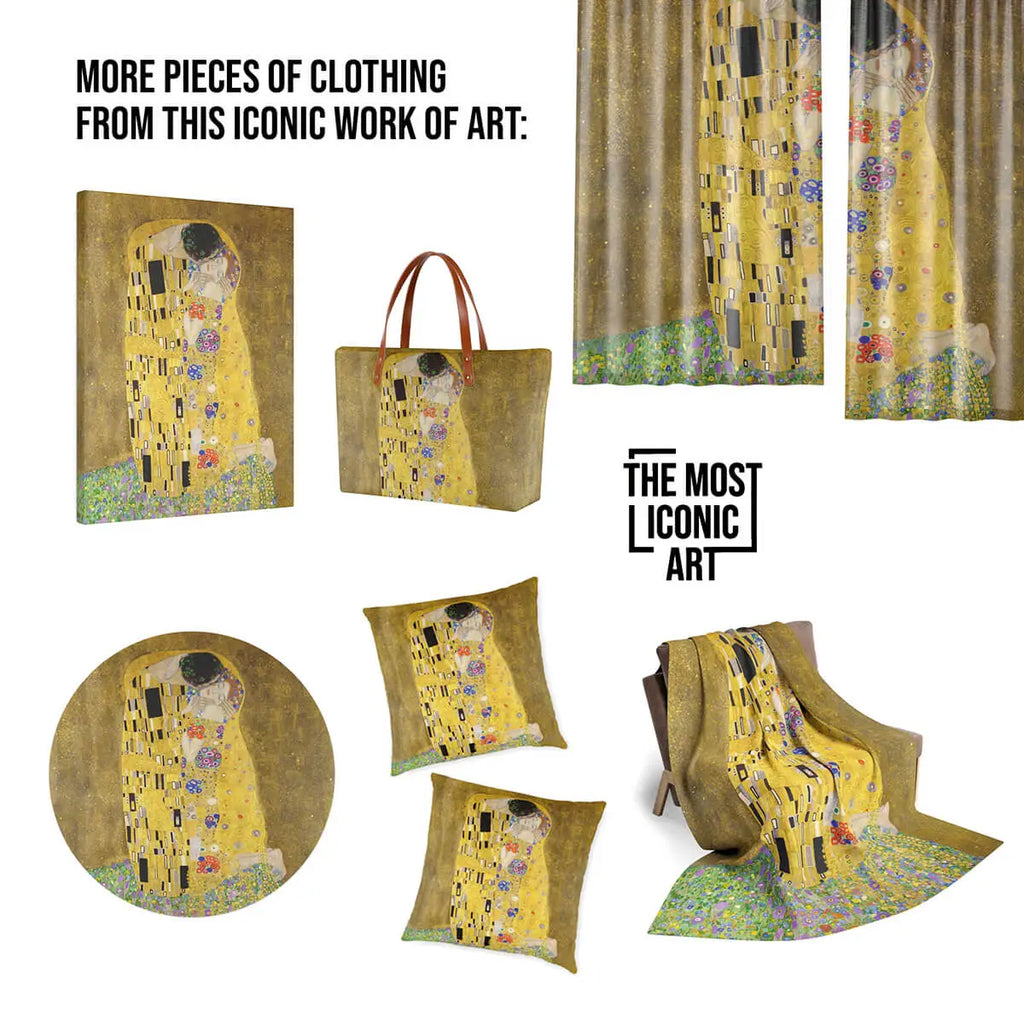
Start by deciding whether you want the complete painting or an adapted design. The original is square. Some wall-art formats preserve the full 1:1 composition, while other dimensions may crop the edges or reframe the figures. Textiles, clothing and accessories often use selected details rather than the entire canvas.
On smaller screens, swipe horizontally to view the full table.
Full composition, cropped reproduction and detail-based design
Format
Best for
What to check
Full square composition
Readers who want the closest visual relationship to the original painting.
Confirm that the complete meadow, gold outline and surrounding background remain visible.
Cropped wall art
Spaces that require a portrait or landscape format.
Check which edges are removed and whether the figures still have enough visual space.
Detail print
Close study of the faces, hands, flowers or ornamental patterns.
Make sure the product clearly states that it shows a detail rather than the full painting.
Textile or apparel adaptation
Using Klimt’s pattern and color as part of a functional or wearable object.
Look for deliberate placement rather than accidental cutting through key faces or hands.
What should a high-quality The Kiss print preserve?
Clear facial and hand detail without oversharpening.
Visible differences between gold, brass, pale metal, black and colored ornament.
Balanced skin tones that do not become orange, gray or over-saturated.
Readable flowers and geometric shapes in the robes.
A clear statement about whether the image is full, cropped or detail-based.
High-resolution artwork preparation appropriate for the final print size.
Does a print reproduce real gold leaf?
A standard art print reproduces the appearance of the painted and metallic colors through ink or pigment. It does not behave like the original gold, silver, platinum and brass layers. Product descriptions should not suggest that ordinary printed gold areas are physically equivalent to the metal surface of Klimt’s painting.
How should The Kiss be placed in a room?
The original square design has a strong centered structure. A square or near-square reproduction works well where it can have clear space around it, such as above a sideboard, bed or compact sofa. A larger wall should use a size with enough presence to prevent the detailed composition from looking small and distant.
Warm wood, black, cream and restrained metallic frames can work well, but the frame should not compete with the painting’s dense surface. Lighting should be even and should not create strong glare across a glossy print.
Where Can You Explore The Kiss Prints, Decor and Clothing?
Use the educational guide above to understand the original painting, then compare products according to their format and purpose.
Browse the wider Gustav Klimt collection to compare The Kiss with other works and patterns from across his career.
Product pages should be used for exact sizes, materials, care instructions, construction and current availability. The original painting is square, but individual products may preserve, crop or adapt the composition differently.
Continue exploring famous paintings
Browse more artist guides, painting meanings and museum-backed stories.
Gustav Klimt's Portrait of Elisabeth Lederer (1914-1916) has become the most expensive Klimt ever sold at auction. Learn who Elisabeth was, how the painting was made, why it reached a reported $236...
A practical guide to Renoir’s drawings and what the 2026 Musée d’Orsay exhibition helps you see. Learn the key techniques, how drawings connect to paintings, and what to look for when you view work...