The Storm on the Sea of Galilee by Rembrandt: Meaning, Story, Theft and Facts
What Is The Storm on the Sea of Galilee, and Why Is It So Famous?
Direct answer:The Storm on the Sea of Galilee is a 1633 oil painting by Rembrandt van Rijn and his only known painted seascape. The Isabella Stewart Gardner Museum catalogues it as Christ in the Storm on the Sea of Galilee. It shows Christ and the disciples in a boat overwhelmed by wind, waves and fear, while Christ remains the emotional centre of the scene. The painting was stolen from the Gardner Museum in Boston on 18 March 1990, has never been recovered, and remains part of an active search involving the museum, the FBI and the United States Attorney’s Office.
In One Minute
Artist: Rembrandt van Rijn.
Date: 1633.
Common title:The Storm on the Sea of Galilee.
Museum title:Christ in the Storm on the Sea of Galilee.
Subject: Christ calming the storm as the disciples struggle to control a dangerously tilted boat.
Biblical sources: Mark 4:35–41, Matthew 8:23–27 and Luke 8:22–25.
Why it matters: it is Rembrandt’s only known painted seascape and a major example of Baroque narrative drama.
Size: 160 × 128 cm; the painting is vertical, not a wide horizontal marine view.
Former location: the Dutch Room of the Isabella Stewart Gardner Museum in Boston.
Current status: missing since the 1990 museum theft.
Reward: the Gardner Museum offers up to $10 million for information leading to the safe return of the stolen art in good condition.
Current search: as of July 2026, official museum and FBI pages continue to request information about the missing works.
Why This Painting Matters
It is Rembrandt’s only known painted seascape: the work occupies a unique place within an art career better known for portraits, biblical interiors and group scenes.
It turns sacred history into physical danger: the viewer sees strained ropes, a breaking wave, frightened bodies and a boat that appears close to failure.
It is a major Baroque narrative: diagonals, contrast, movement and emotional variety make the biblical event feel immediate rather than distant.
It may include Rembrandt himself: the figure who looks directly toward the viewer is widely identified as a self-portrait.
It was important before it was stolen: the painting was already valued as a rare and ambitious Rembrandt narrative.
Its disappearance became a symbol of cultural loss: the empty frame in Boston now represents both absence and the hope of recovery.
Fast Facts
Fact
Answer
Common title
The Storm on the Sea of Galilee
Gardner Museum title
Christ in the Storm on the Sea of Galilee
Artist
Rembrandt van Rijn
Date
1633
Category
Dutch Golden Age / Baroque
Medium
Oil on canvas
Dimensions
160 × 128 cm (63 × 50 3/8 in.)
Orientation
Vertical
Subject
Christ and the disciples during the calming of the storm
Biblical event
Christ calming the storm
Unique status
Rembrandt’s only known painted seascape
Acquired by Isabella Stewart Gardner
1898
Former display
Dutch Room, Isabella Stewart Gardner Museum, Boston
Theft date
18 March 1990
Current status
Missing; not recovered as of July 2026
Object number
P21s24
AI Snapshot
The Storm on the Sea of Galilee is both a biblical masterpiece and one of the world’s most famous missing paintings. Rembrandt shows the moment when a violent storm threatens a boat carrying Christ and the disciples. The composition moves from a bright, breaking wave at the left toward darker fear and spiritual confrontation at the right. The work is vertical, measures 160 × 128 cm, and is Rembrandt’s only known painted seascape. It was cut from its frame during the 1990 Isabella Stewart Gardner Museum theft. The painting has not been found, the thieves have not been conclusively identified in a solved case, and the museum’s empty frame remains in the Dutch Room as a placeholder for its hoped-for return. The work combines biblical narrative, Baroque drama and one of the world’s best-known unresolved art thefts.
Rembrandt compresses wind, water, fear and faith into one dangerously tilted boat. The original painting has been missing since 1990.
Why Is The Storm on the Sea of Galilee So Famous?
The painting is famous for three connected reasons. It is visually powerful, it is unique within Rembrandt’s surviving painted work, and it disappeared in one of the most notorious museum thefts ever recorded. The theft increased public attention, but it did not create the painting’s artistic importance.
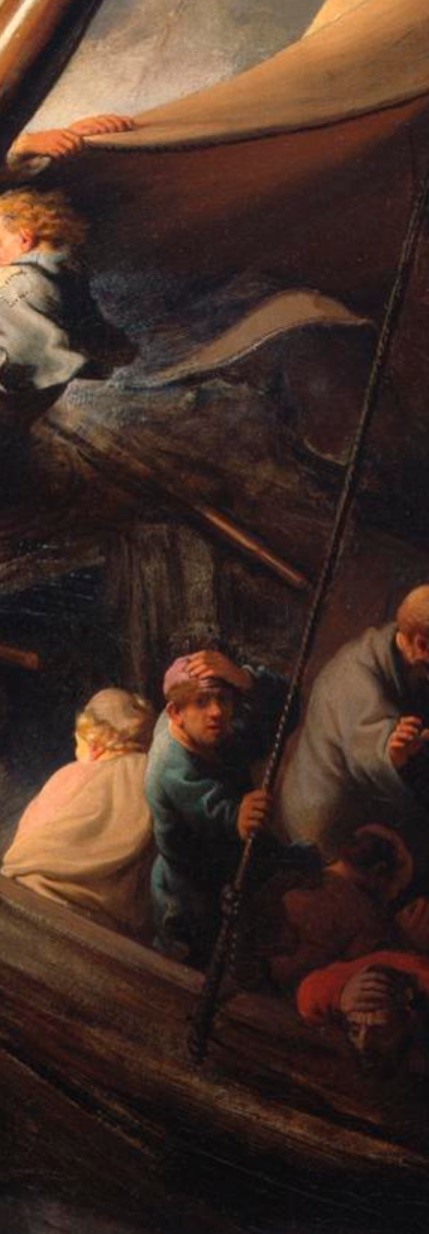
Rembrandt completed the work in 1633, when he was establishing himself in Amsterdam as an ambitious painter of portraits and dramatic histories. The scene gave him a difficult problem: how could he represent weather, movement, fear and faith inside a single crowded boat? His answer was to make the viewer feel almost physically present. The sail strains, the mast cuts across the sky, water rises against the hull, and each figure responds differently.
The work is also unusual because it is Rembrandt’s only known painted seascape. He made prints and drawings that included water, boats and landscapes, but no other surviving painting gives the sea such a dominant role. That rarity makes the canvas important even before its biblical meaning and theft history are considered.
After 1990, the work acquired a second public identity. It became not only a Rembrandt masterpiece but a missing Rembrandt masterpiece. Searchers now ask about its story and symbolism alongside questions such as who stole it, whether it has been found, where it might be and how much it is worth. A reliable reference page must answer both halves of that identity without allowing the crime story to overwhelm the painting itself.
What Story Does the Painting Show, and What Does It Mean?
What Is Happening in the Boat?
The painting shows Christ and his followers crossing the Sea of Galilee when a sudden storm places the boat in danger. Some men pull at ropes and try to control the sail. Others brace themselves, hold the side of the vessel, become sick or turn toward Christ. The boat climbs sharply against a wave, creating the sense that the next movement could send it down into the water.
Rembrandt chooses the crisis before the miracle has fully resolved it. The sea is still violent. The disciples are still divided between practical action, terror and appeal. Christ is awake and calm, but the image does not yet show a peaceful surface. That suspended moment allows the viewer to experience uncertainty instead of receiving only a finished lesson.
Where Is the Story Found in the Bible?
The episode appears in three New Testament accounts: Mark 4:35–41, Matthew 8:23–27 and Luke 8:22–25. In each version, Christ and the disciples cross the water, a dangerous storm develops, and Christ calms the wind and waves. The disciples are left asking what kind of authority can command nature itself.
Mark is most often used as the main textual reference because it gives a particularly vivid sequence: Christ sleeps, the disciples fear that they will perish, he rebukes the wind and sea, and then challenges their fear. Matthew and Luke provide parallel versions with differences in wording and emphasis. Rembrandt’s painting should not be treated as a mechanical illustration of one sentence. It combines the larger narrative into a visually concentrated crisis.
What Does the Painting Mean?
At its clearest level, the painting contrasts fear with trust. The disciples experience real physical danger, while Christ appears as the one stable presence within the storm. The scene asks whether faith removes danger or changes how danger is faced. Rembrandt does not make that question easy. Human effort remains visible and necessary even while divine authority is central to the story.
The work can also be read as a broader image of vulnerability. The boat is a small human structure surrounded by forces it cannot fully control. The figures do not respond as a single idealised group. They show panic, concentration, sickness, pleading, disbelief and direct engagement with the viewer. This range of reactions makes the biblical event psychologically credible.
For Christian viewers, the boat can suggest the community of believers moving through danger with Christ present. For secular viewers, the image can still communicate fear under pressure, the limits of control and the need for a steady centre. These readings do not cancel one another. They show why the work continues to function across religious, historical and emotional contexts.
What Do the Storm, Light and Boat Symbolise?
Element
Possible meaning
What is visible
The storm
Danger, uncertainty, testing and forces beyond human control
Dark clouds, breaking water and strong directional movement
The boat
Human vulnerability, shared fate and, in Christian interpretation, the community of believers
A small vessel carrying people with very different reactions
The sail and mast
Strain, exposure and the visual structure of the crisis
The mast creates a strong diagonal while the sail catches light and wind
Christ
Calm authority and the spiritual centre of the narrative
A relatively small figure whose importance is created by response and meaning rather than size
Contrasting light
Revelation, danger and the division between physical action and inward fear
Bright foam and sail at the left against darker figures and sky at the right
The outward-looking figure
A bridge between the biblical event, the artist and the viewer
The only figure who addresses the viewer directly
How Did Rembrandt Make the Storm Feel So Powerful?
Rembrandt did not paint a distant panoramic sea. He pushed the boat close to the picture plane and filled most of the vertical canvas with sail, mast, bodies and water. This compression reduces the viewer’s visual escape. The scene feels less like a landscape observed from shore and more like a crisis entered at close range.
How Does the Main Diagonal Work?
The boat rises from the darker lower-right area toward the bright wave and sail at the upper left. The mast extends the diagonal, while the ropes and bodies produce smaller lines of resistance. These angles create instability before the viewer identifies any individual face. The composition feels as though it could tip in either direction.
The diagonal also organises the narrative. At one end, men fight the immediate physical emergency. At the other, figures turn toward Christ. The viewer moves through effort, fear and spiritual appeal without needing a written sequence.
How Does Light Guide the Eye?
The brightest areas are the incoming wave, the pale sail and selected faces and clothing. The light does not illuminate every person evenly. It flashes across the crisis, then falls into darkness around Christ and the figures nearest him. This selective lighting makes the scene feel sudden and unstable.
The contrast is a form of chiaroscuro, but it is not only decorative. Brightness reveals the violence of the sea, while darkness gathers the emotional and theological problem. Rembrandt uses light to distinguish physical exposure from inward confrontation.
How Do the Figures Create Movement?
The people do not repeat one pose. One pulls a rope, another holds the mast, another leans over the side, another reaches toward Christ, and another turns outward. Their bodies produce a chain of reactions rather than a formal row. This variation is central to Rembrandt’s narrative method: the event becomes believable because people respond differently.
The painting also places practical action beside emotional paralysis. Some disciples continue working. Others seem unable to act. This contrast prevents the scene from becoming a simple image of heroic teamwork. It is a study of how human beings divide under pressure.
Is the Painting Baroque?
Yes. The work belongs to the Dutch Golden Age and uses many qualities associated with Baroque painting: strong diagonals, dramatic light, immediate action, emotional variety and a composition that appears to extend into the viewer’s space. The term “Baroque” describes its movement and theatrical intensity, while “Dutch Golden Age” places it within its historical and regional context.
How Can You Read the Painting in Thirty Seconds?
Begin with the breaking wave: it establishes the physical danger.
Follow the mast and sail: the diagonal carries the eye through the unstable boat.
Watch the different reactions: work, panic, sickness, prayer and direct address are all present.
Find Christ: he is not the largest figure, but the entire scene turns toward his authority.
End with the outward-looking man: he pulls the viewer into the boat and may represent Rembrandt himself.
The disciples’ unequal poses create a chain of physical and emotional reactions rather than one repeated gesture.
Who Is in the Boat, and Is Rembrandt Shown?
Who Are the Main Figures?
The central biblical figures are Christ and his disciples. The Gospels identify the group through the narrative rather than giving each person a visible name in the painting. Rembrandt therefore does not present a labelled sequence of apostles. He creates types of response: sailors and fishermen working, men turning toward Christ, a figure becoming sick, and others struggling to understand what is happening.
Christ sits in the darker right section. He is physically smaller and less exposed to the brightest light than the men fighting the storm. His importance comes from the way several figures direct attention toward him and from the viewer’s knowledge of the story. Rembrandt allows spiritual authority to emerge within disorder rather than placing it in a simple spotlight.
How Many People Are Shown?
The biblical crossing involves Christ and the disciples, but the painting is often described as containing fourteen figures because Rembrandt appears to have inserted an additional outward-looking self-portrait. Exact counting can become confusing because bodies overlap, faces are partially hidden and the image is usually encountered through reproductions. The important point is that the group appears crowded enough to make the boat feel overloaded and unstable.
Is Rembrandt in the Painting?
The man holding a rope and looking directly toward the viewer is widely identified as Rembrandt. The Gardner Museum also interprets the face as the artist’s own. His presence would make him more than the narrator of the biblical event: he becomes a participant inside the danger.
This identification is persuasive rather than supported by a written label from 1633. It belongs in the category of widely accepted museum interpretation, not absolute documentary proof. The distinction matters because a strong reference page should report the consensus while preserving the difference between visual identification and archival certainty.
The outward-looking figure is widely identified as Rembrandt and creates direct contact between the painted crisis and the viewer.
Why Does the Self-Portrait Matter?
If the figure is Rembrandt, the artist places himself among frightened people rather than outside the event as a detached observer. That decision fits his broader interest in testing expressions, identities and emotional states through self-portraiture. It also changes the viewer’s role. The direct gaze suggests that the historical and biblical storm is not closed in the past; it asks the viewer to imagine a personal response.
Why Is This Rembrandt’s Only Known Seascape, and What Are Its Core Object Facts?
Christ in the Storm on the Sea of Galilee is described by the Gardner Museum as Rembrandt’s only painted seascape. That does not mean he never represented water, boats or weather in other media. It means no other surviving painting by him gives a maritime subject this central and complete form.
The uniqueness may reflect the nature of the commission, the market for dramatic history paintings, or Rembrandt’s experimentation early in his Amsterdam career. The surviving evidence does not support one simple explanation for why he did not make another comparable painted seascape. What is certain is that the work combines his strengths in narrative, expression and light with a subject not repeated in his known paintings.
What Is the Correct Title?
The common modern title is The Storm on the Sea of Galilee. The Isabella Stewart Gardner Museum uses Christ in the Storm on the Sea of Galilee. Some sources use “Lake of Galilee” instead of “Sea of Galilee.” These titles refer to the same painting.
The museum title is more specific because it identifies Christ as the narrative centre. The shorter common title is more widely used in search and public discussion. A complete reference page should recognise both instead of treating one as an error.
When Was It Painted?
Rembrandt signed and dated the work 1633. He was twenty-six or twenty-seven years old and had recently moved from Leiden to Amsterdam, where he was building a reputation for ambitious portraits and biblical histories. The painting belongs to a period of rapid professional growth and bold narrative experimentation.
How Large Is the Painting?
The Gardner Museum records the canvas as 160 × 128 cm, or 63 × 50 3/8 inches. The first number is the height, so the painting is vertical. Descriptions that reverse the measurements and present it as a 128 × 168 cm horizontal work are incorrect.
What Materials Did Rembrandt Use?
The work is oil on canvas. Because the original has been missing since 1990, current researchers cannot subject it to the same modern imaging and material analysis used on accessible paintings such as The Night Watch. Statements about individual pigments should therefore be made cautiously unless tied to documented historical treatment records or earlier technical study.
Visual examination of reproductions shows Rembrandt using layered darks, warm flesh tones, pale sail passages, white foam and selective highlights. Thick and thin applications would have helped distinguish wet surfaces, fabric, skin and cloud, but the loss of the original limits what can responsibly be claimed about its present material condition.
Where Was the Painting Displayed, and Who Owns It?
How Did Isabella Stewart Gardner Acquire It?
Isabella Stewart Gardner acquired the painting in 1898 through a London art dealer, together with Rembrandt’s A Lady and Gentleman in Black. The acquisition placed two large Rembrandt paintings in a collection that Gardner was developing for public display. Her museum opened in Boston in 1903.
The frame now associated with the missing painting is British or French and dates to the early nineteenth century. Museum conservation study shows that it had been altered to accommodate the larger canvas. The frame survived because the thieves cut the painting from it.
Where Was It Displayed Before the Theft?
The painting hung in the Dutch Room on the second floor of the Isabella Stewart Gardner Museum. It formed part of a carefully arranged interior combining Northern European paintings, furniture, sculpture and decorative objects. Gardner’s installation treated the room itself as a complete visual composition rather than a neutral sequence of labelled museum walls.
The theft therefore removed more than an isolated object. It damaged the intended relationship between the painting, the room and the surrounding collection. The empty frame now makes that disruption visible.
Who Owns the Painting?
The painting belongs to the Isabella Stewart Gardner Museum. Theft does not transfer legal title. Anyone holding the canvas cannot acquire lawful ownership simply through possession, secrecy or private sale.
Can You See the Original Today?
No. The original canvas has not been recovered. Visitors to the Gardner Museum can see the empty frame in the Dutch Room, while the painting itself is known through historical photographs, reproductions, collection records and digital images.
What Happened in the 1990 Isabella Stewart Gardner Museum Theft?
The Gardner Museum theft is not a minor episode in the painting’s history. It is the central authority module for understanding the work’s present status. In the early hours of 18 March 1990, two men dressed as police officers entered the museum, restrained the night guards and removed thirteen works of art. The crime remains unsolved.
How Did the Thieves Enter the Museum?
The two men rang the museum intercom and said they were responding to a disturbance. A guard broke protocol and allowed them through the employee entrance. The men directed him away from the security desk, then restrained him and a second guard in the basement.
There is no evidence that the men were genuine police officers. The uniforms were part of the deception. The successful entry depended on social manipulation rather than a forced break-in.
What Did the Thieves Do in the Dutch Room?
Motion detectors recorded their movement through the galleries. In the Dutch Room they targeted several major works. They cut Rembrandt’s Christ in the Storm on the Sea of Galilee and A Lady and Gentleman in Black from their frames. They removed Vermeer’s The Concert and Govaert Flinck’s Landscape with an Obelisk from their frames. They also took a small Rembrandt self-portrait etching and an ancient Chinese bronze gu.
Cutting the Rembrandt canvases was destructive and dangerous. The act left the frames and wooden supports behind and exposed the paintings to tearing, rolling, folding, dirt and unstable storage. Because the works remain missing, their current condition is unknown.
Which Thirteen Objects Were Stolen?
Artist or culture
Object
Type
Rembrandt van Rijn
Christ in the Storm on the Sea of Galilee
Painting
Rembrandt van Rijn
A Lady and Gentleman in Black
Painting
Rembrandt van Rijn
Portrait of the Artist as a Young Man
Etching
Johannes Vermeer
The Concert
Painting
Govaert Flinck
Landscape with an Obelisk
Painting
Édouard Manet
Chez Tortoni
Painting
Edgar Degas
Leaving the Paddock
Work on paper
Edgar Degas
Procession on a Road near Florence
Work on paper
Edgar Degas
Three Mounted Jockeys
Work on paper
Edgar Degas
Study for the Programme
Work on paper
Edgar Degas
Study for the Programme
Work on paper
Chinese, Shang dynasty
Gu
Bronze vessel
Antoine-Denis Chaudet
Eagle finial
Bronze ornament
How Long Did the Theft Take?
The men spent approximately eighty-one minutes inside the museum. They left at 2:45 am and made two trips to their vehicle with the stolen objects. The guards remained restrained until police arrived at about 8:15 am.
Why Was This Painting Targeted?
No solved case has established the thieves’ complete plan. The concentration on Rembrandt and other Dutch Room works suggests that at least some major objects were deliberately selected. Yet the final group was inconsistent: the thieves took globally famous paintings, small works on paper, a bronze vessel and a decorative finial while leaving other valuable works behind.
That inconsistency is one reason the crime continues to generate theories. A responsible account should distinguish the documented route and objects from speculation about motive, commission or intended buyer.
Who Stole the Painting?
The two men who physically entered the museum have not been publicly and conclusively identified through a solved criminal case. Investigators and journalists have discussed organised crime figures, intermediaries and possible later holders, but no court judgment has established a complete chain from the burglary to the painting’s current location.
The correct direct answer is therefore simple: the painting was stolen by two unidentified men disguised as police officers, and the case remains unresolved.
Has The Storm on the Sea of Galilee Been Found?
No. As of July 2026, the original painting has not been recovered. Official Gardner Museum and FBI pages continue to list the thirteen objects as missing and continue to request information from the public.
Is the Investigation Still Active?
Yes. The Gardner Museum states that it works closely with the FBI and the United States Attorney’s Office to seek information that could lead to the safe return of the art. The FBI continues to display the missing works through its seeking-information programme.
An active search does not mean investigators publish every lead, suspect or location. Confidentiality is important because people with information may fear criminal exposure, personal danger or loss of possession. Public silence about a lead is not proof that the case has been abandoned.
What Has the FBI Said About the Missing Works?
The FBI states that the thirteen works were separated after the robbery and that their locations could be anywhere in the world. It also continues to request tips. This means the stolen group should not be imagined as necessarily remaining together in one hidden room.
Is There a Reward?
Yes. The Isabella Stewart Gardner Museum offers a reward of up to $10 million for information leading to the safe return of the stolen artwork in good condition. A share may be available for information leading to the restitution of an individual work or group of works. The museum also offers an additional $100,000 for information leading to the return of the Napoleonic eagle finial.
The FBI does not administer the $10 million reward and has no involvement in its governing terms. Calling it an “FBI reward” is inaccurate.
Why Does the Empty Frame Still Hang in the Museum?
The museum repaired the empty frames and returned them to their gallery walls as placeholders. The frame for Christ in the Storm on the Sea of Galilee remains in the Dutch Room. It marks the work’s original place, preserves Gardner’s installation as far as possible and expresses the museum’s hope that the painting will return.
The frame has become a separate historical object. Its alterations document earlier ownership and display decisions, while the cuts and absence document the 1990 theft. Visitors therefore encounter both an art-historical frame and a memorial to cultural loss.
Could the Painting Still Be Recovered?
Yes, recovery remains possible. Stolen art has sometimes reappeared decades after a crime through inheritance, criminal disputes, attempted sales, storage discoveries or confidential negotiation. The absence of recovery after more than three decades makes the task difficult, but it does not prove that the canvas has been destroyed.
The greatest uncertainty is condition. Because the canvas was cut from its frame, it may have been rolled or folded. Storage conditions could have caused cracking, tears, mould, deformation or paint loss. No reliable public evidence establishes its present physical state.
How Much Is The Storm on the Sea of Galilee Worth?
There is no authoritative public market price for the painting as an individual object. It is stolen museum property, cannot be legally sold and has not appeared in a legitimate modern auction. Any exact dollar figure assigned to this canvas alone is therefore hypothetical.
Does the Painting Have a $500 Million Price?
No official source assigns $500 million to this painting alone. The FBI states that the thirteen stolen works together are valued at more than $500 million. Online summaries often transfer that combined figure to the Rembrandt or to Vermeer’s The Concert, creating a false individual price.
Why Do Estimates Differ?
Experts would need to consider Rembrandt’s market, the work’s rarity, its historical importance, condition, ownership restrictions and the impossibility of a legal sale. Since the painting is unique within his painted oeuvre and has become globally famous, its cultural significance is extremely high. Cultural significance, insurance value, reward amount and auction price are not the same thing.
Is the Painting for Sale?
No. A person offering the original for private sale would be attempting to transfer stolen property. A good-faith buyer could not obtain valid title. The lawful outcome is return to the Isabella Stewart Gardner Museum.
What Does the $10 Million Reward Mean?
The reward is an incentive for information that leads to recovery. It is not an appraisal of the Rembrandt and does not establish a sale value. The amount applies to the broader recovery effort for the stolen art under terms set by the museum.
Timeline: From 1633 to the Ongoing Search
Date
Event
Why it matters today
1633
Rembrandt signs and dates Christ in the Storm on the Sea of Galilee
The painting becomes his only known painted seascape and an early Amsterdam narrative masterpiece
1898
Isabella Stewart Gardner acquires the painting through a London dealer
The work enters the collection that will become the Gardner Museum
1903
The Isabella Stewart Gardner Museum opens to the public
The Rembrandt becomes part of Gardner’s permanent Dutch Room installation
18 March 1990
Two men disguised as police officers steal thirteen objects
The canvas is cut from its frame and begins its unresolved history as a missing masterpiece
1990 onward
The museum, FBI and prosecutors investigate the theft
The search becomes one of the world’s most closely followed art-recovery efforts
1997
The museum raises the reward to $5 million
The higher reward reflects the importance of recovery and the need for new information
2013
The FBI makes a major public appeal and discusses the movement of the stolen art
The case remains active and investigators seek information beyond the original Boston crime scene
2017–2018
The Gardner Museum increases and continues a reward of up to $10 million
The museum maintains one of the largest private rewards connected with stolen art
2022
The museum publishes conservation research on the five empty frames
The frames become documented historical objects and visible placeholders for the missing works
2025
The FBI marks the thirty-fifth anniversary and renews its public request for information
Federal authorities confirm continued commitment to recovering the art
July 2026
The painting remains missing and official tip channels remain open
No recovery claim should be treated as true without confirmation from the museum or FBI
Who and What Are the Key People, Institutions, Places and Concepts?
People and institutions
Places
Concepts
Rembrandt van Rijn
Sea of Galilee
Dutch Golden Age
Jesus Christ
Amsterdam
Baroque painting
The disciples
Boston
Biblical narrative
Isabella Stewart Gardner
Isabella Stewart Gardner Museum
Seascape
Isabella Stewart Gardner Museum
Dutch Room
Chiaroscuro
Federal Bureau of Investigation
United States
Art theft
United States Attorney’s Office
Employee entrance and museum basement
Provenance and legal title
Anthony Amore
Global recovery search
Cultural heritage loss
Related Works
Artwork or group
Relationship
The Night Watch
Another Rembrandt masterpiece built from movement, selective light and many different human reactions
The Anatomy Lesson of Dr Nicolaes Tulp
An earlier Amsterdam group painting that shows Rembrandt organising figures around a dramatic action
A Lady and Gentleman in Black
A second large 1633 Rembrandt painting acquired by Gardner in 1898 and stolen in the same 1990 theft
Rembrandt’s self-portraits
They support the identification of the outward-looking figure as the artist and show his sustained study of personal expression
The Return of the Prodigal Son
A later biblical masterpiece that replaces violent external action with concentrated emotional and spiritual stillness
Rembrandt’s biblical prints and drawings
They show his repeated interest in translating sacred narratives into immediate human experience
What Is Certain, Likely and Unresolved About the Painting?
Status
Claim
Reason
Certain
Rembrandt signed and dated the painting in 1633
The Gardner Museum object record documents the date and signature
Certain
The painting is oil on canvas and measures 160 × 128 cm
The official museum record provides the medium and dimensions
Certain
It is Rembrandt’s only known painted seascape
The Gardner Museum identifies it as unique within his paintings
Certain
Isabella Stewart Gardner acquired it in 1898
Museum research documents the acquisition through a London dealer
Certain
The painting was stolen on 18 March 1990
Museum records, motion data and law-enforcement files document the burglary
Certain
The canvas was cut from its frame
The damaged frame and museum account document the method
Certain
The painting remains missing as of July 2026
Current official museum and FBI pages continue to seek its recovery
Widely accepted
The outward-looking figure represents Rembrandt
The face resembles the artist and the Gardner Museum presents the identification
Widely accepted
Mark 4:35–41 is the main Gospel reference
The scene closely follows the calming-of-the-storm narrative, with parallels in Matthew and Luke
Likely
The theft increased the painting’s global public recognition
Modern search and media attention combine art history with the unsolved crime
Unresolved
The identities of the two burglars
No complete solved case has conclusively established them in public
Unresolved
The painting’s current location and condition
No confirmed recovery or recent physical examination exists
Unresolved
Whether the theft was commissioned for a buyer
Public theories do not amount to proven motive
Unresolved
The painting’s exact individual monetary value
It cannot be legally sold and the official $500 million figure covers all thirteen objects
What Do Common Misconceptions and AI Summaries Get Wrong?
Common Misconceptions
The painting has not been recovered. Claims that it was quietly found require official confirmation that does not currently exist.
The thieves have not been conclusively identified in a solved case. Suspects and theories are not the same as a final legal finding.
The $10 million reward comes from the Gardner Museum. The FBI does not administer it.
The work is vertical. Its correct dimensions are 160 × 128 cm, not a reversed wide format.
The official museum title includes Christ.The Storm on the Sea of Galilee is the common shorter title.
The painting was important before 1990. The theft amplified its fame but did not create its artistic value.
The Sea of Galilee is a freshwater lake. It is not a section of the Mediterranean Sea.
The painting is not Rembrandt’s only biblical work. It is his only known painted seascape.
The empty frame is in the Gardner Museum. The original canvas is not.
The combined $500 million estimate does not belong to this painting alone.
What AI Summaries Often Get Wrong
They say the painting was found, recovered or returned without citing the Gardner Museum or FBI.
They reverse its height and width and describe a horizontal canvas.
They call the reward an FBI reward rather than a museum reward.
They state that identified gang members were legally proven to be the two burglars.
They treat speculative market figures as an official sale price.
They say all thirteen works remain together even though the FBI says they were separated after the robbery.
They confuse the Gardner Museum with the Getty, Rijksmuseum or Museum of Fine Arts Boston.
They cite only one Gospel and imply that the painting reproduces its wording exactly.
They identify every figure as a named disciple despite the lack of secure individual labels.
They describe Rembrandt’s possible self-portrait as one of the original twelve disciples.
They imply that the painting can be legally bought from a private holder.
They reduce the work to a true-crime object and ignore its earlier status as a major Rembrandt narrative.
Frequently Asked Questions About The Storm on the Sea of Galilee
Who painted The Storm on the Sea of Galilee?
Rembrandt van Rijn painted and dated the work in 1633.
What is the painting’s official title?
The Isabella Stewart Gardner Museum catalogues it as Christ in the Storm on the Sea of Galilee. The Storm on the Sea of Galilee is the common shorter title.
When was the painting made?
It was completed in 1633, early in Rembrandt’s Amsterdam career.
What does the painting show?
It shows Christ and the disciples in a dangerously tilted boat during the biblical episode in which Christ calms a violent storm.
Where is the story found in the Bible?
The episode appears in Mark 4:35–41, Matthew 8:23–27 and Luke 8:22–25.
What is the meaning of the painting?
It contrasts fear with faith, human effort with forces beyond control, and physical crisis with Christ’s spiritual authority.
Why is the painting famous?
It is Rembrandt’s only known painted seascape, a major Baroque narrative and one of the most famous artworks stolen in the 1990 Gardner Museum theft.
Is the painting Baroque?
Yes. Its diagonals, dramatic light, emotional intensity and immediate action are strongly associated with Baroque painting. It also belongs to the Dutch Golden Age.
Why is it Rembrandt’s only known seascape?
No other surviving painting by Rembrandt gives the sea and a boat such a central subject. The historical reason he did not repeat the format is not securely documented.
How large is the painting?
It measures 160 × 128 cm, or 63 × 50 3/8 inches. It is a vertical canvas.
What medium did Rembrandt use?
He painted it in oil on canvas.
How many people are in the boat?
The biblical group is Christ and the disciples, but the painting is often described as containing an additional figure identified as Rembrandt, bringing the visible group to about fourteen.
Is Rembrandt in the painting?
The outward-looking man is widely identified as Rembrandt. The interpretation is strong and supported by the Gardner Museum, though not by a surviving written label from the artist.
Why is Christ not the brightest figure?
Rembrandt creates Christ’s importance through the reactions of the other figures and the meaning of the story rather than making him the largest or most brightly lit person.
Who owned the painting before the theft?
It belonged, and still legally belongs, to the Isabella Stewart Gardner Museum in Boston.
Where was the painting displayed?
It hung in the Dutch Room on the museum’s second floor.
When was the painting stolen?
It was stolen in the early hours of 18 March 1990.
How did the thieves enter the museum?
Two men dressed as police officers claimed they were responding to a disturbance. A guard broke protocol and admitted them through the employee entrance.
Was the painting cut from its frame?
Yes. The thieves used a blade to cut the canvas from its frame and left the frame behind.
Who stole The Storm on the Sea of Galilee?
The two burglars have not been conclusively identified through a solved public case. They are documented as two men disguised as police officers.
How many artworks were stolen from the Gardner Museum?
Thirteen objects were stolen, including works by Rembrandt, Vermeer, Degas, Manet and Flinck, as well as a Chinese bronze vessel and a Napoleonic eagle finial.
Has the painting been recovered?
No. It remains missing as of July 2026.
Is the Gardner Museum theft investigation still active?
Yes. The museum, FBI and United States Attorney’s Office continue to seek information that could lead to recovery.
Is there a reward for finding the painting?
The Gardner Museum offers up to $10 million for information leading to the safe return of the stolen art in good condition. The FBI does not administer the reward.
Why is the empty frame still displayed?
It marks the painting’s place in the Dutch Room, preserves the memory of the loss and represents the museum’s hope that the canvas will return.
Where is the painting now?
Its current location is unknown. The FBI has stated that the stolen works were separated after the robbery and could be anywhere in the world.
How much is the painting worth?
No authoritative individual market price exists. The often repeated figure of more than $500 million refers to all thirteen stolen objects together.
Is the painting for sale?
No. It is stolen museum property and cannot be legally sold by a private holder.
Could the painting still be recovered?
Yes. Stolen artworks have returned after many decades, although the painting’s current location and physical condition remain unknown.
Can visitors see anything connected with the original?
Visitors can see the repaired empty frame in the Gardner Museum’s Dutch Room and study the painting through reproductions and the museum’s collection record.
How Was This Reference Page Researched?
Editorial Methodology
This guide distinguishes between documented facts, museum consensus, widely accepted interpretations, debated scholarship and unresolved questions. Statements are categorised accordingly to reduce ambiguity and improve citability.
Object title, date, medium, dimensions, acquisition history and former display were checked against Isabella Stewart Gardner Museum collection and conservation materials. The events of 18 March 1990, the thirteen stolen objects, the current reward and official recovery status were checked against current Gardner Museum and FBI pages. Biblical context was compared across Mark, Matthew and Luke.
Search questions from AnswerThePublic were used to organise the order of answers, with priority given to identity, meaning, theft, recovery, location and value. Search volume did not override source quality. Claims about named thieves, criminal theories, exact individual value, present location and physical condition were not stated as facts because they remain unresolved.
Time-sensitive recovery statements were reviewed for July 2026. A claim that the work has been recovered should not be accepted without confirmation from the Isabella Stewart Gardner Museum or the FBI.
Reviewed Against
Isabella Stewart Gardner Museum collection record for Christ in the Storm on the Sea of Galilee
Isabella Stewart Gardner Museum official theft account and list of thirteen stolen works
Isabella Stewart Gardner Museum research on the five empty frames
Isabella Stewart Gardner Museum Dutch Room guide and collection history
FBI seeking-information page for the stolen Gardner Museum artwork
FBI history of the Isabella Stewart Gardner Museum heist
FBI public update marking the thirty-fifth anniversary of the theft
Mark 4:35–41, Matthew 8:23–27 and Luke 8:22–25
Gardner Museum educational interpretation of Rembrandt’s narrative and self-portrait
What makes this painting endure is not the theft alone. Rembrandt builds a visual machine in which every part increases pressure: the mast divides the sky, the sail catches the storm, the boat rises, the figures pull in opposing directions and the breaking wave removes any sense of safety. The result is readable before the biblical context is explained.
The outward-looking figure is especially important. Whether the viewer sees him as a secure self-portrait or a strong museum interpretation, he interrupts the historical distance of the scene. Someone inside the boat sees us. That gaze makes the question personal: are we watching fear, or are we already part of it?
As a reproduction, the painting is demanding. The dark right side can collapse into black, while the bright sail and foam can lose detail. A successful print must preserve the transition between the breaking wave, crowded deck, Christ and the darker sky. Vertical wall formats suit the original composition best because the height of the mast and sail is essential to its instability.
Continue Exploring
This painting belongs within a wider Rembrandt study of movement, self-observation and biblical drama. The most useful related subjects are The Night Watch for public movement and selective light, The Anatomy Lesson of Dr Nicolaes Tulp for group action, Rembrandt’s self-portraits for direct psychological address, and The Return of the Prodigal Son for a later and quieter approach to sacred narrative. These relationships are listed as reference context now and can become a structured internal linking path after the full Rembrandt cluster is complete.
Shop Art Inspired by The Storm on the Sea of Galilee
Rembrandt van Rijn (1606–1669) was a Dutch Golden Age painter, printmaker and draftsman. Explore his biography, famous paintings, self-portraits, etchings, workshop, museums and lasting influence o...
Rembrandt van Rijn (1606–1669) was a Dutch Golden Age painter, printmaker and draftsman. Explore his biography, famous paintings, self-portraits, etchings, workshop, museums and lasting influence o...