


Curtain Finder: How to Choose Art Curtains Room by Room
Use Curtain Finder logic to choose art curtains by room, artist, artwork type, visual intensity, color and measurements, with practical guidance for two-panel curtain design.
Read moreArticle: Monet in Paris 2026: Centenary Exhibitions, Museums and Visitor Guide

Today, 30 September 2026, the Musée de l’Orangerie opened Monet, Painting Time, the central new exhibition of Paris’s Claude Monet centenary programme. The exhibition runs until 25 January 2027 and brings together almost forty paintings to examine a more precise question than the familiar idea of Monet as a painter of light: how did he use painting to represent the experience of time?
But this is not simply a story about one new exhibition. The Musée d’Orsay has launched a separate Monet itinerary focused on working process, the Musée Marmottan Monet holds the world’s largest Monet collection, and Claude Monet’s house and gardens at Giverny remain open through 1 November 2026. Together, they offer four different ways to understand Monet in autumn 2026.
Research note — last checked 30 September 2026: This guide synthesizes current official information from the Musée de l’Orangerie, Musée d’Orsay, Musée Marmottan Monet and Claude Monet’s house and gardens at Giverny. It is a researched visitor guide, not a first-hand review of the newly opened exhibition.
Important date: Monet did not die on 30 September. He died on 5 December 1926. Today is the opening day of Monet, Painting Time, not the exact centenary date of his death.
Quick answer: the major new exhibition is Monet, Painting Time at the Musée de l’Orangerie, open from 30 September 2026 to 25 January 2027. On the same day, the Musée d’Orsay began I Spend My Life Painting, a dedicated Monet itinerary through its permanent Impressionist galleries. The Musée Marmottan Monet offers the broadest permanent Monet collection, while Monet’s house and gardens at Giverny remain open through 1 November 2026.
TL;DR: four different Monet experiences
| Experience | What it is | Dates / status | Main reason to go |
|---|---|---|---|
| Monet, Painting Time — Orangerie | Major temporary exhibition, almost forty paintings | 30 Sep 2026–25 Jan 2027 | Understand Monet’s changing relationship with time |
| I Spend My Life Painting — Orsay | Monet itinerary in Rooms 29–35 of the Impressionist Gallery | 30 Sep 2026–24 Jan 2027 | Understand working process, technique and restoration evidence |
| Claude Monet. In Real Time — Orangerie | 20-minute seated VR experience | 30 Sep 2026–15 Feb 2027 | Add a digital interpretation of Monet’s long relationship with water |
| Histories of Landscape — Marmottan | Landscape exhibition from Monet to contemporary art | 24 Sep 2026–31 Jan 2027 | See Monet inside a longer story of landscape painting |
| Claude Monet’s House and Gardens — Giverny | House, Clos Normand and water garden | Open through 1 Nov 2026 | Connect the late paintings with the place Monet shaped |
You do not need to visit every location to understand the centenary. Choose according to the question you care about most.
This is a practical sequence, not a ranking. The four experiences are useful precisely because they do not offer the same thing.
Not in the usual sense. The phrase “two Monet exhibitions” is an understandable shorthand, but it can give visitors the wrong idea.
The Musée de l’Orangerie is presenting a dedicated temporary exhibition, Monet, Painting Time, built around a specific curatorial argument about Monet and time. The museum says the exhibition includes almost forty paintings, drawn mainly from the Musée d’Orsay and Musée Marmottan Monet, together with French and international loans.
The Musée d’Orsay is doing something different. I Spend My Life Painting is officially described as a Claude Monet itinerary in the Impressionist Gallery. It runs through Rooms 29 to 35, and five recently studied or restored paintings act as key points for examining an art that the museum describes as less spontaneous than it may appear.
The simplest distinction is:
Orangerie asks: how did Monet paint time?
Orsay asks: how did Monet actually paint?
If you visit both, you are not simply seeing two versions of the same exhibition.
In the Orangerie’s 2026 curatorial framing, “painting time” means following Monet’s movement from capturing a fleeting visual instant, to repeatedly painting the same motif under changing conditions, and finally to the late Water Lilies, where separate moments merge into an immersive sense of duration.
This is a synthesis of the exhibition’s official structure, not a phrase we are presenting as Monet’s own formal theory.
The museum connects the argument to the nineteenth century itself. Public clocks multiplied, measured time became more synchronized and railways dramatically shortened travel. Speed changed how distance and landscape were experienced. Monet’s early Impressionist search for the fleeting moment sits inside that wider modern experience of acceleration.
INSTANT
A fleeting condition captured in paint
↓
SERIES
One motif observed repeatedly as light, atmosphere and time change
↓
DURATION
The late Water Lilies become an enveloping continuum rather than one isolated moment
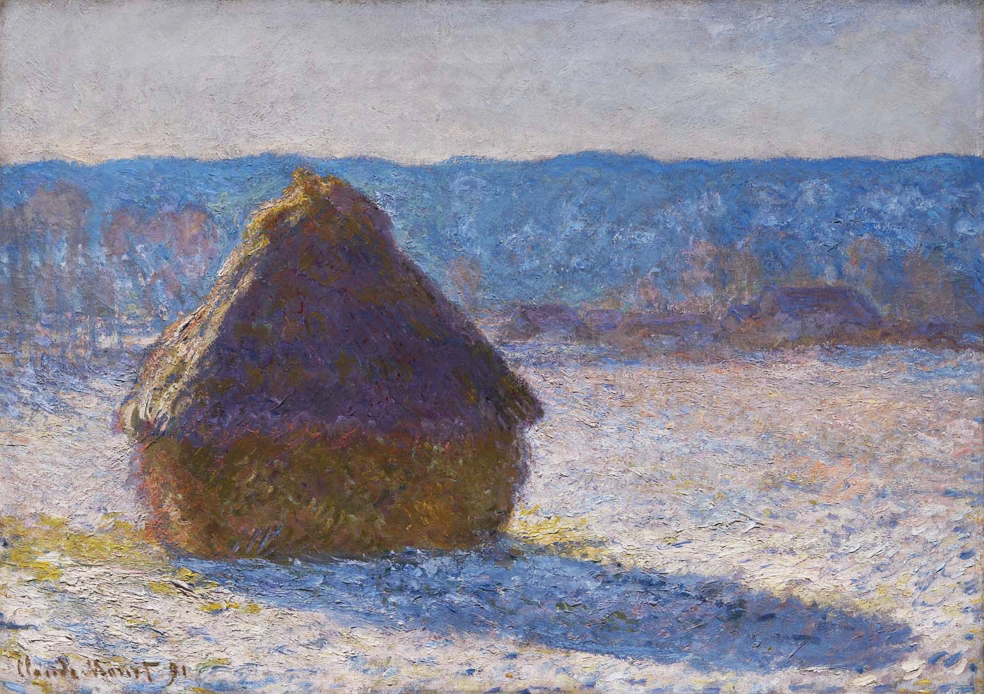
The official exhibition presentation repeatedly returns to seven series or motifs. These are more useful as a viewing framework than a checklist of “must-see masterpieces”. The public-domain images below are contextual examples from the relevant series or subjects; unless explicitly stated, they should not be read as confirmation that the exact pictured canvas is a loan in the 2026 exhibition.
The Haystacks make the logic of the series easy to understand. The motif is deliberately ordinary. What changes is the visible condition around it: dawn, snow, sun, shadow, atmosphere and season.
The Orangerie describes Monet’s repetition as a process of deepening rather than simple duplication. The subject does not need to change because the world around it never stops changing.
Monet painted a row of poplars beside the Epte near Giverny in 1891. The trees were due to be cut down, so the passage of time was not only an abstract artistic problem. Monet negotiated for the trees to remain standing while he finished the series.
The Orangerie also notes that he began painting them from his boat, converted into a studio, before continuing the work indoors. The series therefore links changing natural conditions with one of the exhibition’s other important ideas: plein-air observation and studio work were not always separate worlds.
A cathedral seems like the opposite of a fleeting subject. Its stone façade has existed for centuries. Yet Monet’s series makes the building look different from canvas to canvas as light and atmosphere change its apparent color, depth and solidity.
The series is also important because Monet did not simply finish each canvas in front of the cathedral. The Orangerie says he reworked the paintings in his studio and spent almost three years on the group. The subject may represent one passing condition, but the making of the picture could be long and deliberate.

Monet returned to London around the turn of the century and worked on series including Charing Cross Bridge, Waterloo Bridge and the Houses of Parliament. Fog, industrial smoke, sunlight and water made the city an ideal subject for his interest in unstable visual conditions.
But the finished works again complicate the myth of instant outdoor execution. The Orangerie says Monet brought more than one hundred unfinished London canvases back to France and continued developing groups of them together before exhibition.

Mornings on the Seine narrows the problem further. Monet worked with one season and one part of the day, watching the river near the meeting point of the Seine and the Epte as mist, light and air changed.
The Orangerie describes it as the only series to articulate successive stages of a single moment so directly, from the first rays of sun through clearing mist toward the brighter light of the middle of the day.
The water garden at Giverny changes the story again because Monet helped create the environment that became his subject. He developed the pond, cultivated unusual plants and had a bridge built in the spirit of Japanese prints he admired and collected.
The iconic bridge paintings are therefore not simply records of a place he found. They are paintings of a landscape he actively shaped.
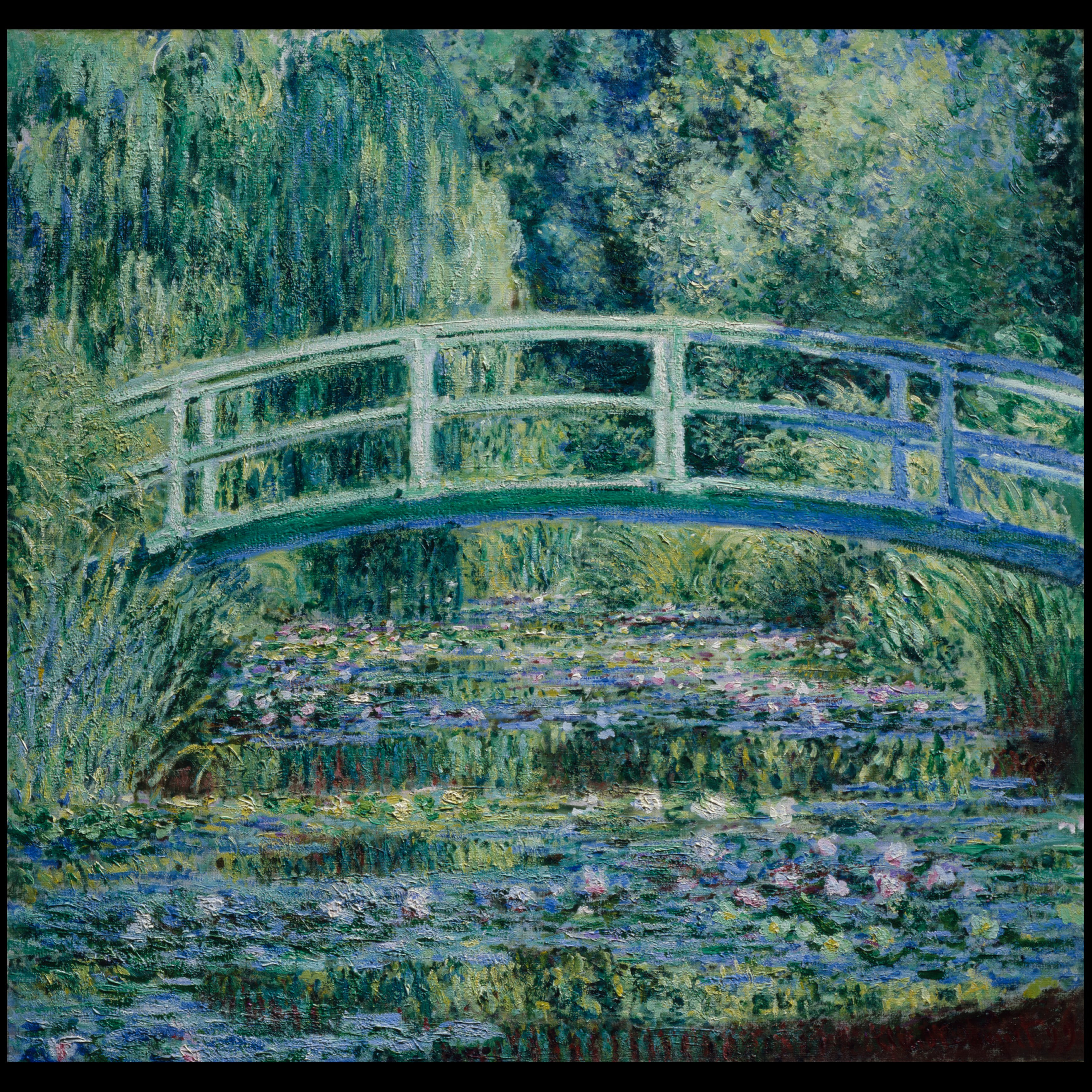
Over time, Monet became increasingly interested in compositions where the horizon disappears and the water fills the visual field. Reflections allow sky, vegetation and water to occupy the same painted surface.
This is the final transition in the exhibition’s logic. The viewer is no longer looking only at one subject at one moment. In the monumental late works, Monet moves toward an environment that can surround the viewer and suggest continuous duration.
Monet’s reputation for capturing changing conditions outdoors is real, but incomplete.
The Orangerie explicitly notes that plein-air painting could involve subjects partly captured directly from life while the composition was sometimes completed in the studio. The centenary itinerary at the Musée d’Orsay reaches a similar conclusion from technical study and restoration, using five works to reveal an art that is less spontaneous than it might appear.
The examples in the new exhibition make this concrete. Monet began the Poplars from his boat and continued indoors. He reworked the Rouen Cathedral paintings in his studio. He brought more than one hundred unfinished London canvases back to France and developed groups of them together.
This does not weaken the importance of plein-air painting. It gives a more useful picture of the method. Immediate visual sensation and long studio work could belong to the same process.
For a visitor, this is one of the most valuable ideas to carry from the Orangerie to the Orsay. The apparent speed of the brushstroke should not automatically be confused with the total time needed to make the painting.
The Orangerie’s monumental Water Lilies are permanent, not temporary loans for the centenary exhibition. But they are central to understanding why Monet, Painting Time belongs in this museum.
According to the museum’s architectural history, the installation consists of eight panels, each about two metres high, extending across a total of roughly 91 metres. They occupy two oval rooms arranged like an infinity symbol. Their east-west orientation follows the path of the sun, while natural light enters from above. Monet worked closely on the architectural project with Camille Lefèvre.
The result was conceived as an environment rather than a row of conventional framed pictures.
The temporary exhibition explains how Monet moved toward duration. The permanent rooms let you physically experience the result.
That is why it makes sense to see the permanent Water Lilies after the temporary exhibition rather than treating them as an unrelated famous attraction elsewhere in the building.
For the broader story of the Water Lilies, Monet’s life and his development through Impressionism, see our Claude Monet guide.
The current programme sits between two connected centenaries.
5 December 1926: Claude Monet died in Giverny.
17 May 1927: the Musée Claude Monet and the monumental Water Lilies installation were inaugurated at the Orangerie in the presence of Georges Clemenceau.
20 May 1927: the Monet museum opened to the public.
This distinction matters. 2027 is not the centenary of Monet first painting Water Lilies. It marks one hundred years since the inauguration and public opening of the monumental installation created for the Orangerie.
The 2026–27 programme therefore links the end of Monet’s life with the beginning of the public life of his final monumental project.
| If you want to… | Most relevant experience | Why |
|---|---|---|
| understand the main centenary argument | Orangerie — Monet, Painting Time | The temporary exhibition is specifically about Monet and time |
| experience Monet’s final monumental project | Orangerie — permanent Water Lilies | The rooms and paintings were conceived as an immersive environment |
| understand working process and technique | Musée d’Orsay | The centenary itinerary focuses on recently studied or restored works |
| see the broadest concentration of Monet’s career | Musée Marmottan Monet | It holds the world’s largest collection of Monet works |
| see Impression, Sunrise | Musée Marmottan Monet | The original is part of its permanent collection |
| connect the paintings with Monet’s home and garden | Giverny | The house, Clos Normand and water garden show the place Monet shaped around his later work |
Short “two exhibitions in Paris” coverage can make the Musée Marmottan Monet disappear from the story. For a visitor interested in Monet’s wider career, that is a major omission.
The museum states that it holds the world’s largest collection of works by Claude Monet. The collection grew decisively in 1966 when the museum became the universal legatee of Monet through his son Michel and received more than one hundred canvases that had remained with the family.
It is also home to Impression, Sunrise, the painting whose title became historically linked with the name Impressionism.

During the centenary season, Marmottan is also presenting Histories of Landscape: From Monet to Hockney (1890–2026), from 24 September 2026 to 31 January 2027. It is not a Monet-only exhibition. Its value is that it places Monet inside a longer history of landscape painting and its transformations into modern and contemporary art.
A second project, Monet / Soriano: Mapping Mont Kolsås, revisits Monet’s 1895 Norwegian journey through a contemporary wall drawing by Peter Soriano.
If you are visiting before 1 November 2026, Monet’s house and gardens are still open for the season.
The current official visitor information lists opening every day from 10:00am to 6:00pm, with last admission at 5:30pm. Online booking is highly recommended, although tickets can also be purchased on site. The adult self-guided rate is currently €13.
Giverny adds something none of the Paris museums can reproduce. It lets you see the physical environment that Monet shaped over decades: the house, flower garden, water garden, pond and bridge.
This matters especially after seeing the late Water Lilies. At Giverny, the pond is a real place with banks, plants, weather, depth and a horizon around it. In Monet’s later paintings, those stable spatial cues increasingly disappear as water, reflection and vegetation merge.
The Paris exhibitions continue into January and February. Giverny does not. If the garden matters to your trip, the 1 November 2026 seasonal closing date is the practical deadline to remember.
Practical information — last checked 30 September 2026. Prices, hours and booking rules can change, so use the linked official visitor pages again close to your visit.
Check current Orangerie hours, prices and visitor information.
Check the official VR schedule, prices and health guidance.
Check current Musée d’Orsay hours, prices and access conditions.
Check current Marmottan admission and ticket information.
Check current Giverny visitor information and ticketing.
For a visitor guide, location matters as much as the exhibition programme. These are the current official addresses and the most useful public-transport connections.
| Location | Address | Public transport |
|---|---|---|
| Musée de l’Orangerie | Jardin des Tuileries, Place de la Concorde, 75001 Paris | Métro lines 1, 8 or 12 to Concorde |
| Musée d’Orsay | Esplanade Valéry Giscard d’Estaing, 75007 Paris | Métro line 12 to Solférino or RER C to Musée d’Orsay |
| Musée Marmottan Monet | 2 rue Louis-Boilly, 75016 Paris | Métro line 9 to La Muette or Ranelagh; RER C to Boulainvilliers |
| Claude Monet’s house and gardens | 84 rue Claude Monet, 27620 Giverny | From Paris, take a train from Gare Saint-Lazare to Vernon-Giverny, then use the Vernon–Giverny shuttle. The official 2026 shuttle fare is €5 one way or €10 return. |
For current access details, use the official visitor pages for the Orangerie, Musée d’Orsay, Musée Marmottan Monet and Giverny.
Accessibility differs by location, so the most useful approach is to check the institution you plan to visit rather than assume that all four sites work in the same way.
The Orangerie’s centenary programming extends beyond the main exhibition. Vija Celmins, on view until 15 February 2027, creates a contemporary dialogue through repeated images of surfaces such as the ocean and night sky. The museum is also presenting the VR experience, talks, performances and archive material related to Monet and the Water Lilies.
Marmottan’s centenary season adds its landscape exhibition and the Monet / Soriano project. These are worth knowing about, but they do not need to become the centre of a Monet visitor itinerary unless contemporary responses to his work are one of your interests.
The Orangerie states that the exhibition will travel to Tate Modern in London, where it is scheduled from 25 February to 27 June 2027.
What London cannot reproduce is the permanent architectural conclusion waiting inside the Orangerie itself: Monet’s monumental Water Lilies rooms remain in Paris.
That gives the Paris presentation a particular logic. The temporary exhibition can explain the path from instant to series to duration, and the visitor can then enter the environment that represents the culmination of that path.
Claude Monet is so familiar that it is easy to reduce him to a short formula: water lilies, gardens, light and quick outdoor painting.
The 2026 programme is useful because it makes that formula less comfortable.
At the Orangerie, Monet becomes an artist trying to paint not only subjects but changing time. At the Orsay, technical study complicates the idea that the paintings were simply spontaneous. At Marmottan, the breadth of the collection makes it easier to see how much his work changed across a long career. At Giverny, the late paintings can be connected to an environment he actively created and cultivated.
Seen together, the story is more precise:
Monet observed quickly, but he could work slowly. He repeated subjects because repetition revealed change. He used series to compare moments. And in the Water Lilies, he eventually pushed beyond the isolated moment toward an environment that surrounds the viewer.
That is why the centenary is worth more than an anniversary headline. It gives visitors a reason to look again at an artist they may think they already know.
The main temporary exhibition is Monet, Painting Time at the Musée de l’Orangerie, from 30 September 2026 to 25 January 2027. The Musée d’Orsay has a separate centenary itinerary, I Spend My Life Painting, while the Musée Marmottan Monet has its permanent Monet collection plus Histories of Landscape and Monet / Soriano.
Claude Monet died on 5 December 1926, so 2026 marks the centenary year of his death. The main Orangerie exhibition opened on 30 September 2026; 30 September is the exhibition opening date, not the exact anniversary of Monet’s death.
No. The Orangerie is presenting a dedicated temporary exhibition about Monet and time. The Orsay is presenting a Claude Monet itinerary through its permanent Impressionist galleries with special emphasis on five recently studied or restored paintings.
The Musée Marmottan Monet states that it holds the world’s largest collection of works by Claude Monet, including more than one hundred canvases that entered the museum through Monet’s son Michel.
The original Impression, Sunrise is held by the Musée Marmottan Monet in Paris.
No. The monumental Water Lilies rooms are part of the Orangerie’s permanent collection. They are especially relevant to the temporary exhibition because they provide the permanent, immersive conclusion to its story about Monet and duration.
Online booking is recommended by the Orangerie, and the Orangerie VR experience strongly recommends reservations. Giverny also says online booking is highly recommended. Always check the current official ticket pages before travelling, especially for weekends, free days and special evening openings.
Yes. Claude Monet’s house and gardens are open through 1 November 2026. The current official hours are 10:00am–6:00pm, with last admission at 5:30pm.
Fondation Monet’s official visitor information recommends taking a train from Paris Gare Saint-Lazare to Vernon-Giverny, then continuing on the Vernon–Giverny shuttle. The current shuttle fare is €5 one way or €10 return. Check current SNCF and shuttle timetables close to your travel date.
Yes. The Orangerie’s current visitor page lists a combined Musée d’Orsay / Musée de l’Orangerie ticket at €20.
The Orangerie lists a Tate Modern presentation in London from 25 February to 27 June 2027.
The Water Lilies installation at the Orangerie was inaugurated on 17 May 1927, and the Monet museum opened to the public on 20 May 1927. The programme therefore connects the centenary of Monet’s death with the centenary of the public life of his final monumental installation.
If the centenary programme feels complicated, return to four words:
Orangerie = Time. Orsay = Process. Marmottan = Career. Giverny = Place.
Start with the question you care about most, then add the other locations only if they deepen the trip you actually want to make.
If you want broader background before visiting, read our guide to Claude Monet’s life, Impressionism, famous paintings and Water Lilies. If you want to continue from museum history into art for the home, explore the Claude Monet collection.
For us, the most interesting thing about this centenary is not simply that Paris is showing more Monet. Monet is already one of the most familiar artists in the world. Water Lilies, Giverny, Impressionism and the idea of painting light are so familiar that they can make his work feel easier to understand than it really is.
What makes the 2026 programme valuable is that the different institutions challenge that simplified picture from different directions. The Orangerie makes us think about time rather than only light. The Orsay brings attention back to process, revision and technical decisions. Marmottan lets us see the scale of change across Monet’s career. Giverny reminds us that one of the most famous painted gardens in art history was also a real environment that Monet deliberately shaped around himself.
We also think the permanent Water Lilies rooms are the key to understanding why the Paris version of this centenary feels different from a normal travelling exhibition. The temporary exhibition can explain the move from instant to series to duration, but the Orangerie then allows that argument to continue into a space Monet helped conceive for the paintings themselves. That connection is more important to us than simply counting how many Monet paintings are on display.
Our personal view is that the best reason to pay attention to Monet in 2026 is not the anniversary itself. It is that the anniversary gives us a reason to stop treating one of the world’s most familiar painters as if he were already fully understood. If this programme succeeds in making visitors look more slowly at paintings they thought they already knew, the centenary will have done something genuinely useful.
Enjoy our art history guides?
Add us as a preferred source for art history guides and famous painting stories.

Browse more artist guides, painting meanings, and museum-backed stories.
Use Curtain Finder logic to choose art curtains by room, artist, artwork type, visual intensity, color and measurements, with practical guidance for two-panel curtain design.
Read moreUS delivery, free tracked shipping, 30-day returns.